

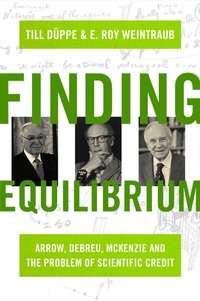
Finding Equilibrium
Arrow, Debreu, McKenzie and the Problem of Scientific Credit
1st Edition
Published on 28. July 2015
304 pages
978-1-4008-5012-9 (ISBN)
Description

The remarkable story and personalities behind one of the most important theories in modern economics
Finding Equilibrium explores the post-World War II transformation of economics by constructing a history of the proof of its central dogma-that a competitive market economy may possess a set of equilibrium prices. The model economy for which the theorem could be proved was mapped out in 1954 by Kenneth Arrow and Gerard Debreu collaboratively, and by Lionel McKenzie separately, and would become widely known as the "Arrow-Debreu Model." While Arrow and Debreu would later go on to win separate Nobel prizes in economics, McKenzie would never receive it. Till Düppe and E. Roy Weintraub explore the lives and work of these economists and the issues of scientific credit against the extraordinary backdrop of overlapping research communities and an economics discipline that was shifting dramatically to mathematical modes of expression.
Based on recently opened archives, Finding Equilibrium shows the complex interplay between each man's personal life and work, and examines compelling ideas about scientific credit, publication, regard for different research institutions, and the awarding of Nobel prizes. Instead of asking whether recognition was rightly or wrongly given, and who were the heroes or villains, the book considers attitudes toward intellectual credit and strategies to gain it vis-à-vis the communities that grant it.
Telling the story behind the proof of the central theorem in economics, Finding Equilibrium sheds light on the changing nature of the scientific community and the critical connections between the personal and public rewards of scientific work.
Finding Equilibrium explores the post-World War II transformation of economics by constructing a history of the proof of its central dogma-that a competitive market economy may possess a set of equilibrium prices. The model economy for which the theorem could be proved was mapped out in 1954 by Kenneth Arrow and Gerard Debreu collaboratively, and by Lionel McKenzie separately, and would become widely known as the "Arrow-Debreu Model." While Arrow and Debreu would later go on to win separate Nobel prizes in economics, McKenzie would never receive it. Till Düppe and E. Roy Weintraub explore the lives and work of these economists and the issues of scientific credit against the extraordinary backdrop of overlapping research communities and an economics discipline that was shifting dramatically to mathematical modes of expression.
Based on recently opened archives, Finding Equilibrium shows the complex interplay between each man's personal life and work, and examines compelling ideas about scientific credit, publication, regard for different research institutions, and the awarding of Nobel prizes. Instead of asking whether recognition was rightly or wrongly given, and who were the heroes or villains, the book considers attitudes toward intellectual credit and strategies to gain it vis-à-vis the communities that grant it.
Telling the story behind the proof of the central theorem in economics, Finding Equilibrium sheds light on the changing nature of the scientific community and the critical connections between the personal and public rewards of scientific work.
All prices
More details
Edition
Course Book
Language
English
Place of publication
Princeton, NJ
United States
Publishing group
De Gruyter
Target group
Professional and scholarly
Edition type
Digital original
Product notice
Reflowable
Illustrations
11 halftones.
File size
1,62 MB
ISBN-13
978-1-4008-5012-9 (9781400850129)
Schweitzer Classification
Other editions
Additional editions
Till Dueppe | E. Roy Weintraub
Finding Equilibrium
Arrow, Debreu, McKenzie and the Problem of Scientific Credit
Book
07/2014
Princeton University Press
€52.04
Shipment within 10-20 days
Persons
Till Düppe is assistant professor of economics at the Université du Québec à Montréal. He is the author of The Making of the Economy. E. Roy Weintraub is professor of economics at Duke University. He is the author of How Economics Became a Mathematical Science.
Content
Preface ix
Chronology xxiii
Part I People 1
Chapter 1 Arrow's Ambitions 3
Chapter 2 McKenzie's Frustrations 24
Chapter 3 Debreu's Silence 47
Part II Context 65
Chapter 4 Sites 67
Chapter 5 Community 98
Part III Credit 129
Chapter 6 Three Proofs 131
Chapter 7 Aftermath 172
Chapter 8 The Proofs Become History 204
Conclusion 231
Coda 245
Acknowledgments 249
References 251
Index of Names 267
Index of Subjects 273
Chronology xxiii
Part I People 1
Chapter 1 Arrow's Ambitions 3
Chapter 2 McKenzie's Frustrations 24
Chapter 3 Debreu's Silence 47
Part II Context 65
Chapter 4 Sites 67
Chapter 5 Community 98
Part III Credit 129
Chapter 6 Three Proofs 131
Chapter 7 Aftermath 172
Chapter 8 The Proofs Become History 204
Conclusion 231
Coda 245
Acknowledgments 249
References 251
Index of Names 267
Index of Subjects 273

