

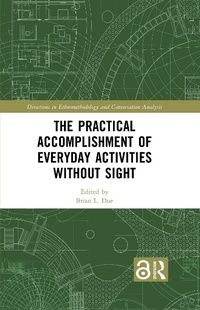
The Practical Accomplishment of Everyday Activities Without Sight
1st Edition
Published on 11. December 2023
258 pages
978-1-003-81776-5 (ISBN)
Description

This book is about the everyday life of people with visual impairment or blindness. Using video ethnographic methods and ethnomethodological conversation analysis, it unpacks the practical accomplishments of everyday activities such as navigating in public space, identifying objects and obstacles, being included in workplace activities, interacting with guide dogs, or interacting in museums or classes in school.
Navigation, social inclusion, and the world of touch constitute key phenomena that are affected by visual impairment and which we study in this book. Whereas sighted people use their sight for navigating, for figuring out the location of co-participants and the embodied cues they produce, and for achieving understanding of objects in the world, visually impaired people on the contrary cannot rely on vision for navigating, for interpreting embodied cues, or for identifying or recognizing objects. Other sensory resources and other practices are employed to accomplish these basic human actions. The chapters in this book present examples and findings relevant to these issues and draw out the general theoretical implications of these findings. Whereas existing research often studies visual impairment from a medical, cognitive, and psychological perspective, this book provides insights into how visually impaired people accomplish ordinary activities in orderly, organized ways by a detailed study of their actions. While most books describe cognitive and biological issues, many of them using experimental methods, this book provides empirical findings about the actual daily lives as it naturally unfolds based on video recordings. The book contributes insights into the practices of living with visual impairment as well as perspectives for rethinking some of the most basic aspects of human sociality, including perception, interaction, multisensoriality and ocularcentrism (the view that the world is de facto designed by and for sighted persons). As such, the book provides novel findings in the field of ethnomethodological conversation analysis.
Renewing the social model of disability, this book will appeal to scholars of sociology with interests in ethnomethodology and conversation analysis, the emergence of practical skills, and understandings of disability in terms of relations between the individual and the social environment.
Chapter 1 of this book is freely available as a downloadable Open Access PDF at http://www.taylorfrancis.com under a Creative Commons [Attribution-Non Commercial-No Derivatives (CC-BY-NC-ND)] 4.0 license.
Navigation, social inclusion, and the world of touch constitute key phenomena that are affected by visual impairment and which we study in this book. Whereas sighted people use their sight for navigating, for figuring out the location of co-participants and the embodied cues they produce, and for achieving understanding of objects in the world, visually impaired people on the contrary cannot rely on vision for navigating, for interpreting embodied cues, or for identifying or recognizing objects. Other sensory resources and other practices are employed to accomplish these basic human actions. The chapters in this book present examples and findings relevant to these issues and draw out the general theoretical implications of these findings. Whereas existing research often studies visual impairment from a medical, cognitive, and psychological perspective, this book provides insights into how visually impaired people accomplish ordinary activities in orderly, organized ways by a detailed study of their actions. While most books describe cognitive and biological issues, many of them using experimental methods, this book provides empirical findings about the actual daily lives as it naturally unfolds based on video recordings. The book contributes insights into the practices of living with visual impairment as well as perspectives for rethinking some of the most basic aspects of human sociality, including perception, interaction, multisensoriality and ocularcentrism (the view that the world is de facto designed by and for sighted persons). As such, the book provides novel findings in the field of ethnomethodological conversation analysis.
Renewing the social model of disability, this book will appeal to scholars of sociology with interests in ethnomethodology and conversation analysis, the emergence of practical skills, and understandings of disability in terms of relations between the individual and the social environment.
Chapter 1 of this book is freely available as a downloadable Open Access PDF at http://www.taylorfrancis.com under a Creative Commons [Attribution-Non Commercial-No Derivatives (CC-BY-NC-ND)] 4.0 license.
More details
Series
Edition
1. Auflage
Language
English
Place of publication
London
United Kingdom
Publishing group
Taylor & Francis Ebooks
Target group
College/higher education
Illustrations
186 Line drawings, black and white; 186 Illustrations, black and white
ISBN-13
978-1-003-81776-5 (9781003817765)
Copyright in bibliographic data and cover images is held by Nielsen Book Services Limited or by the publishers or by their respective licensors: all rights reserved.
Schweitzer Classification
Other editions
Additional editions
Book
05/2025
1st Edition
Routledge
€67.50
Shipment within 15-20 days
Book
12/2023
1st Edition
Routledge
€206.50
Shipment within 15-20 days
Person
Brian L. Due is an associate professor in the Department of Nordic Studies and Linguistics at the University of Copenhagen, Denmark. Due's research and teaching is within EMCA, mulitimodality, ethnographic methods, technology, socio-materiality, mobilities, perception and distributed agency, sensory impairment, and disabilities. He is the co-editor of the Social Interaction: Video-Based Studies of Human Sociality journal. He has also published in journals such as Journal of Pragmatics, Space and Culture, Mobilities, Discourse Studies, Human Studies and Semiotica.
Content
1. The practical accomplishment of living with visual impairment: An EM/CA approach 2. The production and reception of assistance proposals between pedestrians and visually impaired persons during a course in locomotion and orientation 3. Shared intelligibility in interactions between visually impaired people and guide dogs 4. Guided by the blind: Discovering the competences of visually impaired co-authors in the practice of collaborative audio-description 5. Recipient design in a fractured perceptual field: Utilizing the affordances of an object 6. Mitigating responsibility: Attributing membership categories in the face of tech-related troubles 7. Echo and synchrony: Social attunements in visually impaired children's repetitive movements 8. From embodied scanning to tactile inspections: When visually impaired people exhibit object understanding 9. Assembling compositions: Visually impaired people and the experience of art in museums 10. The limits of vision 11. The significance of EM/CA studies in multimodal interaction involving visual impairment in the field of atypical interaction research
