

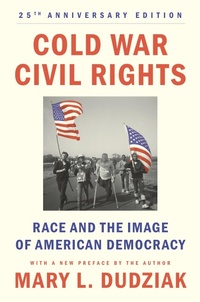
Cold War Civil Rights
Race and the Image of American Democracy, 25th anniversary edition
1st Edition
Published on 23. April 2025
360 pages
978-0-691-27433-1 (ISBN)
Description

A Choice Outstanding Academic Title of the Year
How the fight for civil rights in America became an important front in the Cold War
In 1958, an African American handyman named Jimmy Wilson was sentenced to die in Alabama for stealing less than two dollars. Shocking as this sentence was, it was overturned only after intense international attention and the interference of Secretary of State John Foster Dulles. Soon after World War II, American racism became a major concern of US allies, a chief Soviet propaganda theme, and an obstacle to American Cold War goals throughout Africa, Asia, and Latin America. Racial segregation undermined the American image, harming foreign relations in every administration from Truman to Johnson. Mary Dudziak shows how the Cold War helped to facilitate desegregation and other key social reforms at home as the United States sought to polish its image abroad, yet how a focus on appearances over substance limited the nature and extent of progress. Cold War Civil Rights situates the Cold War in civil rights history while giving an international perspective to the fight for racial justice in America.
How the fight for civil rights in America became an important front in the Cold War
In 1958, an African American handyman named Jimmy Wilson was sentenced to die in Alabama for stealing less than two dollars. Shocking as this sentence was, it was overturned only after intense international attention and the interference of Secretary of State John Foster Dulles. Soon after World War II, American racism became a major concern of US allies, a chief Soviet propaganda theme, and an obstacle to American Cold War goals throughout Africa, Asia, and Latin America. Racial segregation undermined the American image, harming foreign relations in every administration from Truman to Johnson. Mary Dudziak shows how the Cold War helped to facilitate desegregation and other key social reforms at home as the United States sought to polish its image abroad, yet how a focus on appearances over substance limited the nature and extent of progress. Cold War Civil Rights situates the Cold War in civil rights history while giving an international perspective to the fight for racial justice in America.
More details
Other editions
Additional editions
Mary L. Dudziak
Cold War Civil Rights
Race and the Image of American Democracy, 25th anniversary edition
Book
06/2025
Princeton University Press
€30.50
Shipment within 10-20 days
Mary L. Dudziak
Cold War Civil Rights
Race and the Image of American Democracy, 25th anniversary edition
Book
06/2025
Princeton University Press
€99.13
Shipment within 10-20 days
Person
Mary L. Dudziak is the Asa Griggs Candler Professor of Law at Emory University. Her books include War Time: An Idea, Its History, Its Consequences and Exporting American Dreams: Thurgood Marshall's African Journey.
Content
- Cover
- Contents
- List of Illustrations
- Preface to the 25th Anniversary Edition
- Preface to the 2011 Edition
- Introduction
- Chapter 1. Coming to Terms with Cold War Civil Rights
- Chapter 2. Telling Stories about Race and Democracy
- Chapter 3. Fighting the Cold War with Civil Rights Reform
- Chapter 4. Holding the Line in Little Rock
- Chapter 5. Losing Control in Camelot
- Chapter 6. Shifting the Focus of America's Image Abroad
- Conclusion
- Notes
- Acknowledgments
- Index
