

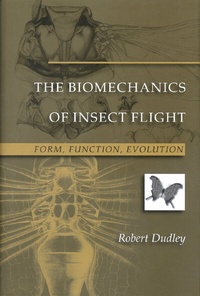
The Biomechanics of Insect Flight
Form, Function, Evolution
1st Edition
Published on 19. November 2018
496 pages
978-0-691-18634-4 (ISBN)
Description

From the rain forests of Borneo to the tenements of Manhattan, winged insects are a conspicuous and abundant feature of life on earth. Here, Robert Dudley presents the first comprehensive explanation of how insects fly. The author relates the biomechanics of flight to insect ecology and evolution in a major new work of synthesis.
The book begins with an overview of insect flight biomechanics. Dudley explains insect morphology, wing motions, aerodynamics, flight energetics, and flight metabolism within a modern phylogenetic setting. Drawing on biomechanical principles, he describes and evaluates flight behavior and the limits to flight performance. The author then takes the next step by developing evolutionary explanations of insect flight. He analyzes the origins of flight in insects, the roles of natural and sexual selection in determining how insects fly, and the relationship between flight and insect size, pollination, predation, dispersal, and migration. Dudley ranges widely--from basic aerodynamics to muscle physiology and swarming behavior--but his focus is the explanation of functional design from evolutionary and ecological perspectives.
The importance of flight in the lives of insects has long been recognized but never systematically evaluated. This book addresses that shortcoming. Robert Dudley provides an introduction to insect flight that will be welcomed by students and researchers in biomechanics, entomology, evolution, ecology, and behavior.
The book begins with an overview of insect flight biomechanics. Dudley explains insect morphology, wing motions, aerodynamics, flight energetics, and flight metabolism within a modern phylogenetic setting. Drawing on biomechanical principles, he describes and evaluates flight behavior and the limits to flight performance. The author then takes the next step by developing evolutionary explanations of insect flight. He analyzes the origins of flight in insects, the roles of natural and sexual selection in determining how insects fly, and the relationship between flight and insect size, pollination, predation, dispersal, and migration. Dudley ranges widely--from basic aerodynamics to muscle physiology and swarming behavior--but his focus is the explanation of functional design from evolutionary and ecological perspectives.
The importance of flight in the lives of insects has long been recognized but never systematically evaluated. This book addresses that shortcoming. Robert Dudley provides an introduction to insect flight that will be welcomed by students and researchers in biomechanics, entomology, evolution, ecology, and behavior.
More details
Other editions
Additional editions
Book
09/2002
Princeton University Press
€108.70
Shipment within 10-20 days

Book
01/2000
Princeton University Press
€71.80
Article exhausted; check different version
Person
Robert Dudley is Professor of Biomechanics and Comparative Physiology at the University of California, Berkeley, and the author of numerous articles on the biomechanics of insect flight. He is also a Research Associate at the Smithsonian Tropical Research Institute in the Republic of Panama.
Content
- Cover
- Title Page
- Copyright Page
- CONTENTS
- ACKNOWLEDGMENTS
- SYMBOLS
- CHAPTER ONE: Flight and the Pterygote Insecta
- 1.1 Insect Diversity
- 1.2 Basic Aerodynamics
- 1.3 Why Study Flight Biomechanics?
- 1.4 Summary
- CHAPTER TWO: Morphology of the Flight Apparatus
- 2.1 Thoracic Design
- 2.2 Wings
- 2.3 Ancillary Structures
- 2.4 Summary
- CHAPTER THREE: Kinematics and Aerodynamics of Flight
- 3.1 Wing and Body Motions
- 3.2 Aerodynamics
- 3.3 Mechanical Power Requirements
- 3.4 Summary
- CHAPTER FOUR: Energetics and Flight Physiology
- 4.1 Oxygen Consumption
- 4.2 Muscle Physiology
- 4.3 Thermoregulation in Flight
- 4.4 Summary
- CHAPTER FIVE: Stability, Maneuverability, and Maximum Flight Performance
- 5.1 Stability
- 5.2 Maneuverability
- 5.3 Three-Dimensional Flight Behavior
- 5.4 Limits to Insect Flight Performance
- 5.5 Summary
- CHAPTER SIX: Evolution of Flight and Flightlessness
- 6.1 Origin of Flight in Hexapods
- 6.2 Evolutionary Consequences of Flight and Flightlessness
- 6.3 Summary
- CHAPTER SEVEN: Flight and Insect Diversification
- 7.1 Miniaturization
- 7.2 Pollination
- 7.3 Predation
- 7.4 Long-Range Dispersal and Migration
- 7.5 Comparison of Insect and Vertebrate Flight
- 7.6 Summary
- CHAPTER EIGHT: Future Directions in Insect Flight Biomechanics
- 8.1 Aerodynamic Mechanisms
- 8.2 Insect Flight Biomechanics in Nature
- 8.3 Exploring Insect Diversity
- GLOSSARY
- REFERENCES
- INDEX
