

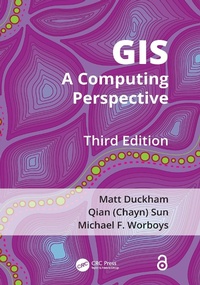
GIS
A Computing Perspective
3rd Edition
Published on 30. July 2023
492 pages
978-1-4665-8720-5 (ISBN)
Description

Following two successful editions, the third edition of GIS: A Computing Perspective has been completely revised and updated, with extensive new content reflecting the significant progress that has been made in the realm of GIS within the last 20 years. Major new topics covered for the first time in this edition include: graph databases and graph query languages, ontology engineering and qualitative spatial reasoning, geosensor networks and GeoAI, decentralized computing and online algorithms, and critical GIS and data sovereignty.
Features
Includes an entirely new chapter on AI and GIS, including ontologies and the Semantic Web, knowledge representation (KR) and spatial reasoning, machine learning and spatial analysis, and neural networks and deep learning
Presents new material reflecting the advances made in cloud computing, stream computing, and sensor networks, as well as extensively revised and updated content on cartography, visualization, and interaction design
Connects the technology to the social aspects and implications of GIS, including privacy and fair information practices, FATE (fairness, accountability, transparency, and ethics), and codes of conduct for responsible use of GIS
Integrates the necessary background to foundational areas, such as databases and data structures, algorithms and indexes, and system architecture and AI, provided in context so readers new to those topics can still understand the concepts being discussed
Incorporates over 20 carefully explained spatial algorithms; over 60 inset boxes with in-depth material that enriches the central topics; and more than 300 color figures to support the reader in mastering key concepts
Welcomes a new coauthor, Qian (Chayn) Sun, to the third edition, who brings her expertise in topics such as web mapping, cloud computing, critical geography, and machine learning with big spatial data
Intended for anyone interested in understanding GIS, especially students taking upper-level undergraduate and graduate courses in computer science and geography, as well as academics, researchers, practitioners, and professionals working in the field and involved in advanced GIS projects.
Features
Includes an entirely new chapter on AI and GIS, including ontologies and the Semantic Web, knowledge representation (KR) and spatial reasoning, machine learning and spatial analysis, and neural networks and deep learning
Presents new material reflecting the advances made in cloud computing, stream computing, and sensor networks, as well as extensively revised and updated content on cartography, visualization, and interaction design
Connects the technology to the social aspects and implications of GIS, including privacy and fair information practices, FATE (fairness, accountability, transparency, and ethics), and codes of conduct for responsible use of GIS
Integrates the necessary background to foundational areas, such as databases and data structures, algorithms and indexes, and system architecture and AI, provided in context so readers new to those topics can still understand the concepts being discussed
Incorporates over 20 carefully explained spatial algorithms; over 60 inset boxes with in-depth material that enriches the central topics; and more than 300 color figures to support the reader in mastering key concepts
Welcomes a new coauthor, Qian (Chayn) Sun, to the third edition, who brings her expertise in topics such as web mapping, cloud computing, critical geography, and machine learning with big spatial data
Intended for anyone interested in understanding GIS, especially students taking upper-level undergraduate and graduate courses in computer science and geography, as well as academics, researchers, practitioners, and professionals working in the field and involved in advanced GIS projects.
More details
Edition
3rd edition
Language
English
Place of publication
Baton Rouge
United States
Publishing group
Taylor & Francis Inc
Target group
College/higher education
Professional and scholarly
Illustrations
37 Tables, black and white; 130 Line drawings, color; 46 Line drawings, black and white; 168 Halftones, color; 14 Halftones, black and white; 298 Illustrations, color; 60 Illustrations, black and white
File size
73,44 MB
ISBN-13
978-1-4665-8720-5 (9781466587205)
Copyright in bibliographic data and cover images is held by Nielsen Book Services Limited or by the publishers or by their respective licensors: all rights reserved.
Schweitzer Classification
Other editions
Additional editions
Book
08/2023
3rd Edition
CRC Press
€191.20
Shipment within 15-20 days
Persons
Matt Duckham is Professor in Geospatial Sciences at RMIT University, Melbourne, Australia and was awarded a PhD in GIS from the University of Glasgow, UK, in 2000. Matt has previously held positions as Associate Dean Geospatial Sciences at RMIT University and as Professor of GIS at the University of Melbourne, Australia. Matt was author of the 2013 book "Decentralized Spatial Computing: Foundations of Geosensor Networks" and coauthor of more than 50 research papers in scholarly journals in the field. Together with Mike Worboys, Matt is a founding editor of the Journal of Spatial Information Science (JOSIS).
Qian (Chayn) Sun is a Senior Lecturer in Geospatial Sciences at RMIT University, Melbourne, Australia and holds a PhD in GIS from Curtin University, Perth, Australia. Prior to her PhD study, she was a Geospatial Analyst and gained extensive experience in multi-disciplinary applied GIS research projects with both government departments and engineering consultancies in New Zealand and Australia. Chayn has authored over 40 research articles in interdisciplinary journals in spatial analysis, spatial and statistical modeling, urban informatics, GeoAI, and human behavior analysis.
Mike Worboys is Professor of Spatial Informatics at the University of Greenwich, London, England and holds a PhD in Mathematics from the University of Birmingham, UK. Before returning to England in 2012, he was Professor in the National Center for Geographic Information and Analysis (NCGIA) and Director of the School of Computing and Information Science at the University of Maine, USA. Mike is a Distinguished Scientist of the ACM and a Life Member of the London Mathematical Society. Mike is also a composer and sound artist, having an interest in instrumental, vocal and electroacoustic music, and holds a PhD in Music (Composition) from the University of Durham. His instrumental and vocal music has been performed at many venues around Britain, including the London Institute for Contemporary Arts (ICA) and the National Maritime Museum.
Qian (Chayn) Sun is a Senior Lecturer in Geospatial Sciences at RMIT University, Melbourne, Australia and holds a PhD in GIS from Curtin University, Perth, Australia. Prior to her PhD study, she was a Geospatial Analyst and gained extensive experience in multi-disciplinary applied GIS research projects with both government departments and engineering consultancies in New Zealand and Australia. Chayn has authored over 40 research articles in interdisciplinary journals in spatial analysis, spatial and statistical modeling, urban informatics, GeoAI, and human behavior analysis.
Mike Worboys is Professor of Spatial Informatics at the University of Greenwich, London, England and holds a PhD in Mathematics from the University of Birmingham, UK. Before returning to England in 2012, he was Professor in the National Center for Geographic Information and Analysis (NCGIA) and Director of the School of Computing and Information Science at the University of Maine, USA. Mike is a Distinguished Scientist of the ACM and a Life Member of the London Mathematical Society. Mike is also a composer and sound artist, having an interest in instrumental, vocal and electroacoustic music, and holds a PhD in Music (Composition) from the University of Durham. His instrumental and vocal music has been performed at many venues around Britain, including the London Institute for Contemporary Arts (ICA) and the National Maritime Museum.
Content
1. Introduction 2. Fundamental Database Concepts 3. Fundamental Spatial Concepts 4. Models of Geospatial Information 5. Representation and Algorithms 6. Structures and Access Methods 7. Architectures 8. Cartography and Geo-visualization 9. Artificial Intelligence and GIS 10. Spatial Information in Context
