

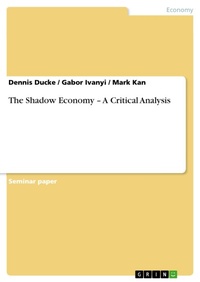
The Shadow Economy - A Critical Analysis
1st Edition
Published on 1. January 2010
52 pages
978-3-640-53365-7 (ISBN)
Description

Seminar paper from the year 2008 in the subject Business economics - General, grade: 1,3, University of Applied Sciences Essen, language: English, abstract: According to the "Focus" magazine approximately 13 million Germans contributed to
the shadow economy in 2006! The estimations of Friedrich Schneider, one
distinguished expert in this area, showed that the extent of the shadow economy in
Germany in 2007 was about 349 billion Euros, which equals to 14.7 percent of
Germany's gross domestic product (GDP)!
The scope of the present assignment is to provide an all-embracing and critical
overview of the shadow economy, to introduce the main causes, effects and dimensions
of the shadow economy and to find answer the question how shadow activities can be
limited.
In this context the hidden sector can be defined as all economic activities that are not
recorded in the national accounts, but normally should be a part of them and be included
in GDP. These actions can be on the one hand absolutely legal in the self-sufficient
economy like do-it-your-self, neighbourhood help, but on the other hand completely
illegal activities like dealing with drugs and smuggling as well as legal activities, which
are illegally being carried out, e.g. tax evasion or illicit work.
The main and most vital reasons for the existence and constant growth of the shadow
economy are high taxes or social security contributions burden and the intensity of state
regulations. But also sociological-psychological causes like subjective perception of tax
burden, falling society values, a bad tax morale and declining loyalty towards the state
can have a tremendous impact on the size of the hidden economy.
But is the shadow economy a threat to the official sector? At first glance, the question
whether the shadow economy is dangerous might appear strange. However, there are
several controversial opinions about this matter. The analysis of the effects caused by
the existence and the growth of the shadow economy is a contradictory topic. The
present assignment characterizes the main negative, e.g. distortion of official economic statistics, lower tax revenues and positive effects, e.g. price stabilization, creation of
new jobs of the shadow economy and their influence on the national economy.
Following this, the study presents the most popular methods of measuring the shadow
economy: direct methods that are mostly based on surveys, the indirect ones that
attempt to quantify shadow economic activities by seeking traces left in the official
sector and the so-called model approach, which tries to determine the hidden economy
by ...
More details
Edition
1. Auflage
Language
English
Place of publication
München
United States
Product notice
Windows
File size
1,74 MB
ISBN-13
978-3-640-53365-7 (9783640533657)
Copyright in bibliographic data and cover images is held by Nielsen Book Services Limited or by the publishers or by their respective licensors: all rights reserved.
Schweitzer Classification
Other editions
Additional editions
Dennis Ducke | Gabor Ivanyi | Mark Kan
The Shadow Economy - A Critical Analysis
Book
02/2010
3rd Edition
Grin Verlag
€27.95
Shipment within 7-9 days
