

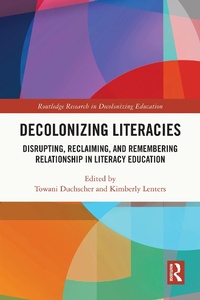
Decolonizing Literacies
Disrupting, Reclaiming, and Remembering Relationship in Literacy Education
1st Edition
Published on 27. September 2023
212 pages
978-1-000-95861-4 (ISBN)
Description

This volume examines the ways in literacy has been used as a weapon and a means for settler colonialism, challenging colonized definitions of literacy and centring relationships as key to broadening understandings.
It begins by confronting the multiple ways that settler colonialism has used literacy and definitions of literacy as a gatekeeper to participation in society. In response to settler colonialism's violent acts of extraction, displacement, and replacement enacted upon the land, the resources, the people, and understandings of literacy, the editors propose a unique approach to decolonizing understandings of literacy through a triangulation of disruption, reclamation, and remembering relationships. This is enacted and explored through a range of diverse chapter contributions, written in the form of stories, poems, artworks, theatres, and essays, allowing the authentic voices of the authors to shine through, and opening up the English Language Arts as a space for engagement and interpretation with diverse, racialized understandings of literacy.
Disrupting Eurocentric, colonized understandings that narrowly define literacy as reading and writing the colonial word, and advancing the movement to decolonize education, it will be of key interest to scholars, researchers, and educators with interest in literacy education, decolonizing education, anti-racist education, inclusive education, land-based literacy, and arts-based literacy.
It begins by confronting the multiple ways that settler colonialism has used literacy and definitions of literacy as a gatekeeper to participation in society. In response to settler colonialism's violent acts of extraction, displacement, and replacement enacted upon the land, the resources, the people, and understandings of literacy, the editors propose a unique approach to decolonizing understandings of literacy through a triangulation of disruption, reclamation, and remembering relationships. This is enacted and explored through a range of diverse chapter contributions, written in the form of stories, poems, artworks, theatres, and essays, allowing the authentic voices of the authors to shine through, and opening up the English Language Arts as a space for engagement and interpretation with diverse, racialized understandings of literacy.
Disrupting Eurocentric, colonized understandings that narrowly define literacy as reading and writing the colonial word, and advancing the movement to decolonize education, it will be of key interest to scholars, researchers, and educators with interest in literacy education, decolonizing education, anti-racist education, inclusive education, land-based literacy, and arts-based literacy.
More details
Series
Edition
1. Auflage
Language
English
Place of publication
London
United Kingdom
Publishing group
Taylor & Francis Ltd
Target group
Professional and scholarly
Product notice
Reflowable
Illustrations
4 Line drawings, black and white; 8 Halftones, black and white; 12 Illustrations, black and white
ISBN-13
978-1-000-95861-4 (9781000958614)
Copyright in bibliographic data and cover images is held by Nielsen Book Services Limited or by the publishers or by their respective licensors: all rights reserved.
Schweitzer Classification
Other editions
Additional editions
Towani Duchscher | Kimberly Lenters
Decolonizing Literacies
Disrupting, Reclaiming, and Remembering Relationship in Literacy Education
Book
12/2024
1st Edition
Routledge
€61.00
Shipment within 10-20 days
Towani Duchscher | Kimberly Lenters
Decolonizing Literacies
Disrupting, Reclaiming, and Remembering Relationship in Literacy Education
Book
09/2023
1st Edition
Routledge
€206.20
Shipment within 10-20 days
Persons
Towani Duchscher is a Postdoctoral Associate at the Werklund School of Education at the University of Calgary in Calgary, Alberta, Canada. Towani Duchscher is a Black, mixed-race educator, dancer, and poet. Duchscher holds a doctorate in the specialization of Curriculum and Learning. Her research attends to how lessons of racism and marginalization are embodied and perpetuated through the explicit, implicit, and null curriculums in schools. Her research interests include decolonization, arts-based research, hidden curriculum, education for decolonization, and anti-racist education. She has authored publications in peer-reviewed journals including Cultural and Pedagogical Inquiry and Journal of the Canadian Association for Curriculum Studies.
Dr. Kimberly Lenters is Associate Professor and Canada Research Chair (Tier 2) in Language and Literacy Education at the University of Calgary where her research focuses on the social material worlds of children's literacy development. Kim's work has consistently focused on those students whose literacy practices are seen to be out-of-step (and therefore, generally unwelcome) in classroom spaces. Most recently, Kim's work has focused on the relationship between play and literacy in spaces beyond the preschool and Kindergarten setting. In addition to several chapters in edited volumes, her work has been published in journals such as Reading Teacher, Literacy, English Teaching: Practice & Critique, Journal of Literacy Research, and Research in the Teaching of English (2019). She is also the co-editor of the volume, Affect and Embodiment in Critical Literacy: Assembling Theory and Practice (2020).
Dr. Kimberly Lenters is Associate Professor and Canada Research Chair (Tier 2) in Language and Literacy Education at the University of Calgary where her research focuses on the social material worlds of children's literacy development. Kim's work has consistently focused on those students whose literacy practices are seen to be out-of-step (and therefore, generally unwelcome) in classroom spaces. Most recently, Kim's work has focused on the relationship between play and literacy in spaces beyond the preschool and Kindergarten setting. In addition to several chapters in edited volumes, her work has been published in journals such as Reading Teacher, Literacy, English Teaching: Practice & Critique, Journal of Literacy Research, and Research in the Teaching of English (2019). She is also the co-editor of the volume, Affect and Embodiment in Critical Literacy: Assembling Theory and Practice (2020).
Content
1. Introduction: Decolonizing Literacies. 2. Artist Statement. 3. Wa'gwan: Graffiti Art. 4. Decolonizing Literacies: A Door Back into Ourselves. DISRUPTING. 5. I Know You Are, and I Am Sorry: An Inquiry Into Anger and Hope. 6. A Reminder of Who I Was. 7. Finding Our Way Through Decolonizing English for Second Language Literacies: A Call for Multiple Approaches of Knowing and Being in Curriculum. 8. 3 Poems: Listen Again - A Journey of Discovering Oneself While Listening to the Stories of Others. Poem 1: English Class. RECLAIMING. 9. Skoden: Graffiti Art. 10. Reclaiming Literacy: Embodying the Stories the Land Reveals. 11. Writing it small-Living it LOUD!!!: Uplifting Decoloniality through Hip Hop Literacy for the Mind Body & Soul. 12. Literacies of Love: Exploring Love, Value, and Respect in Diverse Learning Spaces. 13. 3 Poems: Listen Again - A Journey of Discovering Oneself While Listening to the Stories of Others. Poem 2: Live Loud in white walls. REMEMBERING RELATIONSHIP. 14. What Does It Mean to Read/Write Graffiti as Literacy? 15. Anti-Racism Literacies: A Place of Belonging for Racialized Students. 16. Kistonnoon Ihtaisap'op Tsinikssinistsi - Our Way is Through Our Stories. 17. Reflecting Through the Fourth Wall. 18. Un-settling Settler Allyship: A Response to Reflecting Through the Fourth Wall. 19. Moving Beyond Awareness Toward Action: An Interview with Dr. April Baker-Bell. 20. 3 Poems: Listen Again - A Journey of Discovering Oneself While Listening to the Stories of Others. Poem 3: Listen. 21. Conclusion: Reflecting on Decolonizing Literacies: Remembering Relationships with Each Other, Our Ancestors, and the World
