

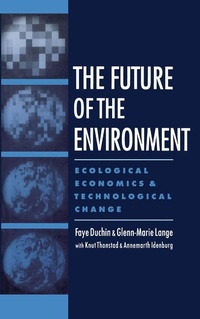
The Future of the Environment
Ecological Economics and Technological Change
1st Edition
Published in December 1994
237 pages
978-0-19-535896-4 (ISBN)
Description

One of the most important and complex problems facing both developing and industrialized nations is how to sustain economic growth without harming the environment. Faye Duchin and Glenn-Marie Lange address this issue in a practical and realistic way: through a detailed evaluation of the well-known approach to sustainable development outlined in the Brundtland Report, Our Common Future.
Taking issue with the Brundtland Report's optimistic and widely accepted assumptions, the authors show that the positive effects of recycling, increased fuel-efficiency, and other technological adjustments will not go far enough to provide for truly sustainable development in the long term. Through a new, broad-based empirical analysis, they argue that unless there are significant changes in lifestyles and the use of technologies, continued environmental degradation cannot be avoided. They warn that the trend of making only slight adjustments in the use of technologies, while feasible from an economic point of view for industrialized nations, will undoubtedly lead to further environmental damage.
In addition to offering a clear and unflinching look at what development is really doing to the global environment, the unique conceptual framework developed for this analysis provides an invaluable basis for analysis for the new, multidisciplinary field of ecological economics. Duchin and Lange describe how this new methodology will enable economists and policy-makers to evaluate our options for the future, and choose those that most effectively reduce environmental degradation and achieve sustainable development. The book will appeal to economists, environmental scientists and activists, policy analysts, and ecologists, as well as the general reader with an interest in the sustainable development of our environment.
More details
Language
English
Place of publication
Oxford
United Kingdom
Illustrations
3 line illus.
File size
12,37 MB
ISBN-13
978-0-19-535896-4 (9780195358964)
Copyright in bibliographic data and cover images is held by Nielsen Book Services Limited or by the publishers or by their respective licensors: all rights reserved.
Schweitzer Classification
Other editions
Additional editions
Faye Duchin | Glenn-Marie Lange
The Future of the Environment
Ecological Economics and Technological Change
Book
03/1995
Oxford University Press Inc
€124.60
Shipment within 15-20 days
Persons
Faye Duchin is Director of the Institute for Economic Analysis at New York University and Vice President of the International Society for Ecological Economics.
Glenn-Marie Lange is a Research Scientist at the Institute for Economic Analysis at New York University.
Content
- Intro
- Contents
- Part I: Methods and Results
- 1. Can Technology Assure Environmentally Sound Economic Development?
- The Nature of the Problem
- The Significance of the Brundtland Report, OUR COMMON FUTURE (OCF)
- Framework for This Study
- Evaluation of the OCF Scenario
- Two Directions for the Future
- Plan of the Book
- 2. The OCF Scenario
- Basic Description of the OCF Scenario
- Detailed Technological Assumptions
- Economic Assumptions
- Representation of Investment
- Alternative Scenarios
- 3. Results and Conclusions
- Global and Regional Economic Implications
- Energy Use and Emissions of Carbon, Sulfur, and Nitrogen
- Growth of Individual Economic Sectors
- International Trade
- Results of Alternative Scenarios
- Appendix 1. Comparison of Results with Other Studies
- Appendix 2. A Note about Results at Different Levels of Aggregation
- Part II: Case Studies
- 4. Emissions
- Carbon Dioxide
- Sulfur Oxides
- Nitrogen Oxides
- Postcombustion Abatement of Nitrogen Emissions
- 5. Electric Power Generation
- Regional Distribution of Production of Electricity
- Representation of Electricity in the World Model
- Production Technology
- Projections Under the OCF Scenario
- Technology and Thermal Conversion Efficiencies
- 6. Industrial Energy Conservation
- Obstacles to Conservation
- Energy Conservation Measures and Reductions in Energy Use
- Projections Under the OCF Scenario
- 7. Processing and Fabrication of Metals
- Representation of Metals in the World Model
- Regional Distribution of Production and Use of Metals
- Use of Metals by the Metal-Fabricating Sectors in 1980 and 1987
- Changes in Metal Use in the United States and Other Developed Economies in the 1980s
- Differences in Metal Use Among Regions
- Virgin Metal Use in World Model Regions
- Projections Under the OCF Scenario
- International Trade in Metals
- 8. Construction
- The Role of the Construction Industry
- Subsectors of Construction
- Maintenance and Repair Construction
- Input Coefficients
- Projections Under the OCF Scenario
- 9. Cement
- The Role of the Cement Industry
- Regional Distribution of Production and Use of Cement
- Production Technology
- Energy Consumption
- Cost Structure
- Projections Under the OCF Scenario
- 10. Pulp and Paper
- Description of the Sector
- Recycling Technology
- Projections Under the OCF Scenario
- 11. Chemicals
- Description of the Sectors
- Regional Distribution of Production and Use of Chemicals
- Production Technology
- Use of Chemicals
- Prospects for the Future
- Updating Parameters
- 12. Household Energy Conservation
- Energy Use in Developed Regions
- Energy Use in Eastern Europe and the Former Soviet Union
- Energy Use in Developing Regions
- 13. Motor Vehicles
- Representation of Road Transportation in the World Model
- Regional Distribution of Production, Fleets, and Sales of Motor Vehicles
- Factors Governing Fuel Use by the Motor Vehicle Fleet
- Regional Distribution of the Mix of Cars and Trucks
- Factors Governing Fuel Efficiency
- Fuel Efficiency of the Average Car and Truck
- Average Miles Driven per Vehicle and Fuel Use per Vehicle
- Incorporating Parameters About Transportation in the Data Base
- Appendixes
- A. Structure of the World Model
- B. Building the World Data Base: Case Study Methodology
- C. World Model Geographic Classification
- D. World Model Sectoral Classification
- References
- Index
- A
- B
- C
- D
- E
- F
- G
- H
- I
- J
- K
- L
- M
- N
- O
- P
- R
- S
- T
- U
- V
- W
- Z
