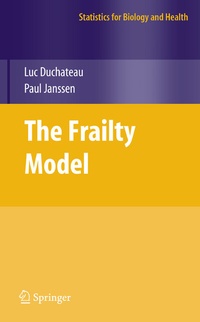
The Frailty Model
Description

Clustered survival data are encountered in many scientific disciplines including human and veterinary medicine, biology, epidemiology, public health and demography. Frailty models provide a powerful tool to analyse clustered survival data. In contrast to the large number of research publications on frailty models, relatively few statistical software packages contain frailty models.
It is demanding for statistical practitioners and graduate students to grasp a good knowledge on frailty models from the existing literature. This book provides an in-depth discussion and explanation of the basics of frailty model methodology for such readers. The discussion includes parametric and semiparametric frailty models and accelerated failure time models. Common techniques to fit frailty models include the EM-algorithm, penalised likelihood techniques, Laplacian integration and Bayesian techniques. More advanced frailty models for hierarchical data are also included.
Real-lifeexamples are used to demonstrate how particular frailty models can be fitted and how the results should be interpreted. The programs to fit all the worked-out examples in the book are available from the Springer website with most of the programs developed in the freeware packages R and Winbugs. The book starts with a brief overview of some basic concepts in classical survival analysis, collecting what is needed for the reading on the more complex frailty models.
Reviews / Votes
From the reviews:
"The book by Duchateau and Jansen is generally easy to follow. The book starts with introduction to the most popular parametric and semiparametric survival models. . this book can be recommended also for undergraduate students in statistics. . the book contains several further extensions of frailty models such as multifrailty and multilevel models with references. Therefore it is valuable also for researchers in survival analysis." (Tommi Härkänen, International Statistical Review, Vol. 76 (3), 2008)
"This book focuses on frailty models and provides an in-depth discussion of the basics of frailty model methodology using numerous real data sets. . The book is well structured and covers very nicely the material for frailty models. . The book is directed towards statistical practitioners and graduate students but it may be useful to a broad interdisciplinary readership of researchers and practitioners in applied statistics, biomedicine and biostatistics. . a reference book for a one-semester applied course in survival analysis focusing on frailties." (Filia Vonta, Journal of Applied Statistics, Vol. 36 (6), August, 2009)
"This book studies so-called frailty models intended for time-to-event data with a cluster structure. . provide a thorough presentation of the most current techniques used in this area of time-to-event analysis with emphasis on analysis of real data sets. The book is intended for students and applied statisticians. . this book gives a good description of frailty models. It is well written and its many real applications and the availability of computer code make it a valuable resource for the applied statistician . ." (Torben Martinussen, Biometrical Journal, Vol. 51 (3), 2009)
More details
Other editions
Additional editions