

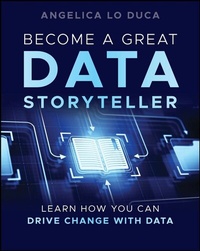
Become a Great Data Storyteller
Description

Unlock the power of data storytelling to create change
Become a Great Data Storyteller: Learn How You Can Drive Change with Data is a transformational journey guided by author and researcher Angelica Lo Duca. This insightful guide challenges the conventional approach to data visualization by emphasizing the creation of compelling data stories. With a focus on understanding the audience's needs, this book offers a unique value proposition: teaching you how to weave raw data into engaging, narrative-driven presentations that can significantly impact decision-making and generate organizational change.
The author masterfully demonstrates the process of building a data story, from creating relatable characters with clear objectives to tailoring these narratives for specific audiences. You'll discover your role as a narrative guide, learning how to employ the power of context to make your data-driven stories not just informative but captivating. This book sets itself apart by focusing on the human aspect of data storytelling, ensuring your narratives resonate deeply with your audience.
In the book, you'll:
- Learn to craft engaging data narratives that go beyond charts and graphs, making your presentations memorable and impactful
- Tailor your data stories to meet the specific needs and interests of your audience, enhancing understanding and engagement
- Position yourself as a pivotal guide in your data stories, using context to turn data into powerful narratives that drive action
For anyone looking to elevate their data presentation skills from ordinary to extraordinary, Become a Great Data Storyteller offers the tools and insights you need. Whether you're a professional seeking to influence decision-making or simply passionate about the art of data, this book is your roadmap to becoming an impactful storyteller. Take the first step towards transforming your data into compelling stories that inspire change. Order your copy today and start changing the way you communicate.
More details
Other editions
Additional editions
Person
ANGELICA LO DUCA is a data specialist and researcher at the Institute of Informatics and Telematics of the National Research Council in Italy. She is also an adjunct professor of Data Journalism at the University of Pisa. She frequently presents and speaks at national and international conferences and events about data storytelling, data science, data journalism, data engineering, and web applications.
Content
Introduction xv
Chapter 1 Why You Need to Become a Data Storyteller 1
The Need for Data Storytelling 2
What Is Data Storytelling? 3
Analyzing a Story 3
Understanding the Data Storytelling Process 6
Making a Data-Driven Story 8
Delivering a Data-Driven Story 9
Case Study: Solstices and Equinoxes 12
Takeaways 16
References 16
Chapter 2 The Role of the Storyteller 19
Who the Data Storyteller Is 20
Three Types of Data Storytellers 22
The Apathetic Data Storyteller 23
The Authoritarian Data Storyteller 24
The Authoritative Data Storyteller 26
The Data Storyteller Skills 27
Humility 28
Sincerity 28
Vulnerability 29
Patience 30
Empathy and Openness 31
Flexibility 32
The Data Storyteller's Role in the Story 32
The External Data Storyteller 33
The Internal Data Storyteller 33
The Absent Data Storyteller 34
Possible Scenarios in Which to Tell a Story 34
Examples of Great Storytellers 36
Steve Jobs 36
Brené Brown 37
Hans Rosling 37
Takeaways 38
References 39
Chapter 3 Making a Successful Data-Driven Story 41
Preproduction: The Data Story Script 42
Theme 42
Subject 47
Script Implementation 49
Production: Data Story Shot 54
Postproduction: Data Story Editing 56
Working in a Team 58
Takeaways 59
References 59
Chapter 4 First Act: Defining the Hero 61
Who the Hero Is 62
How to Extract the Hero from the Data 64
The Data-Hero Humanity Matrix 65
The Data-Hero Concreteness Matrix 68
Describing the Hero 74
Takeaways 77
References 77
Chapter 5 First Act: Defining the Sidekick 79
Who the Sidekick Is 80
Adding a Sidekick to Your Data Story 81
Discovering the Humanity of Your Hero 84
Presenting the Hero and the Sidekick: The First Act 86
The Hook 90
The Hero 91
The Context 91
The First Act's Inciting Event 93
The First Act's Buildup 93
The First Plot Point 94
Takeaways 95
References 95
Chapter 6 Second Act: Defining the Problem 97
Introducing the Problem 98
Problem Types 102
Describe the Problem 105
Communicate the Problem 109
Simplification 110
Use of the Five Senses 112
Takeaways 114
References 114
Chapter 7 Second Act: Defining the Antagonist 117
Who Is the Antagonist? 118
Various Types of Antagonists 121
How to Extract the Antagonist from the Data 124
How to Add the Antagonist to the Story 128
Presenting the Problem: The Second Act 131
Reaction 134
First Pinch Point 134
Second Plot Point 134
Action 135
Second Pinch Point 135
Takeaways 135
References 136
Chapter 8 Third Act: Setting the Climax and Next Steps 137
The Dark Night 139
The Climax 144
Next Steps 150
Structuring the Third Act 152
Takeaways 156
References 156
Chapter 9 From Making to Delivering a Data- Driven Story 159
Completing the Making Phase 161
Production: Data Story Shot 162
Postproduction: Data Story Editing 169
Starting the Delivery Phase 174
Takeaways 176
References 177
Chapter 10 What the Audience Wants and Knows 179
Defining the Audience 180
What the Audience Wants 183
First Plot Point 185
Second Plot Point 187
Next Steps 188
What the Audience Knows 190
Hero 194
Context 195
First Pinch Point 196
Action 197
Dark Night 198
Takeaways 199
References 200
Chapter 11 What the Audience Thinks 203
Introducing the Audience's Thoughts 204
The Stomach-Heart-Brain Theory 209
Adapting Your Story 215
Hook 216
Inciting Event 218
Buildup 220
Reaction 221
Second Pinch Point 222
Climax 223
Takeaways 224
References 224
Chapter 12 Retelling the Story 227
Introduction to Retelling 229
You as the New Narrator of the Story 232
The Channel 233
Time 235
The Context 236
The Audience as the New Narrator of the Story 237
When the Audience Retells the Story 238
Why the Audience Retells the Story 238
Final Thoughts 239
Takeaways 241
References 241
Index 243
Introduction
What you're holding isn't just another book about the general concepts of data storytelling or a set of strategies for best visualizing your data. This book takes you far beyond the basics, equipping you with a proven framework borrowed from the world of cinema and literature-where stories captivate hearts and minds. Step by step, you'll learn how to craft data-driven stories that mirror the structure of great films and novels. You'll understand how to build characters (yes, even in data!), create a gripping plot, and arrange your narrative into a sequence that resonates with your audience. The inspiration for this book is simple: As data storytelling becomes increasingly essential in today's world, there's a pressing need for a guide that not only explains why stories matter but shows you exactly how to tell them. This is that guide.
I have always had a passion for stories, but until I met my Italian teacher in high school, I never knew how to organize and tell them following a logical structure. I remember feeling incredibly frustrated when I wrote stories that started and never finished or went on too long in the introduction and ended suddenly. I crafted very unbalanced stories. Even at school, the essays I did in class weren't that great. They had no structure; they talked about everything and nothing. Then, a flash of genius: My Italian teacher one day explained how to structure a story. From that day, I learned to write balanced, well-organized stories that follow a logical thread. I was only 15 years old. Many years have passed since then, but the desire to tell stories is still alive.
This book derives from the desire to share what I have learned with you, dear reader, to ensure that your data-driven stories are also structured, balanced, and follow a logical thread from beginning to end. Surely, you already know how to analyze data, and perhaps you also know how to present it appropriately. But have you ever thought about organizing your data precisely like a story with characters and a plot? Have you ever thought each story phase must last a certain time to be balanced? Have you ever thought that in order to make the audience listen to you while presenting your story, you must create a certain suspense? In one sentence, have you ever thought about designing your own data-driven story using the techniques that screenwriters, directors, or novelists use?
Well, in this book, you'll do just that: apply cinematic techniques to data storytelling! You will extract a hero from the data, a sidekick, and even an antagonist. You will build a plot based on the goal you want to achieve and structure it in three acts, just like screenwriters and novelists do. Each act will play a role in the story.
Throughout the book, I will use the story of rising temperatures in recent years as an example. I am not an environmental expert, so the example is only for demonstration. If you find any inaccuracies, please be patient and possibly report them to me through the contacts you see in this book.
So, are you ready to face this journey together?
What Does This Book Cover?
This book covers the following topics:
- Chapter 1: Why You Need to Become a Data Storyteller
This chapter introduces the concept of data storytelling and explains why it is essential for communicating insights effectively. Data storytelling differs from data reporting and presentation in that it focuses on creating a narrative involving a "hero" and a "plot." Unlike simple data presentations, data storytelling constructs a coherent story around data points, highlighting the people, events, and transformations the data represents. The chapter emphasizes that stories are powerful because they resonate emotionally, creating a bridge between the storyteller and the audience.
- Chapter 2: The Role of the Storyteller
This chapter explores the qualities of a great data storyteller, likening their role to a director who must make data the focus rather than themselves. It identifies three types of storytellers-apathetic, authoritarian, and authoritative-and emphasizes the importance of being authoritative by engaging, collaborating, and building trust with the audience. Essential skills for great data storytelling include humility, sincerity, vulnerability, empathy, flexibility, openness, and patience. The chapter also outlines three roles a storyteller can play-external, internal, or absent-and discusses synchronous and asynchronous storytelling methods.
- Chapter 3: Making a Successful Data-Driven Story
This chapter delves into the "making" phase of creating a data-driven story, focusing on planning and structuring the narrative through three essential stages: preproduction, production, and postproduction. Preproduction requires selecting a theme, defining the subject, and planning scenes. Production is the story implementation and can be done using any tool. The final step, postproduction, refines and organizes the story by selecting and polishing scenes, ensuring smooth transitions, and enhancing visual and narrative clarity.
- Chapter 4: First Act: Defining the Hero
This chapter focuses on the foundational aspect of data storytelling: defining the hero. A hero in data storytelling differs from literary heroes, as they emerge directly from the data rather than from the imagination. Heroes in data stories are characterized by their quest for an "object of desire" but face obstacles that hinder their journey. Unlike traditional storytelling, the hero in data storytelling must be grounded in real-world elements, either human-like (connected directly to people) or non-human-like (such as abstract concepts or phenomena).
- Chapter 5: First Act: Defining the Sidekick
This chapter explores the role of the supporting character (i.e., the sidekick) in data storytelling, emphasizing that while the hero remains central, a well-crafted sidekick adds depth and resonance to the story. In data storytelling, a sidekick can serve several functions, from being a confidant who reveals the hero's inner thoughts to acting as a proxy for the audience, simplifying complex data.
- Chapter 6: Second Act: Defining the Problem
This chapter centers on defining the problem in data storytelling, which is essential for crafting a compelling narrative. A hero's journey in storytelling only gains meaning with a clear problem that needs solving. Without a problem, there's no story-just a straightforward data presentation. This chapter explains the importance of the problem and describes how to identify and describe it.
- Chapter 7: Second Act: Defining the Antagonist
This chapter defines the antagonist in data storytelling and structuring the story's second act. An antagonist in storytelling opposes the hero and heightens the story's conflict, making the hero's journey to achieving their goal more compelling. In data-driven stories, antagonists aren't just villains but can be forces, circumstances, or even internal conflicts that create obstacles for the hero.
- Chapter 8: Third Act: Setting the Climax and Next Steps
This chapter delves into the structure and elements of the third act in data storytelling, which is critical for resolving the story's tension and providing a satisfying conclusion. Known as the climax phase, this act includes a series of steps to bring the story to its peak: the Dark Night, the Climax, and the Next Steps. Together, these elements provide closure, impact, and motivation for the audience to take action based on the story's message.
- Chapter 9: From Making to Delivering a Data-Driven Story
This chapter discusses the transition from creating a data-driven story to effectively delivering it, focusing on crafting and adapting the story for the audience. With the story completed, the delivery phase involves tailoring it to the specific audience. The chapter emphasizes that while the story's core remains unchanged, its presentation and emphasis should adapt to the audience's expectations and knowledge level.
- Chapter 10: What the Audience Wants and Knows
This chapter begins by underscoring that every audience is unique. Even a small group may consist of individuals with varied responses shaped by their personal beliefs and backgrounds. Therefore, effective data storytelling involves recognizing and respecting this diversity while striving to engage each person individually. This understanding is foundational to audience analysis, a critical skill in storytelling that involves identifying the characteristics, interests, and knowledge levels of different audience segments.
- Chapter 11: What the Audience Thinks
This chapter continues the story adaptation to the audience. While the previous chapter focused on the audience's needs and knowledge, this chapter focuses on the audience's perceptions, which specify how the audience behaves after encountering the story.
- Chapter 12: Retelling the Story
This chapter highlights the importance of repeating data-driven stories to overcome the forgetting curve, which causes most people to forget 90 percent of what they hear within a week. Retelling through varied channels and formats keeps the message alive, helps audiences internalize it, and broadens its reach. Techniques...
