

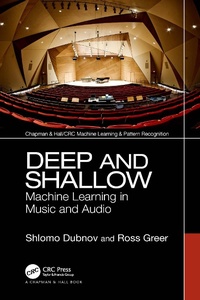
Deep and Shallow
Machine Learning in Music and Audio
1st Edition
Published on 8. December 2023
344 pages
978-1-000-98453-8 (ISBN)
Description

Providing an essential and unique bridge between the theories of signal processing, machine learning, and artificial intelligence (AI) in music, this book provides a holistic overview of foundational ideas in music, from the physical and mathematical properties of sound to symbolic representations. Combining signals and language models in one place, this book explores how sound may be represented and manipulated by computer systems, and how our devices may come to recognize particular sonic patterns as musically meaningful or creative through the lens of information theory.
Introducing popular fundamental ideas in AI at a comfortable pace, more complex discussions around implementations and implications in musical creativity are gradually incorporated as the book progresses. Each chapter is accompanied by guided programming activities designed to familiarize readers with practical implications of discussed theory, without the frustrations of free-form coding.
Surveying state-of-the art methods in applications of deep neural networks to audio and sound computing, as well as offering a research perspective that suggests future challenges in music and AI research, this book appeals to both students of AI and music, as well as industry professionals in the fields of machine learning, music, and AI.
Introducing popular fundamental ideas in AI at a comfortable pace, more complex discussions around implementations and implications in musical creativity are gradually incorporated as the book progresses. Each chapter is accompanied by guided programming activities designed to familiarize readers with practical implications of discussed theory, without the frustrations of free-form coding.
Surveying state-of-the art methods in applications of deep neural networks to audio and sound computing, as well as offering a research perspective that suggests future challenges in music and AI research, this book appeals to both students of AI and music, as well as industry professionals in the fields of machine learning, music, and AI.
Reviews / Votes
"Deep and Shallow by Shlomo Dubnov and Ross Greer is an exceptional journey into the convergence of music, artificial intelligence, and signal processing. Seamlessly weaving together intricate theories with practical programming activities, the book guides readers, whether novices or experts, toward a profound understanding of how AI can reshape musical creativity. A true gem for both enthusiasts and professionals, this book eloquently bridges the gap between foundational concepts of music information dynamics as an underlying basis for understanding music structure and listening experience, and cutting-edge applications, ushering us into the future of music and AI with clarity and excitement."Gil Weinberg, Professor and Founding Director, Georgia Tech Center for Music Technology
"The authors make an enormous contribution, not only as a textbook, but as essential reading on music information dynamics, bridging multiple disciplines of music, information theory, and machine learning. The theory is illustrated and grounded in plenty of practical information and resources."
Roger B. Dannenberg, Emeritus Professor of Computer Science, Art & Music, Carnegie Mellon University
More details
Series
Edition
1. Auflage
Language
English
Place of publication
London
United Kingdom
Publishing group
Taylor & Francis Ltd
Target group
College/higher education
Professional and scholarly
Product notice
Reflowable
Illustrations
32 Line drawings, color; 74 Line drawings, black and white; 2 Halftones, color; 34 Illustrations, color; 74 Illustrations, black and white
ISBN-13
978-1-000-98453-8 (9781000984538)
Copyright in bibliographic data and cover images is held by Nielsen Book Services Limited or by the publishers or by their respective licensors: all rights reserved.
Schweitzer Classification
Other editions
Additional editions
Book
12/2023
1st Edition
Chapman & Hall/CRC
€73.20
Shipment within 10-20 days
Book
12/2023
1st Edition
Chapman & Hall/CRC
€176.10
Shipment within 10-20 days
Persons
Shlomo Dubnov is a Professor in the Music Department and Affiliate Professor in Computer Science and Engineering at the University of California, San Diego. He is best known for his research on poly-spectral analysis of musical timbre and inventing the method of Music Information Dynamics with applications in Computer Audition and Machine improvisation. His previous books on The Structure of Style: Algorithmic Approaches to Understanding Manner and Meaning and Cross-Cultural Multimedia Computing: Semantic and Aesthetic Modeling were published by Springer.
Ross Greer is a PhD Candidate in Electrical & Computer Engineering at the University of California, San Diego, where he conducts research at the intersection of artificial intelligence and human agent interaction. Beyond exploring technological approaches to musical expression, Ross creates music as a conductor and orchestrator for instrumental ensembles. Ross received his B.S. and B.A. degrees in EECS, Engineering Physics, and Music from UC Berkeley, and an M.S. in Electrical & Computer Engineering from UC San Diego.
Ross Greer is a PhD Candidate in Electrical & Computer Engineering at the University of California, San Diego, where he conducts research at the intersection of artificial intelligence and human agent interaction. Beyond exploring technological approaches to musical expression, Ross creates music as a conductor and orchestrator for instrumental ensembles. Ross received his B.S. and B.A. degrees in EECS, Engineering Physics, and Music from UC Berkeley, and an M.S. in Electrical & Computer Engineering from UC San Diego.
Content
Preface
Chapter 1 Introduction to Sounds of Music
Chapter 2 Noise: the Hidden Dynamics of Music
Chapter 3 Communicating Musical Information
Chapter 4 Understanding and (Re)Creating Sound
Chapter 5 Generating and Listening to Audio Information
Chapter 6 Artificial Musical Brains
Chapter 7 Representing Voices in Pitch and Time
Chapter 8 Noise Revisited: Brains that Imagine
Chapter 9 Paying (Musical) Attention
Chapter 10 Last Noisy Thoughts, Summary and Conclusion
Appendix A Introduction to Neural Network Frameworks: Keras, Tensorflow, Pytorch
Appendix B Summary of Programming Examples and Exercises
Appendix C Software Packages for Music and Audio Representation and Analysis
Appendix D Free Music and Audio Editting Software
Appendix E Datasets
Appendix F Figure Attributions
References
Index
Chapter 1 Introduction to Sounds of Music
Chapter 2 Noise: the Hidden Dynamics of Music
Chapter 3 Communicating Musical Information
Chapter 4 Understanding and (Re)Creating Sound
Chapter 5 Generating and Listening to Audio Information
Chapter 6 Artificial Musical Brains
Chapter 7 Representing Voices in Pitch and Time
Chapter 8 Noise Revisited: Brains that Imagine
Chapter 9 Paying (Musical) Attention
Chapter 10 Last Noisy Thoughts, Summary and Conclusion
Appendix A Introduction to Neural Network Frameworks: Keras, Tensorflow, Pytorch
Appendix B Summary of Programming Examples and Exercises
Appendix C Software Packages for Music and Audio Representation and Analysis
Appendix D Free Music and Audio Editting Software
Appendix E Datasets
Appendix F Figure Attributions
References
Index
