

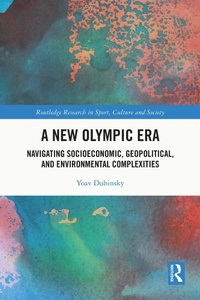
A New Olympic Era
Navigating Socioeconomic, Geopolitical, and Environmental Complexities
Published on 1. April 2026
160 pages
978-1-040-50249-5 (ISBN)
Description

This book examines the new era of the Olympic Movement as it is forced to navigate through old and new socioeconomic, geopolitical, and environmental challenges.
Against a background of geopolitics, commercialization, technological development, extreme weather, and associated accelerating changes in global society, the book looks at the past, present and future of the idealistic philosophy of Olympism, and at the duality of the Olympic Movement as it faces the often contradictory challenges of the 21st Century. Drawing on multi-disciplinary perspectives from history, sociology, political science, philosophy, business and management, and communications, the book discusses the evolution of the Modern Olympic Movement and the role of Olympism before exploring in depth the new era of the Olympic Games, including the impacts of Tokyo 2020 and Beijing 2022, the significance of Paris 2024, the legacy of Olympic Agenda and Thomas Bach's presidency, and looking ahead to Los Angeles 2028, Brisbane 2032 and beyond. The book unpacks the key themes that run through contemporary Olympic Studies, including nation-branding, diplomatic boycotts, international politics, sports-washing, greenwashing, corruption, sustainability, public spending, public resistance, surveillance, athlete activism, cultural diplomacy and the external impacts of Covid-19 and extreme weather. It argues that the Olympic Games can still add value to the 'incoherent mosaic' of the human experience, and asks what lies ahead for the Olympic Movement.
This book is essential reading for anybody with an interest in the Olympic Games, mega sports events, or the wider significance of sport in contemporary society.
Against a background of geopolitics, commercialization, technological development, extreme weather, and associated accelerating changes in global society, the book looks at the past, present and future of the idealistic philosophy of Olympism, and at the duality of the Olympic Movement as it faces the often contradictory challenges of the 21st Century. Drawing on multi-disciplinary perspectives from history, sociology, political science, philosophy, business and management, and communications, the book discusses the evolution of the Modern Olympic Movement and the role of Olympism before exploring in depth the new era of the Olympic Games, including the impacts of Tokyo 2020 and Beijing 2022, the significance of Paris 2024, the legacy of Olympic Agenda and Thomas Bach's presidency, and looking ahead to Los Angeles 2028, Brisbane 2032 and beyond. The book unpacks the key themes that run through contemporary Olympic Studies, including nation-branding, diplomatic boycotts, international politics, sports-washing, greenwashing, corruption, sustainability, public spending, public resistance, surveillance, athlete activism, cultural diplomacy and the external impacts of Covid-19 and extreme weather. It argues that the Olympic Games can still add value to the 'incoherent mosaic' of the human experience, and asks what lies ahead for the Olympic Movement.
This book is essential reading for anybody with an interest in the Olympic Games, mega sports events, or the wider significance of sport in contemporary society.
More details
Series
Language
English
Place of publication
London
United Kingdom
Publishing group
Taylor & Francis Ltd
Target group
College/higher education
File size
8,87 MB
ISBN-13
978-1-040-50249-5 (9781040502495)
Copyright in bibliographic data and cover images is held by Nielsen Book Services Limited or by the publishers or by their respective licensors: all rights reserved.
Schweitzer Classification
Other editions
Additional editions
Yoav Dubinsky
A New Olympic Era
Navigating Socioeconomic, Geopolitical, and Environmental Complexities
Book
approx. 04/2026
1st Edition
Routledge
€210.90
Not yet published
Person
Yoav Dubinsky is Associate Teaching Professor in the Lundquist College of Business at the University of Oregon, USA. Dr. Dubinsky covered or researched five Olympic Games and has been involved with the International Olympic Academy in Olympia, Greece, as a student, coordinator and a lecturer, and in 2024 founded the University of Oregon Olympic Studies Hub. Dr. Dubinsky's research focuses on sports, nation branding, and public diplomacy, especially in the contexts of the Olympic Movement, international sports, the United States and Israel.
Content
1. Introduction 2. Entering a New Olympic Era (776 B.C. to 2020) 3. The Coronavirus Games (Tokyo 2020 and Beijing 2022) 4. The Seine-sational Agenda 2020 Games (Paris 2024) 5. Olympism Inc. and Socioeconomic Complexities 6. Olympic Truce, Terrorism and Geopolitical Complexities 7. Sustainability, Greenwashing and Environmental Complexities 8. Thomas Bach's Presidential Legacy and the Future of the New Olympic Era
