

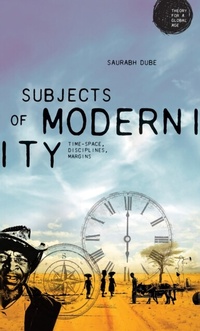
Subjects of Modernity
Time-Space, Disciplines, Margins
1st Edition
Published on 20. January 2017
192 pages
978-1-5261-0513-4 (ISBN)
Description

This book thinks through modernity and its representations by exploring critical considerations of time and space. Drawing on anthropology, history and social theory, it investigates the oppositions and enchantments, the contradictions and contentions, and the identities and ambivalences spawned under modernity. Crucially, it understands these antinomies not as errors, but as constitutive elements of modern worlds.
The book questions routine portrayals of homogeneous time and antinomian blueprints of cultural space, while acknowledging the production of time and space by social subjects. Instead of assuming a straightforward, singular trajectory for the phenomena, it views modernity as involving checkered, contingent and contended processes of meaning and power, which have found heterogeneous historical elaborations over the past five centuries. Bringing together past and present, theory and narrative, it sows the historical, ethnographic and methodological deep into its critical procedures, offering an innovative understanding of cultural identities and imaginatively exploring the relationship between history and anthropology.
An electronic edition of this book is freely available under a Creative Commons (CC BY-NC-ND) licence. -- .
The book questions routine portrayals of homogeneous time and antinomian blueprints of cultural space, while acknowledging the production of time and space by social subjects. Instead of assuming a straightforward, singular trajectory for the phenomena, it views modernity as involving checkered, contingent and contended processes of meaning and power, which have found heterogeneous historical elaborations over the past five centuries. Bringing together past and present, theory and narrative, it sows the historical, ethnographic and methodological deep into its critical procedures, offering an innovative understanding of cultural identities and imaginatively exploring the relationship between history and anthropology.
An electronic edition of this book is freely available under a Creative Commons (CC BY-NC-ND) licence. -- .
Reviews / Votes
'Dube ranges widely and globally - from histories of empires and genealogies of disciplines to recent Dalit artwork from India - to explore and carefully delineate a tension he regards as fundamental to the formation of the modern: the modern subject's inevitable entanglement with those subject to modernity. A tour de force, this book offers a critical, timely and powerful sequel to postcolonial and subaltern studies.'Dipesh Chakrabarty, University of Chicago
'Saurabh Dube, a distinguished scholar of the "enchantments of modernity", turns his attention here to the various "subjects" to which modernity has given rise: to its agents, its subalterns and its narrators; to the particular sort of space and time it produces and presumes; above all, to the disciplined and undisciplined forms of knowledge it has spawned. At a time when the tenets of modernity are increasingly being called into question, he offers us a meditation of unusual insight and critical value.'
Jean and John Comaroff, Harvard University
'Saurabh Dube has crafted an elegantly essayistic critique of the simplistic (and single-stranded) evolutionism that inspires the pretensions of self-proclaimed global and hegemonic modernity. He shows how even progressive and well-meaning scholars conflate heterogeneous complexities, thereby imbuing this all-encompassing conceptual structure with seemingly ineluctable reality. His provocations offer a challenging break with frameworks that for too long have carried colonialism's intellectual heritage forward even after its political demise.'
Michael Herzfeld, Harvard University
'Saurabh Dube's elegant and insightful meditation on modernity, with a focus on the academic and aesthetic trajectories of the phenomenon, as well as on historical actors who both shaped and were shaped by these processes, constitutes an important revisionist take on the subject. Dube's exploration of modernity, through a scrupulous attention to its temporal-spatial imperatives, poses a challenge at both the empirical and conceptual level to the exemplary status of the West. The book models a form of critical scholarship that is generous in its engagement with the work of its interlocutors even as it pushes against the latest cliches to chart new directions. Subjects of modernity deserves to be read very widely across a variety of overlapping fields and subfields, from history to anthropology and from subaltern studies to postcolonial theory.'
Mrinalini Sinha, University of Michigan, Ann Arbor
'Dube's book is an excellent reminder of the possibilities as well as the perils of modernity.'
Projit Bihari Mukharji, Associate Professor, University of Pennsylvania, Postcolonial Studies
'Dube brings an electric urgency to the task of historiography of modernity, a need to look for a way out and away from the exigencies of modernity. The book is disguised as a thesis. But Dube has obviously penned a manifesto. It has its academic credentials - and he is happy to invite readers to skip and scan, reading the book as six essays rather than as a monograph. But at heart, this book is a call for action. And it is this urgency to act that makes this book a benchmark by which we look at the future investigators of modernity and their ethical and privileged respon sibilities for naming and changing the scripts that bind the subject of modernity.'
Nishant Shah is Dean, ArtEZ University of the Arts, The Netherlands and teaches at the Leuphana University, Germany, Economic and Political Weekly, June 2018
'Saurabh Dube's Subjects of modernity is a conceptual reflection on and an extended dialogue with, the vast critical scholarship on modernity that the fields of postcolonial theory, history, and anthropology have yielded. However, rather than treating them as arguments to be transcended, Dube builds on this corpus of writings and further probes them. Methodologically speaking, for the work that this book does, Dube charts a space of, what he aptly calls, 'disciplinary borderlands' (3).'
Partha Pratim Shil, Trinity College, Cambridge, UK, South Asian History and Culture, December 2019
'This book takes an ethnographic approach to its topic by endeavoring to observe how social and disciplinary subjects shaped by modernity go on to constitute modern worlds. Specifically, it attempts to "explore modernity as a contradictory and checkered historical- cultural entity and category as well as a contingent and contended process and condition" (1). Most of the subjects considered are intellectuals and academic disciplines (specifically history and anthropology), although the argument occasionally focuses on artists as well [...] Central to the volume-and its most original contribution-are various deliberations on the productions of time and space by various subjects. To be clear, by "time" the book means history and temporality whereas "space" suggests tradition and culture.'
Peter Gottschalk, Wesleyan University, Connecticut, USA, History and Theory, March 2020 -- .
More details
Series
Language
English
Place of publication
Manchester
United Kingdom
Target group
College/higher education
Professional and scholarly
Edition type
Digital original
Illustrations
6 black & white illustrations
6 black & white illustrations
ISBN-13
978-1-5261-0513-4 (9781526105134)
Copyright in bibliographic data and cover images is held by Nielsen Book Services Limited or by the publishers or by their respective licensors: all rights reserved.
Schweitzer Classification
Other editions
Additional editions
Book
05/2019
Manchester University Press
€33.10
Shipment within 15-20 days
Person
Saurabh Dube is Research Professor at the Centre for Asian and African Studies at El Colegio de Mexico, Mexico City -- .
Content
1 Subjects of modernity: an introduction
2 Intimations of modernity: time and space
3 Maps of modernity: antinomies and enticements
4 Disciplines of modernity: entanglements and ambiguities
5 Margins of modernity: identities and incitements
6 Modern subjects: an epilogue
Index -- .
2 Intimations of modernity: time and space
3 Maps of modernity: antinomies and enticements
4 Disciplines of modernity: entanglements and ambiguities
5 Margins of modernity: identities and incitements
6 Modern subjects: an epilogue
Index -- .
