

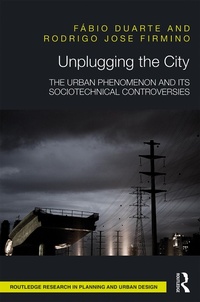
Unplugging the City
The Urban Phenomenon and its Sociotechnical Controversies
Published on 16. October 2017
174 pages
978-1-315-52324-8 (ISBN)
Description

Modernity has entrusted technology with such power that it is treated as an autonomous entity, with its own manners and morals. Technological disruptions are also socially disruptive: technological failures reveal both the constituents of the technology itself and the social fabric woven by this technology. Cities are the quintessential technological arrangement, not only materially but also as a conceptual framework: the ubiquity of technology makes us think and plan cities mostly in terms of technological arrangements.
Unplugging the City: The Urban Phenomenon and its Sociotechnical Controversies proposes a conceptual and methodological framework for analyzing certain urban phenomena as a technological assemblage. It demonstrates, through multiple case studies, the sociotechnical complexities involved in the stabilization and disruption of urban technological arrangements. Examples range from the urban phantasmagorias portrayed in science-fiction movies to the urban proposals of Brasilia and Masdar, from the book of bike-sharing systems to pervasive global surveillance systems.
Written by Fabio Duarte and Rodrigo Firmino, based on their original research and publications, this is an essential resource for those interested in the theory and study of technology and its inextricable influence on the city.
Unplugging the City: The Urban Phenomenon and its Sociotechnical Controversies proposes a conceptual and methodological framework for analyzing certain urban phenomena as a technological assemblage. It demonstrates, through multiple case studies, the sociotechnical complexities involved in the stabilization and disruption of urban technological arrangements. Examples range from the urban phantasmagorias portrayed in science-fiction movies to the urban proposals of Brasilia and Masdar, from the book of bike-sharing systems to pervasive global surveillance systems.
Written by Fabio Duarte and Rodrigo Firmino, based on their original research and publications, this is an essential resource for those interested in the theory and study of technology and its inextricable influence on the city.
Reviews / Votes
"In Unplugging the City, Fabio Duarte and Rodrigo Firmino develop the concept of unplugging as a heuristic to tease apart and understand the complex sociotechnical assemblages that enable cities to function and shape everyday life. Written in a clear and engaging narrative, they illustrate their ideas through a series of case studies relating to various technologies - from bikeshare to surveillance cameras - drawing on empirical research conducted in a number of cities. Their analysis will be of interest and value to anyone seeking to understand the relationship between cities and technologies."Rob Kitchin, National University of Ireland Maynooth
"A cutting-edge analysis of how a myriad of new technologies are involved in the rapid reorganisation of cities and urban life, Unplugging the City is a superb and much-needed book. From video and data surveillance to bike sharing, from driverless cars to guided buses, and from Wikileaks to sci-fi cinema, the book explores and exposes the politics and possibilities of new communications and mobility innovations in cities with great topicality and erudition"
Stephen Graham, Professor of Cities and Society, Newcastle University
"This book skilfully delivers a collection of interconnected topics focusing on various developmental aspects of contemporary cities-including mobility, technology, infrastructure, planning and design. The book is an invaluable reading for urban policy makers, researchers, practitioners and students that are interested in exploring the interplay between urban technologies and cities."
Tan Yigitcanlar, Queensland University of Technology, Australia; author of the Technology and the City
More details
Series
Language
English
Place of publication
London
United Kingdom
Publishing group
Taylor & Francis Ltd
Target group
College/higher education
Illustrations
1 Tables, black and white; 22 Halftones, black and white
File size
4,52 MB
ISBN-13
978-1-315-52324-8 (9781315523248)
Copyright in bibliographic data and cover images is held by Nielsen Book Services Limited or by the publishers or by their respective licensors: all rights reserved.
Schweitzer Classification
Other editions
Additional editions
Fabio Duarte | Rodrigo Jose Firmino
Unplugging the City
The Urban Phenomenon and its Sociotechnical Controversies
Book
05/2019
1st Edition
Routledge
€68.30
Shipment within 15-20 days
Fabio Duarte | Rodrigo Jose Firmino
Unplugging the City
The Urban Phenomenon and its Sociotechnical Controversies
Book
10/2017
1st Edition
Routledge
€205.90
Shipment within 10-20 days
Persons
Fabio Duarte is a scholar and research lead at the Massachusetts Institute of Technology Senseable City Lab and professor at the Pontificia Universidade Catolica do Parana (PUCPR), Brazil. Duarte is an urban planner with a PhD in Communications from the University of Sao Paulo, Brazil, and has been a research associate at Harvard Graduate School of Design.
Rodrigo Firmino is professor in urban management at the Pontificia Universidade Catolica do Parana (PUCPR), Brazil. Firmino is an architect and urban planner with a PhD in Urban Planning from Newcastle University, UK, and has been a visiting scholar at the University College London (2015), and a postdoc fellow at the University of Sao Paulo (2004).
Rodrigo Firmino is professor in urban management at the Pontificia Universidade Catolica do Parana (PUCPR), Brazil. Firmino is an architect and urban planner with a PhD in Urban Planning from Newcastle University, UK, and has been a visiting scholar at the University College London (2015), and a postdoc fellow at the University of Sao Paulo (2004).
Content
Foreword Introduction From Shared Wheels to Controlled Spaces Chapter 1 Unplugging the City: Mobility and Territorialization of Urban Sociotechnical Systems Chapter 2 Disassembling Bike-Sharing Systems: Surveillance, Advertising, and the Social Inequalities of a Global Technological Arrangement Chapter 3 Learning from Failures: Unearthing Rail Proposals in Curitiba's Bus Rapid Transit Chapter 4 Driverless Cars: Glossing the Rugged Pavements Ahead Chapter 5 Constructing New Invisible Territories through the Monitoring of People and Spaces Chapter 6 The Weakest Link: Unplugging Digital Territorialities Chapter 7 Planning Delusion: Between Prescription and Provocation Chapter 8 Urban Phantasmagorias: The Immanent Cities of the Future Chapter 9 Folie a Deux - A Salute to Mark Weiser
