

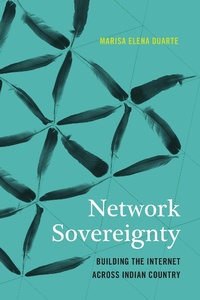
Network Sovereignty
Description

In 2012, the United Nations General Assembly determined that affordable Internet access is a human right, critical to citizen participation in democratic governments. Given the significance of information and communication technologies (ICTs) to social and political life, many U.S. tribes and Native organizations have created their own projects, from streaming radio to building networks to telecommunications advocacy. In Network Sovereignty, Marisa Duarte examines these ICT projects to explore the significance of information flows and information systems to Native sovereignty, and toward self-governance, self-determination, and decolonization.
By reframing how tribes and Native organizations harness these technologies as a means to overcome colonial disconnections, Network Sovereignty shifts the discussion of information and communication technologies in Native communities from one of exploitation to one of Indigenous possibility.
More details
Other editions
Additional editions
Person
Marisa Elena Duarte is assistant professor of justice and sociotechnical change with the School of Social Transformation at Arizona State University.
Content
Introduction
1. Network Thinking
2. Reframing ICTs in Indian Country
3. The Overlap between Technology and Sovereignty
4. Sociotechnical Landscapes
5. Internet for Self-Determination
6. Network Sovereignty
7. Decolonizing the Technological
Conclusion
