

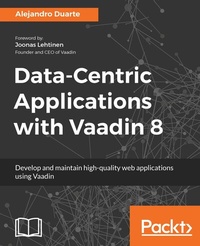
Data-Centric Applications with Vaadin 8
Develop and maintain high-quality web applications using Vaadin
1st Edition
Published on 23. September 2024
202 pages
978-1-78328-885-4 (ISBN)
Description

This book teaches you everything you need to know to create stunning Vaadin applications for all your web development needs. Deep dive into advanced Vaadin concepts while creating your very own sample Vaadin application.Key Features - A one-stop book to enhance your working knowledge with Vaadin.
- Explore and implement the architecture of Vaadin applications.
- Delve into advanced topics such as data binding, authentication and authorization to improvise your application's performance.
Book DescriptionVaadin is an open-source Java framework used to build modern user interfaces. Vaadin 8 simplifies application development and improves user experience. The book begins with an overview of the architecture of Vaadin applications and the way you can organize your code in modules.Then it moves to the more advanced topics about advanced topics such as internationalization, authentication, authorization, and database connectivity. The book also teaches you how to implement CRUD views, how to generate printable reports, and how to manage data with lazy loading. By the end of this book you will be able to architect, implement, and deploy stunning Vaadin applications, and have the knowledge to master web development with Vaadin. What you will learn - Modularize your Vaadin applications with Maven
- Create high quality custom components
- Implement robust and secure authentication and authorization mechanisms
- Connect to SQL databases efficiently
- Design robust CRUD (Create, Read, Update, Delete) views
- Generate stunning reports
- Improve resource consumption by using lazy loading
Who this book is forIf you area Software developer with previous experience with Vaadin and would like to gain more comprehensive and advanced skills in Vaadin web development, then this book is for you.
- Explore and implement the architecture of Vaadin applications.
- Delve into advanced topics such as data binding, authentication and authorization to improvise your application's performance.
Book DescriptionVaadin is an open-source Java framework used to build modern user interfaces. Vaadin 8 simplifies application development and improves user experience. The book begins with an overview of the architecture of Vaadin applications and the way you can organize your code in modules.Then it moves to the more advanced topics about advanced topics such as internationalization, authentication, authorization, and database connectivity. The book also teaches you how to implement CRUD views, how to generate printable reports, and how to manage data with lazy loading. By the end of this book you will be able to architect, implement, and deploy stunning Vaadin applications, and have the knowledge to master web development with Vaadin. What you will learn - Modularize your Vaadin applications with Maven
- Create high quality custom components
- Implement robust and secure authentication and authorization mechanisms
- Connect to SQL databases efficiently
- Design robust CRUD (Create, Read, Update, Delete) views
- Generate stunning reports
- Improve resource consumption by using lazy loading
Who this book is forIf you area Software developer with previous experience with Vaadin and would like to gain more comprehensive and advanced skills in Vaadin web development, then this book is for you.
More details
Other editions
Additional editions
Alejandro Duarte
Data-Centric Applications with Vaadin 8
Book
04/2018
Packt Publishing
€45.30
Shipment within 3-4 weeks
Person
Duarte Alejandro :
Alejandro Duarte is a developer advocate and trainer at Vaadin Ltd. He is also the author of Vaadin 7 UI Design by Example: Beginner's Guide (Packt, 2013). Graduating from the National University of Colombia with a B.S. in computer science, Alejandro learned how to program with the BASIC programming language at age 13 and has worked on many software development projects in startup-like and big companies in several countries. When he isn't coding, he splits his time between his family, his beautiful girlfriend, and his passion for the electric guitar. You can follow him on Twitter at @alejandro_du.
Alejandro Duarte is a developer advocate and trainer at Vaadin Ltd. He is also the author of Vaadin 7 UI Design by Example: Beginner's Guide (Packt, 2013). Graduating from the National University of Colombia with a B.S. in computer science, Alejandro learned how to program with the BASIC programming language at age 13 and has worked on many software development projects in startup-like and big companies in several countries. When he isn't coding, he splits his time between his family, his beautiful girlfriend, and his passion for the electric guitar. You can follow him on Twitter at @alejandro_du.
Content
Table of Contents - Creating new Vaadin projects
- Modularization and main screens
- Implementing server-side components with internationalization
- Implementing authentication and authorization
- Connecting to SQL databases using JDBC
- Connecting to SQL Databases using ORM Frameworks
- Implementing CRUD User Interfaces
- Adding Reporting Capabilities
- Lazy Loading
- Modularization and main screens
- Implementing server-side components with internationalization
- Implementing authentication and authorization
- Connecting to SQL databases using JDBC
- Connecting to SQL Databases using ORM Frameworks
- Implementing CRUD User Interfaces
- Adding Reporting Capabilities
- Lazy Loading
