

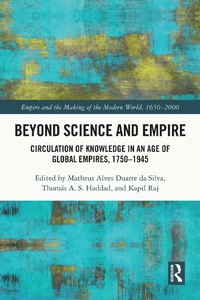
Beyond Science and Empire
Circulation of Knowledge in an Age of Global Empires, 1750-1945
1st Edition
Published on 23. September 2023
212 pages
978-1-000-92905-8 (ISBN)
Description

Through ten case studies by international specialists, this book investigates the circulation and production of scientific knowledge between 1750 and 1945 in the fields of agriculture, astronomy, botany, cartography, medicine, statistics, and zoology.
In this period, most of the world was under some form of imperial control, while science emerged as a discrete field of activity. What was the relationship between empire and science? Was science just an instrument for imperial domination? While such guiding questions place the book in the tradition of science and empire studies, it offers a fresh perspective in dialogue with global history and circulatory approaches. The book demonstrates, not by theoretical discourse but through detailed historical case studies, that the adoption of a global scale of analysis or an emphasis on circulatory processes does not entail analytical vagueness, diffusionism in disguise, or complacency with imperialism. The chapters show scientific knowledge emerging from the actions of little-known individuals moving across several Empires-European, Asian, and South American alike-in unanticipated places and institutions, and through complex processes of exchange, competition, collaboration, and circulation of knowledge.
The book will interest scholars and undergraduate and graduate students concerned with the connections between the history of science, imperial history, and global history.
In this period, most of the world was under some form of imperial control, while science emerged as a discrete field of activity. What was the relationship between empire and science? Was science just an instrument for imperial domination? While such guiding questions place the book in the tradition of science and empire studies, it offers a fresh perspective in dialogue with global history and circulatory approaches. The book demonstrates, not by theoretical discourse but through detailed historical case studies, that the adoption of a global scale of analysis or an emphasis on circulatory processes does not entail analytical vagueness, diffusionism in disguise, or complacency with imperialism. The chapters show scientific knowledge emerging from the actions of little-known individuals moving across several Empires-European, Asian, and South American alike-in unanticipated places and institutions, and through complex processes of exchange, competition, collaboration, and circulation of knowledge.
The book will interest scholars and undergraduate and graduate students concerned with the connections between the history of science, imperial history, and global history.
More details
Series
Edition
1. Auflage
Language
English
Place of publication
London
United Kingdom
Publishing group
Taylor & Francis Ltd
Target group
College/higher education
Illustrations
1 Line drawings, black and white; 10 Halftones, black and white; 11 Illustrations, black and white
ISBN-13
978-1-000-92905-8 (9781000929058)
Copyright in bibliographic data and cover images is held by Nielsen Book Services Limited or by the publishers or by their respective licensors: all rights reserved.
Schweitzer Classification
Other editions
Additional editions
Matheus Alves Duarte da Silva | Thomas A. S. Haddad | KAPIL RAJ
Beyond Science and Empire
Circulation of Knowledge in an Age of Global Empires, 1750-1945
Book
06/2025
1st Edition
Routledge
€67.10
Shipment within 10-20 days
Matheus Alves Duarte da Silva | Thomas A. S. Haddad | KAPIL RAJ
Beyond Science and Empire
Circulation of Knowledge in an Age of Global Empires, 1750-1945
Book
08/2023
1st Edition
Routledge
€231.50
Shipment within 15-20 days
Persons
Matheus Alves Duarte da Silva is a Postdoctoral Research Fellow at the University of St Andrews, working on the global history of medicine. He is the author of Quand la peste connectait le monde: production et circulation de savoirs microbiologiques entre Bresil, Inde et France (1894-1922) (2020).
Thomas A. S. Haddad is an Associate Professor of History of Science at the University of Sao Paulo, Brazil, specializing on astral knowledge practices in early modern empires. He is the author of Maps of the Moon: Lunar Cartography from the Seventeenth Century to the Space Age (2019).
Kapil Raj is a Distinguished Research Professor at the Ecole des Hautes Etudes en Sciences Sociales, Paris, whose research is focused on the role of intercultural encounters in the construction of modern science. He is the author of Relocating Modern Science: Circulation and the Construction of Knowledge in South Asia and Europe, 1650-1900 (2007).
Thomas A. S. Haddad is an Associate Professor of History of Science at the University of Sao Paulo, Brazil, specializing on astral knowledge practices in early modern empires. He is the author of Maps of the Moon: Lunar Cartography from the Seventeenth Century to the Space Age (2019).
Kapil Raj is a Distinguished Research Professor at the Ecole des Hautes Etudes en Sciences Sociales, Paris, whose research is focused on the role of intercultural encounters in the construction of modern science. He is the author of Relocating Modern Science: Circulation and the Construction of Knowledge in South Asia and Europe, 1650-1900 (2007).
Content
1. Science and Empire: Past and Present Questions Part 1: Knowledge Production on Imperial Landscapes 2. Putting Ships to New Uses: "Floating Gardens" and the Circulation of Knowledge at Sea and on Land, 1790-1800 3. Regional Knowledge in the Empire: Tobacco Cultivation during the Napoleonic Era 4. Global Communication and Construction of Knowledge in French Naval Medicine: Pierre-Francois Keraudren and the Health Department of French Navy, 1813-1845 5. Positioning the North: Making British Geographical Knowledge of Australia in the Mid-Nineteenth Century 6. Maps and the Man on the Spot: Bio-geographies, Knowledge, and Authority around and about the Zambezi 7. The Global Dimensions of the Rome Zoological Garden and Italian Colonialism in Africa Part 2: Knowledge Production at Imperial Crossroads 8. The Astronomical Observations of Bento Sanches Dorta in Rio de Janeiro, 1781-1787 9. Auguste de Saint-Hilaire's writings between European and Brazilian Audiences, 1816-1850 10. Commercial Statistics of Late Qing China Between Global Interest and Local Irrelevance, 1860-1910 11. Plague and the Global Emergence of Microbiology, 1894-1920
