

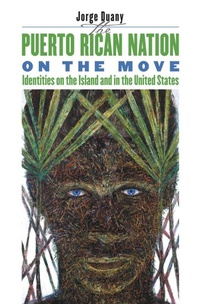
The Puerto Rican Nation on the Move
Description

Puerto Ricans maintain a vibrant identity that bridges two very different places — the island of Puerto Rico and the U.S. mainland. Whether they live on the island, in the States, or divide time between the two, most imagine Puerto Rico as a separate nation and view themselves primarily as Puerto Rican. At the same time, Puerto Ricans have been U.S. citizens since 1917, and Puerto Rico has been a U.S. commonwealth since 1952. Jorge Duany uses previously untapped primary sources to bring new insights to questions of Puerto Rican identity, nationalism, and migration. Drawing a distinction between political and cultural nationalism, Duany argues that the Puerto Rican “nation” must be understood as a new kind of translocal entity with deep cultural continuities. He documents a strong sharing of culture between island and mainland, with diasporic communities tightly linked to island life by a steady circular migration. Duany explores the Puerto Rican sense of nationhood by looking at cultural representations produced by Puerto Ricans and considering how others — American anthropologists, photographers, and museum curators, for example — have represented the nation. His sources of information include ethnographic fieldwork, archival research, interviews, surveys, censuses, newspaper articles, personal documents, and literary texts.
More details
Other editions
Additional editions
Person
Jorge Duany is professor of anthropology at the University of Puerto Rico in Río Piedras and coauthor of Cubans in Puerto Rico: Ethnic Economy and Cultural Identity. He has held teaching and research appointments in the United States, most recently as a visiting professor at the University of Michigan.
Content
- Intro
- Contents
- Acknowledgments
- Introduction: Rethinking Colonialism, Nationalism, and Transnationalism The Case of Puerto Rico
- Notes
- 1. The Construction of Cultural Identities in Puerto Rico and the Diaspora
- Notes
- 2. The Rich Gate to Future Wealth: Displaying Puerto Rico at World's Fairs
- Notes
- 3. Representing the Newly Colonized: Puerto Rico in the Gaze of American Anthropologists, 1898-1915
- Notes
- 4. Portraying the Other: Puerto Rican Images in Two American Photographic Collections
- Notes
- 5. A Postcolonial Colony?: The Rise of Cultural Nationalism in Puerto Rico during the 1950s
- Notes
- 6. Collecting the Nation: The Public Representation of Puerto Rico's Cultural Identity
- Notes
- 7. Following Migrant Citizens: The Official Discourse on Puerto Rican Migration to the United States
- Notes
- 8. The Nation in the Diaspora: The Reconstruction of the Cultural Identity of Puerto Rican Migrants
- Notes
- 9. Mobile Livelihoods: Circular Migration, Transnational Identities, and Cultural Borders between Puerto Rico and the United States
- Notes
- 10. Neither White nor Black: The Representation of Racial Identity among Puerto Ricans on the Island and in the U.S. Mainland
- Notes
- 11. Making Indians out of Blacks: The Revitalization of Taíno Identity in Contemporary Puerto Rico
- Notes
- Conclusion: Nation, Migration, Identity
- Notes
- Works Cited
- Index
