

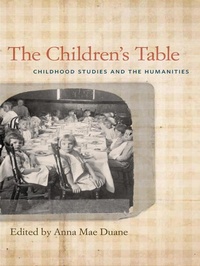
The Children's Table
Description

Like the occupants of the children's table at a family dinner, scholars working in childhood studies can seem sidelined from the "adult" labor of humanities scholarship. The Children's Table brings together scholars from architecture, philosophy, law, and literary and cultural criticism to provide an overview of the innovative work being done in childhood studies-a transcript of what is being said at the children's table. Together, these scholars argue for rethinking the academic seating arrangement in a way that acknowledges the centrality of childhood to the work of the humanities.
The figure we now recognize as a child was created in tandem with forms of modernity that the Enlightenment generated and that the humanities are now working to rethink. Thus the growth of childhood studies allows for new approaches to some of the most important and provocative issues in humanities scholarship: the viability of the social contract, the definition of agency, the performance of identity, and the construction of gender, sexuality, and race. Because defining childhood is a means of defining and distributing power and obligation, studying childhood requires a radically altered approach to what constitutes knowledge about the human subject.
The diverse essays in The Children's Table share a unifying premise: to include the child in any field of study realigns the shape of that field, changing the terms of inquiry and forcing a different set of questions. Taken as a whole, the essays argue that, at this key moment in the state of the humanities, rethinking the child is both necessary and revolutionary.
Contributors: Annette Ruth Appell, Sophie Bell, Robin Bernstein, Sarah Chinn, Lesley Ginsberg, Lucia Hodgson, Susan Honeyman, Roy Kozlovsky, James Marten, Karen Sánchez-Eppler, Carol Singley, Lynne Vallone, John Wall.
More details
Other editions
Additional editions
Person
Content
- Cover Page
- Title Page
- Copyright Page
- Contents
- Acknowledgments
- Introduction. The Children's Table: Childhood Studies and the Humanities
- Part 1. Questioning the Autonomous Subject and Individual Rights
- The Prepolitical Child of Child-Centered Jurisprudence
- Childhood of the Race: A Critical Race Theory Intervention into Childhood Studies
- Childhood Studies and History: Catching a Culture in High Relief
- Childism: The Challenge of Childhood to Ethics and the Humanities
- Part 2. Recalibrating the Work of Discipline
- "So Wicked": Revisiting Uncle Tom's Cabin's Sentimental Racism through the Lens of the Child
- Minority/Majority: Childhood Studies and Antebellum American Literature
- The Architectures of Childhood
- Part 3. Childhood Studies and the Queer Subject
- "I Was a Lesbian Child": Queer Thoughts about Childhood Studies
- Trans(cending)gender through Childhood
- Childhood Studies and Literary Adoption
- Part 4. Childhood Studies: Theory, Practice, Pasts, and Futures
- Childhood as Performance
- In the Archives of Childhood
- Doing Childhood Studies: The View from Within
- Contributors
- Index
