

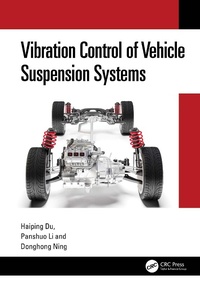
Vibration Control of Vehicle Suspension Systems
1st Edition
Published on 18. December 2023
322 pages
978-1-000-99929-7 (ISBN)
Description

This book covers complex issues for a vehicle suspension model, including non-linearities and uncertainties in a suspension model, network-induced time delays, and sampled-data model from a theoretical point of view. It includes control design methods such as neural network supervisory, sliding mode variable structure, optimal control, internal-model principle, feedback linearization control, input-to-state stabilization, and so on. Every control method is applied to the simulation for comparison and verification.
Features:
Includes theoretical derivation, proof, and simulation verification combined with suspension models
Provides the vibration control strategies for sampled-data suspension models
Focuses on the suspensions with time-delays instead of delay-free
Covers all the models related to quarter-, half-, and full-vehicle suspensions
Details rigorous mathematical derivation process for each theorem supported by MATLAB (R)-based simulation
This book is aimed at researchers and graduate students in automotive engineering, vehicle vibration, mechatronics, control systems, applied mechanics, and vehicle dynamics.
Features:
Includes theoretical derivation, proof, and simulation verification combined with suspension models
Provides the vibration control strategies for sampled-data suspension models
Focuses on the suspensions with time-delays instead of delay-free
Covers all the models related to quarter-, half-, and full-vehicle suspensions
Details rigorous mathematical derivation process for each theorem supported by MATLAB (R)-based simulation
This book is aimed at researchers and graduate students in automotive engineering, vehicle vibration, mechatronics, control systems, applied mechanics, and vehicle dynamics.
More details
Edition
1. Auflage
Language
English
Place of publication
London
United Kingdom
Publishing group
Taylor & Francis Ltd
Target group
College/higher education
Professional and scholarly
Illustrations
65 Tables, black and white; 106 Line drawings, black and white; 1 Halftones, black and white; 107 Illustrations, black and white
ISBN-13
978-1-000-99929-7 (9781000999297)
Copyright in bibliographic data and cover images is held by Nielsen Book Services Limited or by the publishers or by their respective licensors: all rights reserved.
Schweitzer Classification
Other editions
Additional editions
Haiping Du | Panshuo Li | Donghong Ning
Vibration Control of Vehicle Suspension Systems
Book
09/2025
1st Edition
CRC Press
€83.60
Shipment within 10-20 days
Haiping Du | Panshuo Li | Donghong Ning
Vibration Control of Vehicle Suspension Systems
Book
12/2023
1st Edition
CRC Press
€199.10
Shipment within 10-20 days
Persons
Haiping Du received a PhD from Shanghai Jiao Tong University, Shanghai, China, in 2002. He is a Senior Professor at the School of Electrical, Computer and Telecommunications Engineering, University of Wollongong, Australia. He was a research fellow with the University of Technology, Sydney, from 2005 to 2009, and was a postdoctoral research associate with Imperial College London from 2004 to 2005 and the University of Hong Kong from 2002 to 2003. He is a subject editor of various journals. His research interests include vibration control, vehicle dynamics and control systems, robust control theory and engineering applications, electric vehicles, robotics and automation, and smart materials and structures. He is a recipient of the Australian Endeavour Research Fellowship (2012).
Panshuo Li received her B.S. and M.S. in Mechanical Engineering from Donghua University and Shanghai Jiao Tong University, Shanghai, China, in 2009 and 2012, respectively. She obtained a PhD in Mechanical Engineering from University of Hong Kong, Hong Kong, in 2016. She was a research associate with the Department of Mechanical Engineering, University of Hong Kong, Hong Kong and the School of Electrical, Mechanical and Mechatronic Systems, University of Technology Sydney, Australia. She is currently a Full Professor with the School of Automation, Guangdong University of Technology, Guangzhou, China, and in the editorial board of Proc. IMechE Part I: Journal of Systems and Control Engineering. Her current research interests include switched systems, time-varying systems, and intelligent vehicle control.
Donghong Ning received a B.E. in Agricultural Mechanization and Automation from the College of Mechanical and Electronic Engineering, North West Agriculture and Forestry University, Yangling, China, in 2012 and a PhD in 2018 from the University of Wollongong, Australia. He was an associated research fellow at the University of Wollongong. He is currently a Professor at the College of Engineering, Ocean University of China, Qingdao, China. His research interests include active and semi-active vibration control, multiple degrees of freedom vibration control, interconnected suspension, electromagnetic suspension, and marine motion compensation.
Panshuo Li received her B.S. and M.S. in Mechanical Engineering from Donghua University and Shanghai Jiao Tong University, Shanghai, China, in 2009 and 2012, respectively. She obtained a PhD in Mechanical Engineering from University of Hong Kong, Hong Kong, in 2016. She was a research associate with the Department of Mechanical Engineering, University of Hong Kong, Hong Kong and the School of Electrical, Mechanical and Mechatronic Systems, University of Technology Sydney, Australia. She is currently a Full Professor with the School of Automation, Guangdong University of Technology, Guangzhou, China, and in the editorial board of Proc. IMechE Part I: Journal of Systems and Control Engineering. Her current research interests include switched systems, time-varying systems, and intelligent vehicle control.
Donghong Ning received a B.E. in Agricultural Mechanization and Automation from the College of Mechanical and Electronic Engineering, North West Agriculture and Forestry University, Yangling, China, in 2012 and a PhD in 2018 from the University of Wollongong, Australia. He was an associated research fellow at the University of Wollongong. He is currently a Professor at the College of Engineering, Ocean University of China, Qingdao, China. His research interests include active and semi-active vibration control, multiple degrees of freedom vibration control, interconnected suspension, electromagnetic suspension, and marine motion compensation.
Content
1. Introduction. 2. Active Suspension Control. 3. Semi-active Suspension Control. 4. Integrated Suspension Control. 5. Interconnected Suspension Control. 6. Suspension Control for In-Wheel Motor Driven Electric Vehicle.
