

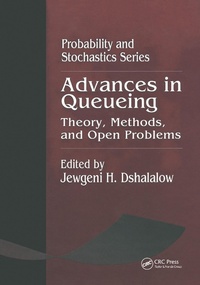
Advances in Queueing Theory, Methods, and Open Problems
1st Edition
Published on 21. July 2023
528 pages
978-1-000-94329-0 (ISBN)
Description

The progress of science and technology has placed Queueing Theory among the most popular disciplines in applied mathematics, operations research, and engineering. Although queueing has been on the scientific market since the beginning of this century, it is still rapidly expanding by capturing new areas in technology. Advances in Queueing provides a comprehensive overview of problems in this enormous area of science and focuses on the most significant methods recently developed.
Written by a team of 24 eminent scientists, the book examines stochastic, analytic, and generic methods such as approximations, estimates and bounds, and simulation. The first chapter presents an overview of classical queueing methods from the birth of queues to the seventies. It also contains the most comprehensive bibliography of books on queueing and telecommunications to date. Each of the following chapters surveys recent methods applied to classes of queueing systems and networks followed by a discussion of open problems and future research directions.
Advances in Queueing is a practical reference that allows the reader quick access to the latest methods.
Written by a team of 24 eminent scientists, the book examines stochastic, analytic, and generic methods such as approximations, estimates and bounds, and simulation. The first chapter presents an overview of classical queueing methods from the birth of queues to the seventies. It also contains the most comprehensive bibliography of books on queueing and telecommunications to date. Each of the following chapters surveys recent methods applied to classes of queueing systems and networks followed by a discussion of open problems and future research directions.
Advances in Queueing is a practical reference that allows the reader quick access to the latest methods.
Reviews / Votes
"The overall editing and production are excellent...There are many books on queueing theory, but I could find no other book that is directly comparable to this one...these authors are all major contributors to queueing theory, and their contributions all reflect the current state of the art. In conclusion, Advances in Queueing would be a welcome addition to the bookshelf of anyone with a scholarly interest in queueing theory."- Computing Reviews, December 1998
More details
Series
Edition
1. Auflage
Language
English
Place of publication
London
United Kingdom
Publishing group
Taylor & Francis Ltd
Target group
Professional and scholarly
ISBN-13
978-1-000-94329-0 (9781000943290)
Copyright in bibliographic data and cover images is held by Nielsen Book Services Limited or by the publishers or by their respective licensors: all rights reserved.
Schweitzer Classification
Other editions
Additional editions
Jewgeni H. Dshalalow
Advances in Queueing Theory, Methods, and Open Problems
Book
12/2019
1st Edition
CRC Press
€81.70
Shipment within 15-20 days
Jewgeni H. Dshalalow
Advas in Queueing Models Methods & Problems
Book
09/1995
1st Edition
CRC Press
€382.60
Shipment within 15-20 days
Person
Dshalalow, Jewgeni H.
Content
1. An Anthology of Classical Queueing Methods Stochastic Methods 2. Queueing Methods in the Theory of Random Graphs 3. Stationary Distributions via First Passage Times 4. An Introduction to Spatial Queues 5. Sample-Path Techniques in Queueing Theory 6. Markov-Additive Processes of Arrivals 7. The ASTA Property 8. Campbell's Formula and Applications to Queueing 9. Excess Level Processes in Queueing Analytic Methods 10. Matrix-Analytic Methods in the Theory of Queues 11. Explicit Wiener-Hopf Factorization for the Analysis of Multi-Dimensional Queues 12. Applications of Singular Perturbation Methods in Queueing 13. The Spectral Expansion Solution Method for Markov Processes on Lattice Strips 14. Applications of Vector Riemann Boundary Value Problems to Analysis of Queueing Systems Approximation, Estimates, and Simulation of Queues 15. Light-Traffic Approximation in Queues and Related Stochastic Models 16. Quantitative Estimates in Queueing 17. Steady State Rare Events Simulation in Queueing Models and Its Complexity Properties 18. Piecewise-Linear Diffusion Processes 19. Approximations of Queues via Small Parameter Method
