

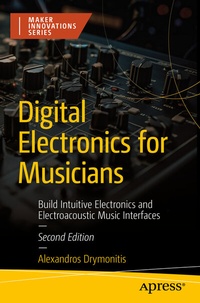
Digital Electronics for Musicians
Description

Alexandros Drymonitis is a sound and new media artist. He has a PhD from the Royal Birmingham Conservatoire, Birmingham City University, on the creation of musical works with Python. His previous studies were on the classical guitar at the Conservatorium van Amsterdam, where he got his first stimuli on music technology. Ever since, he has been making electronic music using opensource software and hardware, such as Pure Data, Arduino, and Python. He has also used Pure Data and Arduino to develop the modular synthesizer system 3dPdModular, and is currently doing postdoc research at the Cyprus University of Technology on instant synthesis for computer controlled acoustic instruments with live coding and AI.
More details
Other editions
Additional editions
Previous edition
Person
Alexandros Drymonitis is a sound and new media artist. He has a PhD from the Royal Birmingham Conservatoire, Birmingham City University, on the creation of musical works with Python. His previous studies were on the classical guitar at the Conservatorium van Amsterdam, where he got his first stimuli on music technology. Ever since, he has been making electronic music using opensource software and hardware, such as Pure Data, Arduino, and Python. He has also used Pure Data and Arduino to develop the modular synthesizer system 3dPdModular, and is currently doing postdoc research at the Cyprus University of Technology on instant synthesis for computer controlled acoustic instruments with live coding and AI.
Content
Chapter 1: Introduction to Pure Data.- Chapter 2: Introduction to Arduino.- Chapter 3: Embedded Computers.- Chapter 4: Going Wireless.- Chapter 5: Getting Started with Musical Applications.- Chapter 6: An Interactive Glove.- Chapter 7: An Interactive Drum Set.- Chapter 8: A DIY Theremin.- Chapter 9: Making a Looper.- Chapter 10: A Patch-Bay Matrix Synthesizer.- Chapter 10: Interactive Projects with AI.
