


Single-Session Therapy Informed by Client Factors and Cognitive Behaviour Therapy
Distinctive Features
3rd Edition
Will be published approx. on 19. October 2026
322 pages
E-Book
978-1-040-99870-0 (ISBN)
Description

In the third edition of this book, Windy Dryden outlines a way of practising single-session therapy that is primarily informed by client factors, followed by ideas stemming from CBT. Windy Dryden calls this way of working 'Single-Session Therapy: Informed by Client Factors and Cognitive Behaviour Therapy' (SST: ICF & CBT).
In this thoroughly updated new edition, more emphasis is placed on the single-session therapy mindset as a way of approaching the first session, which may also be the client's last. In keeping with the structure of books in the 'CBT: Distinctive Features' series, the book comprises 30 key points and is divided into two parts - Theory and Practice, which concisely cover the core features of SST: ICF & CBT.
This book offers essential guidance for students and practitioners who wish to provide help at the point of need and integrate client factors and CBT in doing so.
In this thoroughly updated new edition, more emphasis is placed on the single-session therapy mindset as a way of approaching the first session, which may also be the client's last. In keeping with the structure of books in the 'CBT: Distinctive Features' series, the book comprises 30 key points and is divided into two parts - Theory and Practice, which concisely cover the core features of SST: ICF & CBT.
This book offers essential guidance for students and practitioners who wish to provide help at the point of need and integrate client factors and CBT in doing so.
More details
Series
Edition
3rd edition
Language
English
Place of publication
London
United Kingdom
Publishing group
Taylor & Francis Ltd
Target group
Professional and scholarly
Illustrations
9 Tables, black and white; 2 Line drawings, black and white; 2 Illustrations, black and white
ISBN-13
978-1-040-99870-0 (9781040998700)
Copyright in bibliographic data is held by Nielsen Book Services Limited or its licensors: all rights reserved.
Schweitzer Classification
Other editions
Additional editions
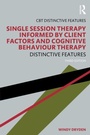
Windy Dryden
Single-Session Therapy Informed by Client Factors and Cognitive Behaviour Therapy
Distinctive Features
Book
approx. 10/2026
3rd Edition
Routledge
€43.50
Not yet published
Windy Dryden
Single-Session Therapy Informed by Client Factors and Cognitive Behaviour Therapy
Distinctive Features
Book
approx. 10/2026
3rd Edition
Routledge
€185.50
Not yet published
Person
Windy Dryden, PhD, is Emeritus Professor of Psychotherapeutic Studies at Goldsmiths, University of London. He is an international authority on Rational Emotive Behaviour Therapy and Single-Session Therapy and is in part-time clinical and consultative practice. He has worked in psychotherapy for more than 50 years and is the author and editor of over 300 books.
Content
Introduction
THEORY
1. Single-Session Therapy Informed by Client Factors and CBT (SST: ICF & CBT): What it is and some basic assumptions
2. The single-session mindset in SST: ICF & CBT
3. Working alliance theory: A generic framework for SST: ICF & CBT
4. Human beings have the capability to help themselves quickly under specific circumstances
5. It is important to privilege clients' viewpoints in SST: ICF & CBT - [ICF Focus]
6. It is important to draw upon a range of client variables in SST: ICF & CBT - [ICF Focus]
7. Dealing with the suitability issue
8. A focus on problems, goals and solutions is important in SST: ICF & CBT
9. People largely create and maintain their problems by a range of cognitive-behavioural factors - [CBT Focus]
10. As far as possible, clients should be helped to deal healthily with the adversity involved in their problem, whether real or inferred - [CBT Focus]
11. Carry out a full assessment of the client's nominated problem drawing on case formulation principles [CBT Focus]
12. In SST: ICF & CBT, it is possible to help clients identify and deal with a central mechanism responsible for the existence of their problems
13. The client's subsequent responses to their first reaction are often more important than the first reaction itself
14. Helpful client characteristics for SST: ICF & CBT
15. Helpful therapist characteristics for SST: ICF & CBT
PRACTICE
16. Good practice in SST: ICF & CBT
17. An overview of the SST: ICF & CBT
18. The first contact
19. Pre-session preparation
20. The session: 1. Beginning well
21. The session: 2. Creating a focus
22. The session: 3. Understanding the nominated problem
23. The session: 4. Setting a goal
24. The session: 5. Identifying the central mechanism
25. The session: 6. Dealing with the central mechanism and finding a solution
26. The session: 7. Making an impact
27. The session: 8. Encouraging your client to rehearse the solution in the session and develop an action plan
28. The session: 9. Ending well
29. After the session
30. The follow-up session
THEORY
1. Single-Session Therapy Informed by Client Factors and CBT (SST: ICF & CBT): What it is and some basic assumptions
2. The single-session mindset in SST: ICF & CBT
3. Working alliance theory: A generic framework for SST: ICF & CBT
4. Human beings have the capability to help themselves quickly under specific circumstances
5. It is important to privilege clients' viewpoints in SST: ICF & CBT - [ICF Focus]
6. It is important to draw upon a range of client variables in SST: ICF & CBT - [ICF Focus]
7. Dealing with the suitability issue
8. A focus on problems, goals and solutions is important in SST: ICF & CBT
9. People largely create and maintain their problems by a range of cognitive-behavioural factors - [CBT Focus]
10. As far as possible, clients should be helped to deal healthily with the adversity involved in their problem, whether real or inferred - [CBT Focus]
11. Carry out a full assessment of the client's nominated problem drawing on case formulation principles [CBT Focus]
12. In SST: ICF & CBT, it is possible to help clients identify and deal with a central mechanism responsible for the existence of their problems
13. The client's subsequent responses to their first reaction are often more important than the first reaction itself
14. Helpful client characteristics for SST: ICF & CBT
15. Helpful therapist characteristics for SST: ICF & CBT
PRACTICE
16. Good practice in SST: ICF & CBT
17. An overview of the SST: ICF & CBT
18. The first contact
19. Pre-session preparation
20. The session: 1. Beginning well
21. The session: 2. Creating a focus
22. The session: 3. Understanding the nominated problem
23. The session: 4. Setting a goal
24. The session: 5. Identifying the central mechanism
25. The session: 6. Dealing with the central mechanism and finding a solution
26. The session: 7. Making an impact
27. The session: 8. Encouraging your client to rehearse the solution in the session and develop an action plan
28. The session: 9. Ending well
29. After the session
30. The follow-up session
