

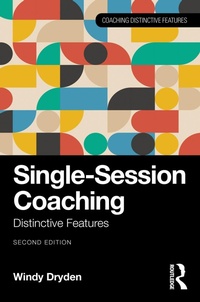
Single-Session Coaching
Distinctive Features
2nd Edition
Published on 27. May 2026
148 pages
978-1-040-82807-6 (ISBN)
Description

In this revised edition of Single-Session Coaching: Distinctive Features, Windy Dryden presents a clear and accessible overview of the theory and practice of Single-Session Coaching (SSC).
Presented in the highly accessible Distinctive Features format, Windy Dryden explores how these approaches allow coaches and clients to tackle problems and find solutions quickly and flexibly. The book is divided into two parts covering the theory and practice of SSC. The chapters clearly examine key topics, including the foundations of SSC, what makes a good SSC coach and coachee, common misconceptions, preparing for and structuring a session and considering significant coachee variables. It explains key terminology, such as the difference between problem-focused and development-focused SSC, and portrays these differences in useful case studies to show the benefits of each for individual clients. Finally, it concludes with details on following up with the coachee, including key questions to ask. With case studies throughout, this approach can be applied in various clinical settings, such as primary care, and non-clinical settings, such as voluntary sectors and is ideal for time-limited scenarios in comparison to other, more time-consuming, coaching methods.
This will be an invaluable tool for coaches in practice and in training, as well as for academics and students of coaching.
Presented in the highly accessible Distinctive Features format, Windy Dryden explores how these approaches allow coaches and clients to tackle problems and find solutions quickly and flexibly. The book is divided into two parts covering the theory and practice of SSC. The chapters clearly examine key topics, including the foundations of SSC, what makes a good SSC coach and coachee, common misconceptions, preparing for and structuring a session and considering significant coachee variables. It explains key terminology, such as the difference between problem-focused and development-focused SSC, and portrays these differences in useful case studies to show the benefits of each for individual clients. Finally, it concludes with details on following up with the coachee, including key questions to ask. With case studies throughout, this approach can be applied in various clinical settings, such as primary care, and non-clinical settings, such as voluntary sectors and is ideal for time-limited scenarios in comparison to other, more time-consuming, coaching methods.
This will be an invaluable tool for coaches in practice and in training, as well as for academics and students of coaching.
More details
Series
Edition
2nd edition
Language
English
Place of publication
London
United Kingdom
Publishing group
Taylor & Francis Ltd
Target group
Professional and scholarly
Illustrations
1 Tables, black and white; 1 Line drawings, black and white; 1 Illustrations, black and white
File size
63,86 MB
ISBN-13
978-1-040-82807-6 (9781040828076)
Copyright in bibliographic data and cover images is held by Nielsen Book Services Limited or by the publishers or by their respective licensors: all rights reserved.
Schweitzer Classification
Other editions
Additional editions

Book
05/2026
2nd Edition
Routledge
€207.98
Shipment within 15-20 days
Book
05/2026
2nd Edition
Routledge
€43.50
Shipment within 15-20 days
Person
Windy Dryden is in clinical and consultative practice and is an international authority on cognitive behaviour therapy and single-session therapy and coaching. He is Emeritus Professor of Psychotherapeutic Studies at Goldsmiths, University of London. He has worked in psychotherapy for more than 50 years and is the author or editor of over 300 books.
Content
Part 1: Theory Chapter 1: Introducing Single-Session Coaching Chapter 2: What is Single-Session Coaching? Chapter 3: The Foundations of Single-Session Coaching Chapter 4: People Can Be Helped in One Session of Coaching Chapter 5: The Single Session Mindset and Mode of Delivery Chapter 6: Why Single-Session Coaching? Chapter 7: Development-Focused Single-Session Coaching Chapter 8: Problem-Focused Single-Session Coaching Chapter 9: The Working Alliance in Single-Session Coaching Chapter 10: What Makes a Good Single-Session Coach and Coachee? Chapter 11: Misconceptions of Single-Session Coaching Part 2: Practice Chapter 12: Good Practice in Single-Session Coaching (The 'Do's') Chapter 13: What Not to Do in Single-Session Coaching (The 'Don'ts') Chapter 14: Placing Single-Session Coaching in Context Chapter 15: Responding to the First Contact Chapter 16: Contracting for Single-Session Coaching Chapter 17: Structuring the Session Effectively Chapter 18: Preparing for the Session Chapter 19: Beginning the Session Chapter 20: Creating and Keeping to a Meaningful Focus in the Session Chapter 21: Agreeing on a Development-Based Process Objective or Problem-Based Process Goal Chapter 22: Identifying and Utilising Important Coachee Variables in the Session Chapter 23: Facilitating Change in Single-Session Coaching: General Factors Chapter 24: Facilitating Change in Development-Focused Single-Session Coaching Chapter 25: Facilitating Change in Problem-Focused Single-Session Coaching Chapter 26: Action Planning and Implementation in Development-Focused Single-Session Coaching Chapter 27: Rehearsing, Action Planning and Implementing the Solution in Problem-Focused Single-Session Coaching Chapter 28: Identifying and Dealing with Roadblocks Chapter 29: Summarising, Moving Forward and Tying-up Loose Ends Chapter 30: Following-up
