

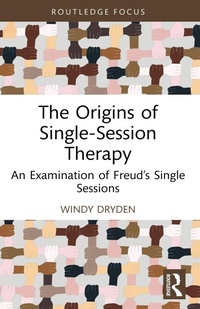
The Origins of Single-Session Therapy
An Examination of Freud's Single Sessions
Published on 6. February 2026
88 pages
978-1-040-84804-3 (ISBN)
Description

This book explores the single-session work done by Sigmund Freud and considers the implications of this work for the current theory and practice of single-session therapy (SST).
While contemporary interest in SST can be traced to Moshe Talmon's (1990) book, its origins go back to Freud. There are three cases in the literature where Freud can be said to practice single-session therapy (SST) and this is the first book that examines these cases in one place and without getting caught up in the intricacies of Freudian theory. Dryden first explores the three cases in which Freud conducted single-session work with patients. Particular attention is paid to the third patient, Margarethe Lutz, who discussed the session in an interview. This work is important because it is the only client-based view of Freud conducting therapy that lasted a single session. The book closely examines the work of Freud in these sessions and tracks how it impacts the development of Single-Session Therapy.
This book will be of interest to any single-session practitioners as well as those scholars and followers of Freud.
While contemporary interest in SST can be traced to Moshe Talmon's (1990) book, its origins go back to Freud. There are three cases in the literature where Freud can be said to practice single-session therapy (SST) and this is the first book that examines these cases in one place and without getting caught up in the intricacies of Freudian theory. Dryden first explores the three cases in which Freud conducted single-session work with patients. Particular attention is paid to the third patient, Margarethe Lutz, who discussed the session in an interview. This work is important because it is the only client-based view of Freud conducting therapy that lasted a single session. The book closely examines the work of Freud in these sessions and tracks how it impacts the development of Single-Session Therapy.
This book will be of interest to any single-session practitioners as well as those scholars and followers of Freud.
More details
Series
Language
English
Place of publication
London
United Kingdom
Publishing group
Taylor & Francis Ltd
Target group
College/higher education
Professional and scholarly
File size
36,65 MB
ISBN-13
978-1-040-84804-3 (9781040848043)
Copyright in bibliographic data and cover images is held by Nielsen Book Services Limited or by the publishers or by their respective licensors: all rights reserved.
Schweitzer Classification
Other editions
Additional editions
Book
approx. 02/2026
1st Edition
Routledge
€78.20
Not yet published
Person
Windy Dryden is in part-time clinical and consultative practice and is an international authority on rational emotive behaviour therapy (REBT) and single-session therapy (SST). He has worked in psychotherapy for more than 50 years and is the author and editor of over 290 books.
Content
1. What is Single-Session Therapy 2. Freud and Aurelia Kronich 3. Freud and Gustav Mahler 4. Freud and Margarethe Lutz 5. The Importance of Mindset in Modern Single-Session Therapy: How Did Freud Fare? 6. Final Reflections References
