

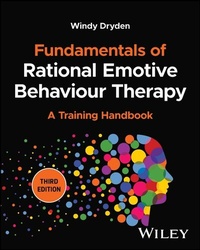
Fundamentals of Rational Emotive Behaviour Therapy
Description

Understand the basics of the essential approach to cognitive-behavioural psychotherapy
Rational Emotive Behaviour Therapy (REBT) is a cognitive-behavioural approach to psychotherapy in which patients are taught to identify and reject irrational and damaging thought patterns and emotional responses. By emphasizing patients' control over their mental and emotional lives, it cultivates honest self-assessment and healthy emotional responses. Since its development in the 1950s, it has stood as one of the most widely used and successful forms of cognitive- behavioural therapy.
Fundamentals of Rational Emotive Behaviour Therapy looks to cultivate a robust foundational understanding of this essential mode of treatment. Seeking to replicate the conditions and learning patterns of an introductory seminar, it emphasizes concrete clinical applications and a continuous connection between theory and practice. The third edition of this pathbreaking guide offers expanded coverage and fully up-to-date research.
Readers of the third edition of Fundamentals of Rational Emotive Behaviour Therapy will also find:
* Detailed treatment of subjects including meta-emotional problem assessment, client misconceptions, and more
* Appendices including a homework skills monitoring form, training in REBT, and more
* An author with decades of experience in REBT and related forms of cognitive- behavioural therapy
Fundamentals of Rational Emotive Behaviour Therapy is ideal for students and researchers looking to develop a working understanding of REBT.
More details
Other editions
Additional editions
Person
Windy Dryden, PhD, is Emeritus Professor of Psychotherapeutic Studies, Goldsmiths, University of London, UK. He was the first Briton to be accredited as an REBT therapist by the Albert Ellis Institute and is a Fellow of the British Psychological Society, the British Association for Counselling and Psychotherapy, and the Albert Ellis Institute. He has authored or edited over 260 books on REBT and the broader field of psychotherapy and counselling.
Content
About the author vii
Introduction ix
1 What you need to know about the theory of REBT to get started 1
2 What you need to know about the practice of REBT to get started 23
3 Teaching the ABCs of REBT 39
4 Distinguishing between healthy and unhealthy negative emotions 53
5 Being specific in the assessment process 71
6 Assessing C 75
7 Assessing A 83
8 Assessing B 87
9 Assessing meta-emotional problems 95
10 Goal-setting 101
11 Eliciting your client's commitment to change 113
12 Preparing your client and yourself to examine their attitudes 123
13 Helping your clients to examine their attitudes 127
14 Helping your clients to strengthen their conviction in their flexible/non-extreme attitudes 141
15 Negotiating homework assignments 153
16 Reviewing homework assignments 173
17 Dealing with your clients' misconceptions of REBT theory and practice 183
18 Using REBT in a single-session therapy format 193
19 An example of an REBT-based single session 207
Appendix I: Homework skills monitoring form 219
Appendix II: Possible reasons for not completing self-help assignments 223
Appendix III: Training in REBT 225
References 227
Index 229
Introduction
Having given numerous introductory training courses in rational emotive behaviour therapy (REBT) in Britain and throughout the world, it seemed to me a number of years ago that it would be valuable to write a training handbook on the fundamentals of REBT in which an attempt is made to recreate the atmosphere of these training courses. In particular, because REBT is a simple approach that is difficult to practise well, I wanted to alert trainees to areas of difficulty that they are likely to experience while attempting to use the approach and show them how they can deal constructively with the problems that they will doubtless encounter along the way.
To do this, I have used constructed verbatim transcript material between trainees and myself as trainer. What this means is that to highlight trainee difficulty and trainer response, I have constructed dialogues that approximate those that have occurred between myself and trainees over the years. None of these dialogues has actually taken place, however. As I do not record my training sessions, I do not have access to actual trainer-trainee dialogues that have occurred. Nevertheless, the constructed dialogues illustrate the typical errors that trainees make in the practice of REBT. In addition, I will make extensive use of constructed dialogue between myself as therapist and my clients.
Please note that on introductory training programmes in REBT, peer counselling is used extensively as a training vehicle. This means that trainees form a pair and take turns counselling one another on real emotional problems and concerns using REBT. In my experience this is a far more effective way of learning how to use REBT and what it feels like to be an REBT client than the use of role-play. To preserve confidentiality, any dialogue that appears in this book between trainees in peer counselling has also been constructed. However, these dialogues are typical of the emotional problems that are raised in this part of the course by trainees in the client role. The performance of REBT trainees in these interchanges approximates the level of skill beginning trainees tend to demonstrate on introductory training courses.
It is important to stress that no book on REBT, however practical, can be a substitute for proper training and supervision in the approach. Thus, this book is best used as an adjunct to these educational activities. I have provided information on where to get training and supervision in REBT in Appendix III, should you be interested in pursuing your interest in this therapeutic approach. Indeed, I hope that this handbook might encourage you to attend initial and more advanced training courses in REBT so that you can learn for yourself what it has to offer you and your clients.
As I said earlier, this training handbook deals with the fundamentals of REBT practice. As such, I have omitted issues of greater complexity, which may distract you from learning the basics. Let me briefly summarise what I will cover in this volume. In the first two chapters, I outline the basic theoretical and practical information that you need to begin to practise REBT. In the third chapter, I present material on how to teach your clients the ABCs of REBT, while in the fourth chapter, I deal with the important issue of helping your clients to distinguish between healthy and unhealthy negative emotions. In Chapter 5, I stress that when you come to assess your clients' problems, at the outset it is important to be specific. In Chapters 6, 7 and 8, I show you how to assess C, A and rigid and extreme basic attitudes at B (previously known as irrational beliefs) respectively. Then, in Chapter 9, I discuss how you can assess your clients' meta-emotional problems and when to work with them in therapy. In Chapter 10, I go on to deal with the important issue of helping your clients to set goals, while in Chapter 11, I show you how to build on goal-setting by encouraging your clients to make a commitment to change. At the heart of REBT is the key task of helping clients to examine their rigid and extreme attitudes, and I devote the next three chapters (Chapters 12-14) to this task. In the next two chapters, I discuss how to negotiate homework assignments with your clients (Chapter 15) and how to review them (Chapter 16). In Chapter 17, I discuss how you can deal with your clients' misconceptions of REBT theory and practice. In Chapters 18 and 19, I discuss how REBT can inform the practice of single-session therapy given the fact that the modal number of therapy sessions clients have is '1'.
Throughout this book I will address you directly as if you are on one of my training courses. Please note that I will use they/them when referring to the gender of the client.
A guide to terminology
The terminology that I have used in this book to describe salient aspects of REBT theory is a significant departure from the traditional ways that these concepts are described in the REBT literature and I will explain the changes that I have made to traditional REBT language and why I have made them.
In Chapter 1 of this book, I will outline REBT's ABC framework. Traditionally, A has stood for 'activating event', B for 'beliefs' and C for the 'consequences' of B. This framework outlines the REBT view of psychological disturbance and health.
From activating event to adversity
In my view, the term 'activating event' is problematic because it is not clear what the event activates. REBT theory states that it should activate B, but some people consider that it activates C. Also, the term 'activating event' can be taken to mean the event itself or the aspect of the event that the person is most disturbed about. REBT states that it should be the latter, but some people consider it to be the former. In this book, I will generally use the term 'adversity' to represent the aspect of the situation about which the person is most disturbed, which is what the A in the ABC framework represents. So, the adversity activates B that accounts for C.
From beliefs to attitudes
Traditionally in REBT B has stood for 'beliefs', which can either be 'irrational' or 'rational'. I have always been unhappy with these terms and decided formally to change them several years ago (Dryden, 2016).
A few years before I took the above decisions, I carried out research on how REBT's ABC framework is understood by different professional and lay groups.1 This research revealed a range of confusions and errors made by these groups about each element in the framework (Dryden, 2013a), but particularly about B. For example, the term 'belief' was often used to describe adversities at A rather than evaluations at B (e.g., 'I believe that you don't like me'). I concluded that such confusions and errors about B could be rectified by using the term 'attitude' rather than 'belief' since the term 'belief' is often used by people in a way that is very different from the way it is used in REBT.
Thus, the term 'belief' has been defined by the Oxford Dictionary of Psychology, fourth edition (Colman, 2015) as 'any proposition that is accepted as true on the basis of inconclusive evidence'. Thus, as we have seen, a client may say something like: 'I believe my boss criticised me', and while they think that they have articulated a belief, this is not actually a 'belief' as the term has been used in REBT, but rather an inference. It is very important to distinguish between an inference at A and an attitude (or belief in the REBT sense) at B, and anything that helps this distinction to be made routinely is to be welcomed. Using the term 'attitude' rather than 'belief' in REBT is one way of doing so.
Definitions of the term 'attitude' are closer to the meaning that REBT theorists ascribe to the term 'belief'. Here are three such definitions of the term 'attitude':
- 'an enduring pattern of evaluative responses towards a person, object, or issue' (Colman, 2015);
- 'a relatively enduring organization of beliefs, feelings, and behavioral tendencies towards socially significant objects, groups, events or symbols' (Hogg & Vaughan, 2005, p. 150);
- 'a psychological tendency that is expressed by evaluating a particular entity with some degree of favor or disfavor' (Eagly & Chaiken, 1993, p. 1).
Before deciding to change the term 'belief' to the term 'attitude' in my writings and clinical work, I used the term 'attitude' rather than 'belief' with my clients and found that it was easier for me to convey the meaning of B when I used 'attitude' than when I used 'belief', and they, in general, found 'attitude' easier to understand in this context than 'belief'.
Consequently, I decided to use the term 'attitude'2 instead of the term 'belief' to denote an evaluative stance taken by a person towards an adversity at A which has emotional,...
