

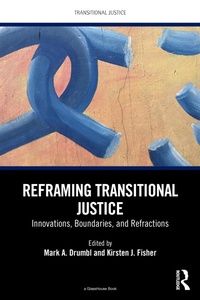
Reframing Transitional Justice
Innovations, Boundaries, and Refractions
1st Edition
Will be published approx. on 17. June 2026
360 pages
978-1-040-64241-2 (ISBN)
Description

This book challenges the simplicity, predestination, and self-evident nature of the contemporary narratives of transitional justice.
Transitional justice is the field of study that examines how states should reckon with massive human rights abuses. The book upends these assumptive narratives on three crucial fronts. The first front is that of innovations. Here, the book questions the ability of transitional justice to deliver tangible successes in an era of rapid and overwhelming technological change and contestation over what constitutes human memory, communicative dialogue, and reliable evidence. The second front involves boundaries. And here the book confronts the professed superpower of transitional justice to do more and more, in an endless concatenation of additives. While there is cause for optimism, this book also suggests that transitional justice remains awkward in how it copes with the existential pressures of environmental, health, and cultural crises. On its third front, refractions, this book identifies how transitional justice addresses racism, misogyny, and democratic backsliding, showing how the prism of transitional justice interventions refracts these scourges remains inadequate. Throughout, the book asks readers to imagine where the field and practice of transitional justice could go from here - what new innovations are required, what boundaries must be stretched or retrenched, and what perspectives need to be considered due to new ways of seeing current and past atrocities.
Accordingly, this book will be of considerable interest to academics, practitioners working on post-conflict reconstruction, and students at all levels ranging from undergraduate to post-doctoral studies in the areas of law, politics, cultural property, criminology, human rights, international relations, and technology studies.
Transitional justice is the field of study that examines how states should reckon with massive human rights abuses. The book upends these assumptive narratives on three crucial fronts. The first front is that of innovations. Here, the book questions the ability of transitional justice to deliver tangible successes in an era of rapid and overwhelming technological change and contestation over what constitutes human memory, communicative dialogue, and reliable evidence. The second front involves boundaries. And here the book confronts the professed superpower of transitional justice to do more and more, in an endless concatenation of additives. While there is cause for optimism, this book also suggests that transitional justice remains awkward in how it copes with the existential pressures of environmental, health, and cultural crises. On its third front, refractions, this book identifies how transitional justice addresses racism, misogyny, and democratic backsliding, showing how the prism of transitional justice interventions refracts these scourges remains inadequate. Throughout, the book asks readers to imagine where the field and practice of transitional justice could go from here - what new innovations are required, what boundaries must be stretched or retrenched, and what perspectives need to be considered due to new ways of seeing current and past atrocities.
Accordingly, this book will be of considerable interest to academics, practitioners working on post-conflict reconstruction, and students at all levels ranging from undergraduate to post-doctoral studies in the areas of law, politics, cultural property, criminology, human rights, international relations, and technology studies.
Reviews / Votes
This provocative and timely volume productively confronts the transitional justice paradigm with trenchant reappraisal in light of emerging digital technologies, structural violence, and theories of justice from the periphery. It asks us to rethink how, when, as well as by and for whom is transitional justice made accessible.Laurel Fletcher, Chancellor's Clinical Professor of Law, University of California, Berkeley (USA)
Reframing Transitional Justice is an interdisciplinary collection, covering multiple cases, that gives transitional justice exactly what it needs - a good shake. This shake-up questions transitional justice as a field and set of tools that have come of age, become too formulaic and too aligned to the status quo, while suggesting alternative futures. Critique is balanced with proposition. The result is a wonderful set of provocations to us all, and one that I recommend to all those seeking to shape a creative, responsive, and questioning transitional justice.
Professor Paul Gready, Director, Centre for Applied Human Rights, University of York (UK)
More details
Series
Edition
1. Auflage
Language
English
Place of publication
London
United Kingdom
Publishing group
Taylor & Francis Ltd
Target group
College/higher education
Product notice
Reflowable
Illustrations
2 Tables, black and white; 1 Line drawings, black and white; 24 Halftones, black and white; 25 Illustrations, black and white
File size
4,42 MB
ISBN-13
978-1-040-64241-2 (9781040642412)
Copyright in bibliographic data and cover images is held by Nielsen Book Services Limited or by the publishers or by their respective licensors: all rights reserved.
Schweitzer Classification
Other editions
Additional editions
Mark A. Drumbl | Kirsten J. Fisher
Reframing Transitional Justice
Innovations, Boundaries, and Refractions
Book
04/2026
1st Edition
Routledge
€68.80
Shipment within 15-20 days
Mark A. Drumbl | Kirsten J. Fisher
Reframing Transitional Justice
Innovations, Boundaries, and Refractions
Book
04/2026
1st Edition
Routledge
€193.50
Shipment within 15-20 days
Persons
Mark A. Drumbl is the Class of 1975 Alumni Professor and Director, Transnational Law Institute, at Washington and Lee University. He has held visiting appointments and has taught at law schools world-wide, including Queen's University Belfast, Oxford University (University College), Universite de Paris II (Pantheon-Assas), Free University of Amsterdam, University of Melbourne, Masaryk University (Czechia), and John Cabot University in Rome. His work has been relied upon by national and international courts; he has served as defense lawyer in Rwandan genocide trials; co-authored an amicus brief to the International Criminal Court in the Ongwen case; and has been an expert in litigation including on international terrorism, with the UN in matters involving child soldiers, and with the UN Human Rights Council in the drafting of a global convention to criminalize racist hate speech. He is editor-in-chief of the International Criminal Law Review.
Kirsten J. Fisher is Associate Professor of Political Studies at the University of Saskatchewan. She has held visiting and research positions at McGill University, the University of Helsinki, the University of Ottawa, and KU Leuven. She works on issues of post-atrocity justice, theories of international criminal law, and post-conflict social reconstruction. Much of her work is grounded in field research in northern Uganda.
Kirsten J. Fisher is Associate Professor of Political Studies at the University of Saskatchewan. She has held visiting and research positions at McGill University, the University of Helsinki, the University of Ottawa, and KU Leuven. She works on issues of post-atrocity justice, theories of international criminal law, and post-conflict social reconstruction. Much of her work is grounded in field research in northern Uganda.
Content
1. Introduction 2. Transitional Justice, Memorialization, and Artificial Intelligence 3. Algorithms, Reparations, Repetitions: How Digital Platforms Erode the Aims of Transitional Justice 4. Algorithmic Justice: Digital Investigations and Transitional Justice 5. Bridging Justice and Technology: Exploring the Integration of Informational and Communication Technologies in Colombia's Transitional Justice Process 6. Memory Workshops in Colombia: Co-creative and Inclusive Community Memory Building 7. Animals, War, and Multispecies Transitional Justice 8. Transitional Justice, Temporalities, and the Restitution of Cultural Objects 9. Nonchalance and the Fascist Gaze 10. Escaping Genocide's Gravity 11. Abolishing the Family Policing System as Transitional and Racial Justice 12. Liberian Peace Huts as Archetypes of Neotraditional Practices Advancing Gender Justice in Transitional Societies 13. Justice in Transition? The Challenge of Feminist Politics for Transitional Justice 14.Beyond Democracy: Alternative Transitions in an Age of Democratic Backsliding 15. Epilogue
