

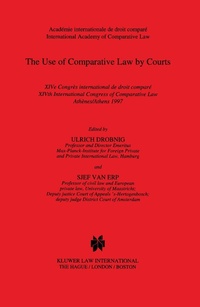
The Use of Comparative Law by Courts
Published on 1. October 1998
352 pages
978-90-411-7035-4 (ISBN)
Description

This new volume contains fourteen national reports and a General Report on the use of comparative law by courts, which were presented at the XIVth International Congress of Comparative Law in Athens. It provides a general survey of the frequency and methods of a comparative recourse to foreign law by courts, describing both the methods of such recourse and the typical fields in which it is undertaken.
The reports offer an interesting cross-section of contemporary court practice from a wide variety of countries around the world - large and small, unitary and federal, and with differing historical backgrounds. All demonstrate the needs of national courts to look to foreign law for inspiration or as a model for dealing with new, unsettled issues of national law, and the reports illustrate well the impact of divergent traditions, attitudes and surrounding circumstances.
Of special interest are both the role of comparative law and the comparative method employed in the practice of a supranational court, such as the European Court of Justice.
In addition to the General Report, this volume contains national reports from the following countries: Canada, European Union, France, Germany, Greece, Iceland, Israel, Japan, Luxembourg, The Netherlands, United Kingdom and United States of America.
The reports offer an interesting cross-section of contemporary court practice from a wide variety of countries around the world - large and small, unitary and federal, and with differing historical backgrounds. All demonstrate the needs of national courts to look to foreign law for inspiration or as a model for dealing with new, unsettled issues of national law, and the reports illustrate well the impact of divergent traditions, attitudes and surrounding circumstances.
Of special interest are both the role of comparative law and the comparative method employed in the practice of a supranational court, such as the European Court of Justice.
In addition to the General Report, this volume contains national reports from the following countries: Canada, European Union, France, Germany, Greece, Iceland, Israel, Japan, Luxembourg, The Netherlands, United Kingdom and United States of America.
More details
Other editions
Additional editions
Ulrich Drobnig
The Use of Comparative Law by Courts
Book
10/1998
1st Edition
Kluwer Law International
€116.10
Shipment within 10-20 days
Content
- Cover
- Title Page
- Copyright Page
- Table of Contents
- Preface
- PART I GENERAL REPORT
- The Use of Comparative Law by Courts
- I. INTRODUCTION
- II. NECESSARY AND VOLUNTARY RECOURSES TO FOREIGN LAW
- A. Necessary Comparison
- i. General Principles of Law
- ii. Examples from the conflict of laws
- B. Legal Rules with an International Element
- i. Uniform international rules
- ii. European Community Law
- iii. Rules shared with other countries
- iv. Maritime and air law
- v. Conflict of laws
- vi. Extradition
- C. Legal Rules of a Purely Domestic Character
- III. METHODS OF JUDICIAL COMPARISON
- i. Contents or effect offoreign rules
- ii. Weight of comparative arguments
- iii. Countries chosen for comparison
- iv. Sources of information
- IV. JUSTIFICATIONS FOR THE USE OF FOREIGN LAW
- V. WHY THE DIFFERENCES?
- PART II NATIONAL REPORTS
- The Use of Comparative Law by Courts: Australian Courts at the Crossroads
- The Use of Comparative Law by Common Law Courts in Canada
- Droit comparé et unification du droit L'utilisation du droit comparé par les tribunaux - Rapport canadien
- L'utilisation de la Methode Comparative par la Cour de Justice des Communautes Europeennes
- L'utilisation du droit comparé par les tribunaux - Rapport français
- The Use of Foreign Law by German Courts
- L'utilisation du droit comparé par les tribunaux helleniques
- Application of a Comparative Method by Icelandic Courts
- The Use of Comparative Law by Israeli Courts
- The Use of Foreign Law by Courts in Japan
- Le recours, par les juridictions luxembourgeoises, aux techniques de droit comparé dans l' interprétation et l' application du droit luxembourgeois
- The Use of the Comparative Law Method by the Judiciary - Dutch National Report
- Comparative Law in British Courts
- The Use of Comparative Law by American Courts
- The Use of Comparative Law by Courts
- Index
- Back Cover
