

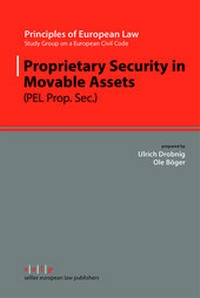
Proprietary Security in Movable Assets
Principles of European Law
Published on 15. December 2014
990 pages
978-3-86653-910-5 (ISBN)
Description

The Study Group on a European Civil Code has taken upon itself the task of drafting common European principles for the most important aspects of the law of obligations and for certain parts of the law of property in movables which are especially relevant for the functioning of the common market.
Like the Commission on European Contract Law's "Principles of European Contract Law", the results of the research conducted by the Study Group on a European Civil Code seek to advance the process of Europeanisation of private law. Among other topics the series tackles sales and service contracts, distribution contracts and security rights, renting contracts and loan agreements, negotiorum gestio, delicts and unjustified enrichment law, transfer of property, and trust law.
The principles furnish each of the national jurisdictions a grid reference. They could be agreed upon by the parties within the framework of the rules of private international law. They may provide a stimulus to both the national and European legislator for moulding private law. Beyond this, they aim to further discussion about the creation of a European Civil Code, or a Common Frame of Reference in the area of patrimonial law, by submitting a concrete model.
The "Principles of European Law" are published in co-operation with Oxford University Press (Great Britain) and Staempfli Publishers (Switzerland).
Like the Commission on European Contract Law's "Principles of European Contract Law", the results of the research conducted by the Study Group on a European Civil Code seek to advance the process of Europeanisation of private law. Among other topics the series tackles sales and service contracts, distribution contracts and security rights, renting contracts and loan agreements, negotiorum gestio, delicts and unjustified enrichment law, transfer of property, and trust law.
The principles furnish each of the national jurisdictions a grid reference. They could be agreed upon by the parties within the framework of the rules of private international law. They may provide a stimulus to both the national and European legislator for moulding private law. Beyond this, they aim to further discussion about the creation of a European Civil Code, or a Common Frame of Reference in the area of patrimonial law, by submitting a concrete model.
The "Principles of European Law" are published in co-operation with Oxford University Press (Great Britain) and Staempfli Publishers (Switzerland).
More details
Other editions
Additional editions
Book
12/2014
1st Edition
Sellier. European Law Publishers
from
€249.00
No shipping information available
Content
- Intro
- Principles of European Law on Proprietary Security in Movable Assets Introduction
- Chapter 1: General Rules
- Section 1: Scope
- Article IX. - 1:101: General rule
- Article IX. - 1:102: Security right in movable asset
- Article IX. - 1:103: Retention of ownership devices: scope
- Article IX. - 1:104: Retention of ownership devices: applicable rules
- Article IX. - 1:105: Exclusions
- Section 2: Definitions
- Article IX. - 1:201: Definitions
- Chapter 2: Creation and Coverage
- Section 1: Creation of security rights
- Subsection 1: General provisions
- Article IX. - 2:101: Methods of creation of security rights
- Article IX. - 2:102: Requirements for creation of security rights in general
- Article IX. - 2:103: Possessory and non-possessory security rights
- Article IX. - 2:104: Specific issues of transferability, existence and specification
- Subsection 2: Granting of security right
- Article IX. - 2:105: Requirements for granting of security right
- Article IX. - 2:106: Time when security right is created by granting
- Article IX. - 2:107: Granting of security right by consumer
- Article IX. - 2:108: Good faith acquisition of security right
- Article IX. - 2:109: Good faith acquisition of security right in encumbered corporeal asset
- Article IX. - 2:110: Delayed creation
- Article IX. - 2:111: Security right in cash, negotiable instruments and documents
- Article IX. - 2:112: General matters of property law
- Subsection 3: Retention of security right
- Article IX. - 2:113: Requirements for retention of security right
- Subsection 4: Right of retention of possession
- Article IX. - 2:114: Right of retention of possession
- Section 2: Creation of retention of ownership devices
- Article IX. - 2:201: Retention of ownership devices
- Section 3: Creation of security rights in specific types of assets
- Article IX. - 2:301: Encumbrance of right to payment of money
- Article IX. - 2:302: Security rights in shares of a company
- Article IX. - 2:303: Security rights in bonds
- Article IX. - 2:304: Negotiable documents of title and negotiable instruments
- Article IX. - 2:305: Security right in an accessory
- Article IX. - 2:306: Proceeds of the originally encumbered assets
- Article IX. - 2:307: Use of encumbered goods for production or combination
- Article IX. - 2:308: Use of goods subject to a retention of ownership device for production or combination
- Article IX. - 2:309: Commingling of assets subject to proprietary security
- Section 4: Coverage of security
- Article IX. - 2:401: Secured rights
- Chapter 3: Effectiveness as Against Third Persons
- Section 1: General rules
- Article IX. - 3:101: Effectiveness as against third persons
- Article IX. - 3:102: Methods of achieving effectiveness
- Article IX. - 3:103: Security right made effective by several methods
- Article IX. - 3:104: Change of method
- Article IX. - 3:105: Security right in an accessory to an immovable
- Article IX. - 3:106: Security right in commingled assets
- Article IX. - 3:107: Registration of acquisition finance devices
- Article IX. - 3:108: Importation of encumbered asset
- Section 2: Possession or control by creditor
- Article IX. - 3:201: Possession
- Article IX. - 3:202: Negotiable documents of title and negotiable instruments
- Article IX. - 3:203: Certificated shares and bonds
- Article IX. - 3:204: Control over financial assets
- Section 3: Registration
- Subsection 1: Operation of the register of proprietary security
- Article IX. - 3:301: European register of proprietary security
- other systems of registration or notation
- Article IX. - 3:302: Structure and operation of the register
- Article IX. - 3:303: Retention of ownership devices and security rights
- Article IX. - 3:304: Authentication as requirement for declarations to the register
- Subsection 2: Entries in the register
- Article IX. - 3:305: Entries to be made by secured creditor and advance filing
- Article IX. - 3:306: Minimum content of the entry in the register
- Article IX. - 3:307: Additional content of the entry
- Article IX. - 3:308: Information appearing on the register
- Article IX. - 3:309: Required consent of the security provider
- Article IX. - 3:310: Identity of security provider, description of encumbered assets and effectiveness of registration
- Article IX. - 3:311: Amendments of entries
- Article IX. - 3:312: Transitional provision in relation to entries in other systems of registration or notation under national law
- Article IX. - 3:313: Automated certification of entry to creditor and security provider
- Article IX. - 3:314: Third person acting as agent of the creditor
- Subsection 3: Protection of the security provider
- Article IX. - 3:315: Security provider's right to deletion or amendment of entry
- Article IX. - 3:316: Review of contested entries by registration office
- Subsection 4: Accessing and searching the register
- Article IX. - 3:317: Access to the register for searching purposes
- Article IX. - 3:318: Searching the register
- Subsection 5: Registered creditors' duty to answer requests for information
- Article IX. - 3:319: Duty to give information
- Article IX. - 3:320: Content of the information
- Article IX. - 3:321: Consequences of correct information given by secured creditor
- Article IX. - 3:322: Consequences of incorrect information given by secured creditor
- Article IX. - 3:323: Consequences of failure to give information
- Article IX. - 3:324: Form of requests and information
- Subsection 6: Duration, renewal and deletion of entries
- Article IX. - 3:325: Duration
- Article IX. - 3:326: Renewal
- Article IX. - 3:327: Deletion
- Subsection 7: Transfer of the security right or of the encumbered asset
- Article IX. - 3:328: Transfer of the security right: general rules
- Article IX. - 3:329: Transfer of the security right: declaration indicating the transfer
- Article IX. - 3:330: Transfer of the encumbered asset: general rules
- Article IX. - 3:331: Transfer of the encumbered asset: declaration of transfer
- Subsection 8: Costs
- Article IX. - 3:332: Distribution of costs
- Subsection 9: Security rights created before establishment of register
- Article IX. - 3:333: Security rights created before establishment of register
- Chapter 4: Priority
- Article IX. - 4:101: Priority: general rules
- Article IX. - 4:102: Superpriority
- Article IX. - 4:103: Continuation of priority
- Article IX. - 4:104: Fruits and proceeds: general rules
- Article IX. - 4:105: Fruits and proceeds: exceptions
- Article IX. - 4:106: Importation of encumbered asset
- Article IX. - 4:107: Priority of execution creditor
- Article IX. - 4:108: Change of ranking
- Chapter 5: Predefault Rules
- Section 1: General principles
- Article IX. - 5:101: General principles
- Section 2: Encumbered assets
- Article IX. - 5:201: Care and insurance of the encumbered assets
- Subsection 1: Security provider's rights and obligations
- Article IX. - 5:202: Rights in general
- Article IX. - 5:203: Use of encumbered industrial material
- Article IX. - 5:204: Dispositions of encumbered assets by traders and manufacturers
- Article IX. - 5:205: Unauthorised use or disposition
- Subsection 2: Secured creditor's rights and obligations
- Article IX. - 5:206: Limited right of use
- Article IX. - 5:207: Banks entitled to dispose of financial assets
- Article IX. - 5:208: Appropriation of civil fruits
- Section 3: Change of parties
- Article IX. - 5:301: Transfer of the secured right
- Article IX. - 5:302: Partial transfer of the secured right
- Article IX. - 5:303: Transfer of encumbered asset
- Section 4: Secured creditor's obligation to give information about secured right
- Article IX. - 5:401: Secured creditor's obligation to give information about secured right
- Chapter 6: Termination
- Article IX. - 6:101: Instances of termination of proprietary security
- Article IX. - 6:102: Loss of proprietary security due to good faith acquisition of ownership
- Article IX. - 6:103: Prescription of the secured right
- Article IX. - 6:104: Consequences of termination
- Article IX. - 6:105: Secured creditor liable to account for proceeds
- Article IX. - 6:106: Recourse of third party security provider
- Chapter 7: Default and Enforcement
- Section 1: General rules
- Article IX. - 7:101: Secured creditor's rights after default
- Article IX. - 7:102: Mandatory rules
- Article IX. - 7:103: Extra-judicial and judicial enforcement
- Article IX. - 7:104: Right to seek court assistance and damages
- Article IX. - 7:105: Predefault agreement on appropriation of encumbered assets
- Article IX. - 7:106: Security provider's right of redemption
- Article IX. - 7:107: Enforcement notice to consumer
- Article IX. - 7:108: Solidary liability of several security providers
- Article IX. - 7:109: Rights of recourse of third party security provider
- Section 2: Enforcement of security rights
- Subsection 1: Extra-judicial enforcement: rules preparatory to realisation
- Article IX. - 7:201: Creditor's right to possession of corporeal asset
- Article IX. - 7:202: Creditor's right to immobilise and to preserve encumbered asset
- Article IX. - 7:203: Intervention of court or other authority
- Article IX. - 7:204: Encumbrance of a right to payment
- Article IX. - 7:205: Negotiable instrument
- Article IX. - 7:206: Negotiable document of title
- Subsection 2: Extra-judicial enforcement: realisation of encumbered asset
- Article IX. - 7:207: General rule on realisation
- Article IX. - 7:208: Notice of extra-judicial disposition
- Article IX. - 7:209: Addressees of the notice
- Article IX. - 7:210: Time and contents of notice
- Article IX. - 7:211: Sale by public or private auction or by private sale
- Article IX. - 7:212: Commercially reasonable price
- Article IX. - 7:213: Buyer's rights in the assets after realisation by sale
- Article IX. - 7:214: Realisation of security in right to payment or in negotiable instrument
- Article IX. - 7:215: Distribution of proceeds
- Article IX. - 7:216: Appropriation of encumbered asset by secured creditor
- Subsection 3: Judicial enforcement
- Article IX. - 7:217: Applicable rules
- Section 3: Rules for retention of ownership devices
- Article IX. - 7:301: Consequences of default under retention of ownership devices
- Article IX. - 7:302: Possession, immobilisation and preservation
- Annexes
