

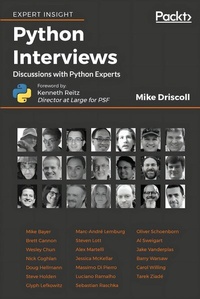
Python Interviews
Description

- Listen to their close thoughts on significant Python topics, such as Python's role in scientific computing, and machine learning
- Understand the direction of Python, and what needs to change for Python 4
Book DescriptionEach of these twenty Python Interviews can inspire and refresh your relationship with Python and the people who make Python what it is today. Let these interviews spark your own creativity, and discover how you also have the ability to make your mark on a thriving tech community. This book invites you to immerse in the Python landscape, and let these remarkable programmers show you how you too can connect and share with Python programmers around the world. Learn from their opinions, enjoy their stories, and use their tech tips. Brett Cannon - former director of the PSF, Python core developer, led the migration to Python 3. Steve Holden - tireless Python promoter and former chairman and director of the PSF. Carol Willing - former director of the PSF and Python core developer, Project Jupyter Steering Council member. Nick Coghlan - founding member of the PSF's Packaging Working Group and Python core developer. Jessica McKellar - former director of the PSF and Python activist. Marc-André Lemburg - Python core developer and founding member of the PSF. Glyph Lefkowitz - founder of Twisted and fellow of the PSF Doug Hellmann - fellow of the PSF, creator of the Python Module of the Week blog, Python community member since 1998. Massimo Di Pierro - fellow of the PSF, data scientist and the inventor of web2py. Alex Martelli - fellow of the PSF and co-author of Python in a Nutshell. Barry Warsaw - fellow of the PSF, Python core developer since 1995, and original member of PythonLabs. Tarek Ziadé - founder of Afpy and author of Expert Python Programming. Sebastian Raschka - data scientist and author of Python Machine Learning. Wesley Chun - fellow of the PSF and author of the Core Python Programming books. Steven Lott - Python blogger and author of Python for Secret Agents. Oliver Schoenborn - author of Pypubsub and wxPython mailing list contributor. Al Sweigart - bestselling author of Automate the Boring Stuff with Python and creator of the Python modules Pyperclip and PyAutoGUI. Luciano Ramalho - fellow of the PSF and the author of Fluent Python. Mike Bayer - fellow of the PSF, creator of open source libraries including SQLAlchemy. Jake Vanderplas - data scientist and author of Python Data Science Handbook.What you will learn - How successful programmers think
- The history of Python
- Insights into the minds of the Python core team
- Trends in Python programming
Who this book is forPython programmers and students interested in the way that Python is used - past and present - with useful anecdotes. It will also be of interest to those looking to gain insights from top programmers.
More details
Other editions
Additional editions
Person
Mike Driscoll has been programming in Python since 2006. He enjoys writing about Python in his blog, The Mouse Vs. The Python. He has coauthored the Core Python refcard for DZone. He has also worked as a technical reviewer for Python 3 Object Oriented Programming, Python 2.6 Graphics Cookbook, Tkinter GUI Application Development Hotshot, and several other books. Mike is the author of the following: Python 101 Python 201: Intermediate Python wxPython Recipes Python Interviews ReportLab: PDF Processing in Python (coming summer 2018
Content
- Steve Holden
- Carol Willing
- Glyph Lefkowitz
- Doug Hellmann
- Massimo Di Pierro
- Alex Martelli
- Marc-Andr
- Barry Warsaw
- Jessica McKellar
- Tarek Ziadé
- Sebastian Raschka
- Wesley Chun
- Steven Lott
- Oliver Schoenborn
- Al Sweigart
- Luciano Ramalho
- Nick Coghlan
- Mike Bayer
- Jake Vanderplas
Chapter 1. Brett Cannon
Brett Cannon is a Canadian software engineer and Python core developer. He is a principal software developer at Microsoft, where he works on editing tools. Previous roles include software engineer at Google and creator at Oplop. Brett became a fellow of the Python Software Foundation (PSF) in 2003 and served as a director of the PSF between 2013 and 2014. He is a former PyCon US committee member and was conference chair of PyData Seattle 2017. Brett led the migration of CPython to GitHub and created importlib. Among his open source achievements is caniusepython3 and he is the co-author of 17 successful Python Enhancement Proposals.
Discussion themes: core developers, v2.7/v3.x, Python sprints.
Catch up with Brett Cannon here: @brettsky
Mike Driscoll: Why did you become a computer programmer?
Brett Cannon: I always found computers interesting, as far back as I can remember. I was lucky enough to go to an elementary school with a computer lab full of Apple IIes, back when that was the cutting edge, so I was exposed to them relatively early on.
In the year between junior high and high school, I took a computer class over the summer and that included a little bit of Apple BASIC. I did it and I excelled at it, to the point that I think I finished the entire class in the first week. It hadn't really clicked that I could do that for a job at that point.
This continued through high school, and then when it came time to pick courses for junior college, my mom had me promise her two things. I agreed that I would take a course in philosophy and I would take a course in computer programming. So that's what I did and I loved both.
Once again, I read my introductory C book in the first two weeks, which was supposed to last for the whole semester. I remember the first time I finished it, I sat down and implemented tic-tac-toe one day after class. I even forgot to eat dinner! It was just one of those eureka moments. The feeling of boundless creativity that this tool provided just engulfed me. That's how I got into programming.
Brett Cannon: 'The feeling of boundless creativity that this tool provided just engulfed me. That's how I got into programming.'
I knew that tic-tac-toe was a solved problem, so I thought that I could actually write the logic so that I could play tic-tac-toe perfectly as a program. I spent something like six hours one evening doing it, and I was utterly blown away that I was actually able to do that. It opened up the possibilities of what computers could do, and the freedom of it and the ability to think about the problems just really grabbed me. I've been doing it ever since.
Driscoll: What led you to becoming so involved with Python and its community?
Cannon: Well, I ended up going to Berkeley and getting a degree in philosophy, but I kept taking computer science courses. The introductory computer science course at Berkeley had an entrance exam, and I was worried that I didn't know object-oriented programming, since I only knew C. So I looked around for an object-oriented programming language. I found Python, learned it, loved it, and kept writing personal programs in it.
At some point along the way, I needed time.strptime, the function to take a string that represents a datetime and parse it back into a time tuple. I was on Windows at the time, and time.strptime wasn't available on Windows. As a result, I came up with a way to parse it where you had to still plug in the locale information but it would still parse it.
Back then, ActiveState's cookbook site was still a thing, so I posted my recipe of how to do strptime up on ActiveState. Later, O'Reilly published the first edition of Python Cookbook, and Alex Martelli included that recipe as the last recipe in the book, which also happened to be the longest recipe in the book.
Brett Cannon: 'So I posted my recipe of how to do strptime up on ActiveState.'
It still ticked me off, though, that people had to input their locale information. I was frustrated that I couldn't solve that. So in the back of my mind, I was continuously thinking about how I could get that locale information out. Eventually, I solved it. It was actually the week after graduating from Berkeley, and I gifted myself the time to write up the solution, so that you didn't have to enter locale information anymore.
After I did that, I emailed Alex Martelli, since we'd exchanged emails a couple of times at that point, and I said, "Hey, I've fixed this so it's not necessary to input the locale anymore. How do I get this upstream?" Alex Martelli said, "Oh, well you just email this mailing list, Python-Dev, and you can submit the patch."
Brett Cannon: 'Alex Martelli said, "Oh, well you just email this mailing list, Python-Dev, and you can submit the patch."'
So, I emailed the list and I think Skip Montanaro was the first person to respond. Skip just said, "Yeah, that's great, just upload the file and we'll work at it and accept it." I thought that was awesome. I was able to contribute to this project and this language, which I thought was really interesting.
Brett Cannon: 'I was able to contribute to this project and this language, which I thought was really interesting.'
All of this happened during a gap year I was taking between undergraduate and graduate school. I was trying to get into graduate school for computer science and I knew that I was going to need some more programming experience, beyond the courses I was taking. I thought that I could contribute to Python and help out. I had all the time in the world back then, so I decided I'd get involved.
Brett Cannon: 'I decided I'd get involved.'
I got on the mailing list and I lurked around asking questions. Then in that same year, I offered to start taking up the Python-Dev summaries, which had stopped at that point. Once again, I figured I had the time to do it, and I realized it was a good way for me to learn, because it forced me to read every single solitary email in Python-Dev.
One interesting side effect was that I got to know about any small issues that nobody had time to take care of, so I saw anything that cropped up before almost anybody else. I was able to very easily pick up small issues to fix and learn, and I was able to continually do that.
In the guise of the Python-Dev summaries, I got to ask more and more questions.
At some point, I knew enough, and I became a core developer right after the first PyCon (at least the first conference labeled PyCon), in 2003. At that point I was hooked. I'd got to know the team and the people had become friends of mine. I just enjoyed it so much and it was fun, so I stuck with it and I've never really stopped for longer than a month since.
https://wiki.python.org/moin/GetInvolved
That doesn't mean that you have to be a core developer to get into the Python community. As long you enjoy it, you can get hooked however it makes sense to you.
Driscoll: What then made you decide to start blogging and writing about Python?
Cannon: Blogging is one of those ways to get involved and since I enjoy writing, that medium happened to fit the way that I like to communicate. I started doing it way back when, and I've more or less consistently done it ever since. I always enjoy that aspect of dispensing knowledge to the world as best as I can.
Driscoll: Was it important that you got into Python at just the right time? Do you recommend getting in early on projects?
Cannon: Yes, it was one of those situations where I was in the right place at the right time, and with the free time I needed to get going. I managed to start when I had enough time to contribute as much as I wanted.
I also got started when the Python project wasn't that big. I remember when I started my master's degree, people would ask what I did in my spare time. When I said I contributed to Python, they'd reply, "Is that the language with the white space?" So I've just been doing this for a long time.
So yes, I got involved in the project at an ideal point, before interest in the language surged around 2005. I sometimes wish that I'd been able to get started with it earlier somehow, but I'd have been younger, so that might not have worked. So it was serendipitous that it all just came together when it did.
Driscoll: What parts of Python have you actively contributed to? Is there a module that you helped start or you had a major influence on, such as the datetime module?
Cannon: My influence was actually the time module. I predate the datetime module! The first modules that I ever authored were the dummy_thread and dummy_threading modules that were in Python 2.
That was another one of those instances where someone came forward and recommended it as a cool thing to do. They said they'd get to it, but over time they didn't get to it, so I emailed...
