

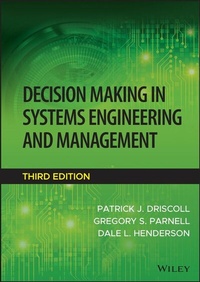
Decision Making in Systems Engineering and Management
Description

A thoroughly updated overview of systems engineering management and decision making
In the newly revised third edition of Decision Making in Systems Engineering and Management, the authors deliver a comprehensive and authoritative overview of the systems decision process, systems thinking, and qualitative and quantitative multi-criteria value modeling directly supporting decision making throughout the system lifecycle. This book offers readers major new updates that cover recently developed system modeling and analysis techniques and quantitative and qualitative approaches in the field, including effective techniques for addressing uncertainty. In addition to Excel, six new open-source software applications have been added to illustrate key topics, including SIPmath Modeler Tools, Cambridge Advanced Modeller, SystemiTool2.0, and Gephi 0.9.2.
The authors have reshaped the book's organization and presentation to better support educators engaged in remote learning. New appendices have been added to present extensions for a new realization analysis technique and getting started steps for each of the major software applications. Updated illustrative examples support modern system decision making skills and highlight applications in hardware, organizations, policy, logistic supply chains, and architecture.
Readers will also find:
* Thorough introductions to working with systems, the systems engineering perspective, and systems thinking
* In-depth presentations of applied systems thinking, including holism, element dependencies, expansive and contractive thinking, and concepts of structure, classification, and boundaries
* Comprehensive explorations of system representations leading to analysis
* In-depth discussions of supporting system decisions, including the system decision process (SDP), tradespace methods, multi-criteria value modeling, working with stakeholders, and the system environment
Perfect for undergraduate and graduate students studying systems engineering and systems engineering management, Decision Making in Systems Engineering and Management will also earn a place in the libraries of practicing system engineers and researchers with an interest in the topic.
More details
Other editions
Additional editions
Persons
Patrick J. Driscoll, PhD, is a Professor Emeritus of Operations Research and in the Department of Systems Engineering at the United States Military Academy. He was lead author and editor for the 3rd edition of Decision Making in Systems Engineering and Management. He has over 30 years' experience teaching systems engineering, mathematics, and operational topics and is the former USMA Transformation Chair, Deputy Department Head, and Program Director for Systems Engineering.
Gregory S. Parnell, PhD, is a Professor of Practice in the Department of Industrial Engineering at the University of Arkansas and Director, System Design and Analytics Laboratory (SyDL), and Director of the M.S. in Operations Management and M.S. In Engineering Management programs. He previously taught at the United States Military Academy, the U.S. Air Force Academy, the Virginia Commonwealth University, and the Air Force Institute of Technology.
Dale L. Henderson, PhD, is a Principal Research Scientist at Amazon and former Assistant Professor in the Department of Systems Engineering at the United States Military Academy.
Content
List of Figures xiii
List of Tables xxiii
1 Working with Systems 1
1.1 Introduction 1
1.2 The Systems Engineering Perspective 7
1.2.1 Systems Trends That Challenge System Engineers 8
1.2.2 Fundamental Tasks of Systems Engineers 12
1.2.3 Relationship of Systems Engineers to Other Engineering Disciplines 14
1.2.4 Education, Training, and Knowledge of Systems Engineers 15
1.3 Systems thinking 17
1.4 System life cycles 20
1.4.1 System life cycle model 23
1.5 Other major system life cycle models 29
1.6 Systems Decision Process (SDP) 34
1.7 Stakeholders and Vested Interests 39
References 47
2 Applied Systems Thinking 51
2.1 Holism Framing
Systems 51
2.1.1 Systems versus Analytic Thinking 54
2.1.2 Check on Learning 56
2.2 Element Dependencies 57
2.2.1 Check on Learning 58
2.3 Expansive and Contractive Thinking 59
2.3.1 Check on Learning 60
2.4 Structure 61
2.5 Classifying Systems 68
2.6 Boundaries 69
2.7 Visibility and Spatial Arrangement 72
2.7.1 Visibility 72
2.7.2 Spatial Arrangement 74
2.7.3 Check on Learning 76
2.8 Evolution and Dynamics 77
References 81
3 System Representations 83
3.1 Introduction 83
3.2 System Model Concepts 84
3.2.1 What Models Are 85
3.2.2 Role of Models in Solution Design 86
3.2.3 Qualities of useful models 87
3.2.4 Building System Models 89
3.2.5 Characteristics of models 95
3.2.6 Exercise the Model 96
3.2.7 Revise the model 97
3.3 Systemigrams 98
3.3.1 Systemigram Rules 99
3.4 Directional Dependency (D2) Diagrams 102
3.4.1 D2 diagrams into math representations 103
3.5 DSM and DMM Models 107
3.5.1 Dependency Structure Matrix (DSM) 108
3.5.2 System Adjacency Matrices 114
3.5.3 Check on Learning 120
3.5.4 Domain Mapping Matrix (DMM) 120
3.6 System Dynamics 122
3.7 IDEF0 Models 129
3.8 Simulation Modeling 138
3.8.1 Analytical Methods versus Simulation 138
3.8.2 Check on Learning 143
3.9 Determining Simulation Sample Size 143
References 147
4 The Systems Decision Process 151
4.1 Introduction 151
4.2 Value versus Alternative Focused Thinking 151
4.3 The SDP in Detail 154
4.3.1 The System Environment 156
4.3.2 When to Use the Systems Decision Process 159
4.3.3 Check on Learning 161
4.4 The Role of Stakeholders 164
References 169
5 Problem Definition 171
5.1 Purpose of the Problem Definition Phase 171
5.1.1 Comparison with Other Systems Engineering Processes 173
5.2 Research and "What is?" 174
5.2.1 Check on Learning 178
5.3 Stakeholder Analysis 179
5.3.1 Techniques for Stakeholder Analysis 181
5.3.2 At Completion FCR
Matrix 195
5.4 Requirements Analysis 197
5.4.1 Margins 201
5.5 Functional Analysis 204
5.6 Assessing System Readiness 213
5.7 Initial Risk Assessment 218
5.7.1 Risk identification 219
5.7.2 Risk Mitigation 229
References 231
6 Value Modeling 235
6.1 Introduction 235
6.2 Qualitative Value Modeling 239
6.2.1 Measures 242
6.3 Quantitative Value Model 249
6.3.1 Value Functions 251
6.3.2 Value Increment Method 256
6.3.3 Weighting Options 259
References 275
7 Solution Design 277
7.1 Introduction 277
7.2 Ideation Techniques 279
7.2.1 Brainstorming 279
7.2.2 Brainwriting 282
7.2.3 Design Thinking 282
7.2.4 Affinity Diagramming 284
7.2.5 Delphi 285
7.2.6 Groupware 287
7.2.7 Lateral and Parallel Thinking and Six Thinking Hats 287
7.2.8 Morphology 287
7.2.9 EndsMeans
Chains 289
7.2.10 Other Ideation Techniques 289
7.3 Screening and Feasibility 291
7.4 Improving Candidate Alternatives 296
7.4.1 Design of Experiments 299
7.4.2 Fractional factorial design 304
7.4.3 Pareto analysis 312
References 315
8 Costing Systems 317
8.1 Introduction 317
8.2 Types of Costs 323
8.3 Cost Estimating Techniques 324
8.3.1 Estimating by Analogy 325
8.3.2 Parametric Estimation Using Cost Estimating Relationships 326
8.3.3 Learning Curves 339
8.4 Time Effects on Cost 345
8.4.1 Time Value of Money 345
8.4.2 Inflation 346
8.4.3 Net Present Value 348
8.4.4 Breakeven Analysis and Replacement Analysis 350
References 353
9 Decision Making via Tradespace Analysis 355
9.1 Introduction 355
9.2 Tradespace Properties 358
9.3 Scoring Solution Alternatives 360
9.4 Scoring Options 363
9.4.1 Candidate Systems Scoring 364
9.4.2 Candidate Components Scoring 367
9.5 Tradespace Analysis on Scoring Results 372
9.5.1 Analyzing Sensitivity on Weights 377
9.5.2 Sensitivity Analysis on Weights Using Excel 379
9.6 Applying Valuefocused
Thinking 380
9.6.1 Improving nonDominated
Alternatives 384
9.6.2 Improving Dominated Alternatives 385
9.7 Supporting the Tradespace Decision 386
9.8 Use valuefocused
thinking to improve solutions 388
9.8.1 Decision Analysis of Dependent Risks 389
9.9 Reporting and Decision Handoff 392
9.9.1 Developing the Report 392
9.9.2 Developing the Presentation 393
9.9.3 Presenting Analysis Results 394
9.9.4 Concluding the Presentation 395
9.9.5 Using a Storyline Approach 396
References 399
10 Stochastic Tradespace Analysis 401
10.1 Introduction 401
10.2 Uncertainty Concepts 403
10.3 Flaw of Averages Considerations 406
10.4 Uncertainty Distributions 409
10.5 Monte Carlo Uncertainty Simulation 410
10.6 Cost Uncertainty Modeling 413
10.7 Realization Analysis 417
10.7.1 Level 1 Analysis Choice
Set Reduction 419
References 429
11 System Reliability 433
11.1 Modeling System Reliability 433
11.2 Math Models in Reliability 434
11.2.1 Common Continuous Reliability Distributions 438
11.2.2 Common Discrete Distributions 444
11.2.3 Check on Learning 446
11.3 Reliability Block Diagrams 446
11.3.1 Series System 449
11.3.2 Parallel System 454
11.3.3 Combined Series and Parallel RBD 455
11.3.4 Koutof
N Systems 456
11.3.5 Complex Systems 456
11.4 Component Reliability Importance Measures 458
11.4.1 Importance Measure for Series System 459
11.4.2 Importance Measure for Parallel System 461
11.4.3 Check on Learning 463
11.5 Allocating and Improving Reliability 463
11.5.1 Check on Learning 465
11.6 Markov models of repairable systems 465
11.6.1 Kolmogorov Differential Equations 466
11.6.2 Transient Analysis 466
11.6.3 Steady State Analysis 468
11.6.4 CTMC Models of Repairable Systems 469
11.6.5 Modeling Multiple Machine Problems 471
References 477
12 Solution Implementation 479
12.1 Introduction 479
12.2 Solution Implementation Phase 481
12.3 The Initiating Process 483
12.4 Planning 485
12.5 Executing 488
12.6 Monitoring and Controlling 489
12.7 Closing 492
12.8 Implementation During Life Cycle Stages 492
12.8.1 Implementation in "Produce the System" 492
12.8.2 Implementation in "Deploy the System" 494
12.8.3 Implementation in "Operate the System" 496
12.8.4 Check on Learning 499
References 503
13 EpilogueProfessional
Practice 505
13.1 Systems Engineering Activities 507
13.2 Working with the systems development team 510
13.3 Building an Interdisciplinary Team 513
13.4 Systems engineering responsibilities 517
13.5 Roles of the Systems Engineer 524
13.6 Characteristics of the Ideal Systems Engineer 525
13.7 Summary 526
References 527
Appendix A: Realization Analysis Levels 0 and 2 529
A.1 Level 0 Analysis Refined
Choice Set Identification 530
A.2 Level 2 Analysis Postselection
Insights 533
References 537
Appendix B: Software Fundamentals 539
B.1 SystemiTool 539
B.2 Cambridge Advanced Modeller (CAM) 540
B.3 Mathematica 542
B.4 Gephi 543
B.5 Vensim PLE 544
B.6 SIPmath 545
List of Figures
Figure 1.1 The stages of a system's life cycle.
Figure 1.2 Waterfall system life cycle model.
Figure 1.3 Spiral life cycle model with embedded risk assessment. Source: Boehm [38].
Figure 1.4 Life cycle assessment of environmental costs of a washing machine [41].
Figure 1.5 Systems decision process used throughout a system life cycle. Source: D/SE, 2010.
Figure 1.6 Simplified risk management cycle affecting systems decisions.
Figure 1.7 Elements of decision quality (the corresponding SDP phases are annotated in the diagram).
Figure 1.8 Systems decision process.
Figure 1.9 Modeling and analysis flow for typical SDP application.
Figure 1.10 Spectrum of modeling purposes. Source: Pidd [18]/with permission of Springer Nature.
Figure 1.11 Three required ingredients for proper problem definition.
Figure 1.12 Stakeholder salience types. Source: Matty [48].
Figure 2.1 Ordered dependency tracing example.
Figure 2.2 Major capability acquisition chart [9].
Figure 2.3 Two abstract system models: graphical and mathematical.
Figure 2.4 A system representation with external feedback.
Figure 2.5 Three possible qualitative structures of a system kernel function.
Figure 2.6 Conceptualization of engineering management system.
Figure 2.7 Landmark® under-counter wine refrigerators. Source: Landmark.
Figure 2.8 Two boundary options for the same BEV system of interest.
Figure 2.9 Degrees of internal understanding of a system.
Figure 2.10 Multilateral friendship systems in a social network. Source: Pidd [17]/ John Wiley & Sons.
Figure 2.11 Three hierarchy levels of system spatial placement. (Courtesy of Kevin Hulsey Illustration Inc.).
Figure 2.12 Structural organization of a system with boundaries.
Figure 2.13 Alternative choice set evolution during a systems project.
Figure 3.1 The tradeoff for solution design goals.
Figure 3.2 The modeling process.
Figure 3.3 Rocket launch discrete event model.
Figure 3.4 Area under the function f(x) = x2.
Figure 3.5 Model characteristics.
Figure 3.6 Types of electric vehicles and their major components [8].
Figure 3.7 Battery electric vehicle (BEV) systemigram mainstay.
Figure 3.8 Battery electric vehicle (BEV) initial systemigram.
Figure 3.9 Directional dependency diagram relationships.
Figure 3.10 diagram and its adjacency matrix.
Figure 3.11 Example diagram for logistic system with associated mathematics.
Figure 3.12 The four domains of axiomatic design.
Figure 3.13 N2 and DSM representations for a four-element interaction.
Figure 3.14 Activity DSM for a seven-task process.
Figure 3.15 A binary component DSM showing physical dependencies for the AW101 Helicopter.
Figure 3.16 Clustered AW101 DSM showing potential component modules.
Figure 3.17 Translating the AW101 DSM into an adjacency matrix. (a) DSM with row input dependencies and (b) Adjacency matrix for DSM with row input.
Figure 3.18 AW101 digraph and module clustering. (a) AW101 DSM as an AdjacentGraph and (b) Potential modules via CommunityGraph.
Figure 3.19 Microsoft Excel CSV file and network layout after importing into Gephi. (a) CSV file with labels and (b) Gephi layout with CSV imported.
Figure 3.20 SMI bounding matrices for DSM. (a) Fully integral and (b) fully modular.
Figure 3.21 DSMs and DMMs commonly supporting system development.
Figure 3.22 Example DMM with design defects.
Figure 3.23 COVID causal loop diagram for major factors. Source: Kumar et al. [31]/with permission of Elsevier.
Figure 3.24 COVID stock and flow diagram supporting dynamic simulation.
Figure 3.25 COVID-19 system behavior over time.
Figure 3.26 Generic IDEF0 model with three functional examples.
Figure 3.27 An A-0 diagram for the Make Coffee function.
Figure 3.28 Level 2 representation of the Problem Definition phase of the SDP.
Figure 3.29 Level 0 model of a fast food restaurant.
Figure 3.30 Level 1 model of a fast food restaurant.
Figure 3.31 Level 2 model of the order process function for a fast food restaurant.
Figure 3.32 ProModel® anti-ballistic missile simulation example [40].
Figure 3.33 Simulation types [41].
Figure 3.34 Simulation-reality relationships.
Figure 4.1 Value-focused versus alternative-focused thinking sequences.
Figure 4.2 Flow of value-focused and alternative-focused thinking.
Figure 4.3 Dynamic approach to problem structuring. Source: Adapted from Corner et al. [5].
Figure 4.4 The systems decision process (SDP).
Figure 5.1 Concept diagram for Problem definition.
Figure 5.2 Online investigative pattern common to literature reviews.
Figure 5.3 An IDEF conceptualization of stakeholder analysis.
Figure 5.4 Two categories for FCR matrix after BEV research.
Figure 5.5 Hypothetical margin allocation example.
Figure 5.6 Affinity diagramming in action.
Figure 5.7 Example functional hierarchy for a battery electric vehicle (BEV).
Figure 5.8 Functional flow diagram for the top level of a NASA flight mission.
Figure 5.9 Partial functional hierarchy for curriculum management system (CMS).
Figure 5.10 Functional flow diagram for Function 4.0: perform mission operations.
Figure 5.11 IDEF0 Level 1 functional analysis example.
Figure 5.12 U.S. Dept of Defense technology readiness levels (TRL).
Figure 5.13 Integration tracking tool for sensor field experiments.
Figure 5.14 Example risk register used during the SDP.
Figure 5.15 Example of constructed risk outcome range scales.
Figure 5.16 Example P-I table for 6 risk elements.
Figure 5.17 Specific P-I table for risk element 3.
Figure 5.18 Example system life cycle cost profile.
Figure 5.19 Estimate of system cost variance over life cycle.
Figure 6.1 Example tradespace involving total value return and risk deviations.
Figure 6.2 Qualitative value model general structure.
Figure 6.3 EV qualitative value model.
Figure 6.4 Simplified value hierarchy for the rocket example.
Figure 6.5 Crosswalk of value functions to objectives.
Figure 6.6 Typical shapes for value functions.
Figure 6.7 Value function for minimizing the logistical footprint value measure for the rocket example.
Figure 6.8 EV example value function and 2D table using the difference method.
Figure 6.9 Value function for the example value increment method.
Figure 6.10 Value functions for the EV example.
Figure 6.11 EV AHP input matrix and normalized matrix with value measure weights.
Figure 6.12 EV AHP consistency ratio matrix and results.
Figure 6.13 Matrix for assigning value measure swing weights.
Figure 6.14 Value measure placement in swing weight matrix: upper left box rule.
Figure 6.15 EV swing weighting results.
Figure 6.16 AHP and swing weighting value measure weight results.
Figure 6.17 Swing weight matrix for CMS concept decision.
Figure 6.18 CMS qualitative value model with tiered weighting.
Figure 6.19 Value functions supporting the CMS concept decision.
Figure 6.20 Rocket design value functions.
Figure 7.1 Define, design, decide loops.
Figure 7.2 Concept map for the Solution design phase.
Figure 7.3 The ideation process.
Figure 7.4 The design thinking process steps. Source: Adapted from Yoshida [13].
Figure 7.5 Zwicky's morphological box. Source: Zwicky [19]/ With permission of Springer Nature.
Figure 7.6 From morphological box to alternatives.
Figure 7.7 Rocket design objectives structure.
Figure 7.8 Feasibility screening.
