

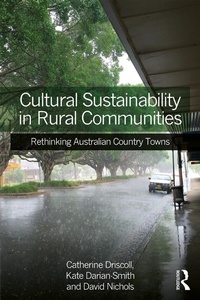
Cultural Sustainability in Rural Communities
Rethinking Australian Country Towns
Published on 6. July 2017
254 pages
978-1-317-15619-2 (ISBN)
Description

There has been a recent expansion of interest in cultural approaches to rural communities and to the economic and social situation of rurality more broadly. This interest has been particularly prominent in Australia in recent years, spurring the emergence of an interdisciplinary field called 'rural cultural studies'.
This collection is framed by a large interdisciplinary research project that is part of that emergence, particularly focused on what the idea of 'cultural sustainability' might mean for understanding experiences of growth, decline, change and heritage in small Australian country towns. However, it extends beyond the initial parameters of that research, bringing together a range of senior and emerging Australian researchers who offer diverse approaches to rural culture. The essays collected here explore the diverse forms that rural cultural studies might take and how these intersect with other disciplinary approaches, offering a uniquely diverse but also careful account of life in country Australia. Yet, in its emphasis on the simultaneous specificity and cross-cultural recognisability of rural communities, this book also outlines a field of inquiry and a set of critical strategies that are more broadly applicable to thinking about the "rural" in the early twenty-first century.
This book will be valuable reading for students and academics of Geography, History, Literary Studies, Cultural Studies, Anthropology and Sociology, introducing rural cultural studies as a new dynamic and integrative discipline.
This collection is framed by a large interdisciplinary research project that is part of that emergence, particularly focused on what the idea of 'cultural sustainability' might mean for understanding experiences of growth, decline, change and heritage in small Australian country towns. However, it extends beyond the initial parameters of that research, bringing together a range of senior and emerging Australian researchers who offer diverse approaches to rural culture. The essays collected here explore the diverse forms that rural cultural studies might take and how these intersect with other disciplinary approaches, offering a uniquely diverse but also careful account of life in country Australia. Yet, in its emphasis on the simultaneous specificity and cross-cultural recognisability of rural communities, this book also outlines a field of inquiry and a set of critical strategies that are more broadly applicable to thinking about the "rural" in the early twenty-first century.
This book will be valuable reading for students and academics of Geography, History, Literary Studies, Cultural Studies, Anthropology and Sociology, introducing rural cultural studies as a new dynamic and integrative discipline.
More details
Language
English
Place of publication
London
United Kingdom
Publishing group
Taylor & Francis Ltd
Target group
College/higher education
Illustrations
2 Tables, black and white; 14 Halftones, black and white; 14 Illustrations, black and white
File size
1,90 MB
ISBN-13
978-1-317-15619-2 (9781317156192)
Copyright in bibliographic data and cover images is held by Nielsen Book Services Limited or by the publishers or by their respective licensors: all rights reserved.
Schweitzer Classification
Other editions
Additional editions
Catherine Driscoll | Kate Darian-Smith | David Nichols
Cultural Sustainability in Rural Communities
Rethinking Australian Country Towns
Book
08/2019
1st Edition
Routledge
€65.20
Shipment within 15-20 days
Catherine Driscoll | Kate Darian-Smith | David Nichols
Cultural Sustainability in Rural Communities
Rethinking Australian Country Towns
Book
07/2017
1st Edition
Routledge
€206.50
Shipment within 10-20 days
Persons
Catherine Driscoll is Professor of Gender and Cultural Studies in the School of Philosophical and Historical Inquiry at the University of Sydney.
Kate Darian-Smith holds joint appointments at the University of Melbourne as Professor of Australian Studies and History in the School of Historical and Philosophical Studies and as Professor of Cultural Heritage in the Faculty of Architecture, Building and Planning.
David Nichols is Senior Lecturer in Urban Planning in the Faculty of Architecture, Building and Planning at the University of Melbourne.
Kate Darian-Smith holds joint appointments at the University of Melbourne as Professor of Australian Studies and History in the School of Historical and Philosophical Studies and as Professor of Cultural Heritage in the Faculty of Architecture, Building and Planning.
David Nichols is Senior Lecturer in Urban Planning in the Faculty of Architecture, Building and Planning at the University of Melbourne.
Content
1. Rethinking Australian country towns
Catherine Driscoll, Kate Darian-Smith and David Nichols
Part I: Place
2. On boredom: hometown
Prudence Black
3. Music and community in Australian country towns: choir singing, belonging and emotion
Chris Gibson and Andrea Gordon
4. Cultural progress in a rural community: the Swan Hill Shakespeare Festival
Kate Darian-Smith, David Nichols and Jane Grant
5. Farm lit: reading narratives of love on the land
Imelda Whelehan and Barbara Pini
6. Deceptive Darwin, the country capital
Tess Lea
Part II: Experience
7. Hometown: sustainable queerness in the more-than-human country town
Katrina Schlunke
8. 'A special Australian country thing': the small hall in Australian country life
David Nichols, Kate Bowles and Gordon Waitt
9. Sticky places: temporality, affect and gender in Australian country towns
Anna Hickey-Moody and Jane Kenway
10. Talk of the town in drought country
Deb Anderson
Part III: Progress
11. Broome's economy: renaturalising neoliberalism?
Stephen Muecke
12. Fostering equality, maintaining hierarchy: problems of race and class in the Country Women's Association of New South Wales, 1956-1970
Jennifer Jones
13. Gender relations in a rural community
Margaret Alston
14. Something to play every day: rural retirement culture
Catherine Driscoll
Catherine Driscoll, Kate Darian-Smith and David Nichols
Part I: Place
2. On boredom: hometown
Prudence Black
3. Music and community in Australian country towns: choir singing, belonging and emotion
Chris Gibson and Andrea Gordon
4. Cultural progress in a rural community: the Swan Hill Shakespeare Festival
Kate Darian-Smith, David Nichols and Jane Grant
5. Farm lit: reading narratives of love on the land
Imelda Whelehan and Barbara Pini
6. Deceptive Darwin, the country capital
Tess Lea
Part II: Experience
7. Hometown: sustainable queerness in the more-than-human country town
Katrina Schlunke
8. 'A special Australian country thing': the small hall in Australian country life
David Nichols, Kate Bowles and Gordon Waitt
9. Sticky places: temporality, affect and gender in Australian country towns
Anna Hickey-Moody and Jane Kenway
10. Talk of the town in drought country
Deb Anderson
Part III: Progress
11. Broome's economy: renaturalising neoliberalism?
Stephen Muecke
12. Fostering equality, maintaining hierarchy: problems of race and class in the Country Women's Association of New South Wales, 1956-1970
Jennifer Jones
13. Gender relations in a rural community
Margaret Alston
14. Something to play every day: rural retirement culture
Catherine Driscoll
