

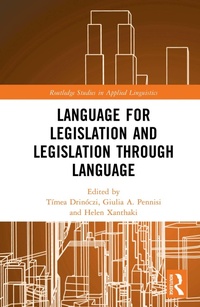
Language for Legislation and Legislation through Language
Published on 30. September 2025
488 pages
978-1-040-41092-9 (ISBN)
Description

This collection teaches us how language and legislation interact to produce effective laws. It brings linguistics, lawyers, theory, and practices together to show how linguistic tools, concepts, and methodologies can be applied to improve the law's clarity, transparency, and efficiency, thus widening its social reach.
Drawing on case studies across Europe, chapters critically reflect on the dynamics of legislative drafting and the dissemination of legislation and the ways in which drafted legislation both creates laws and serves to communicate their meaning. This volume features perspectives from national and transnational examples to demonstrate the impact of varied stakeholders-legislative bodies, law interpreters, and law enforcers-on the implementation of legislation, particularly when legislative texts are translated and interpreted across different settings. Through the lens of discourse analysis, legislative texts are analyzed in lexico-grammatical and textual terms, highlighting the disparity between what is conceived and what might be expressed clearly in words and how this knowledge can inform better drafting practices. This collection charts a way forward for linguistics as a discipline to contribute to a better understanding of the nuances around effective legislative expression.
This book will appeal to scholars and stakeholders working at the intersection of language and the law, in such fields as applied linguistics, forensic linguistics, regulation, legislation, and legislative drafting.
Drawing on case studies across Europe, chapters critically reflect on the dynamics of legislative drafting and the dissemination of legislation and the ways in which drafted legislation both creates laws and serves to communicate their meaning. This volume features perspectives from national and transnational examples to demonstrate the impact of varied stakeholders-legislative bodies, law interpreters, and law enforcers-on the implementation of legislation, particularly when legislative texts are translated and interpreted across different settings. Through the lens of discourse analysis, legislative texts are analyzed in lexico-grammatical and textual terms, highlighting the disparity between what is conceived and what might be expressed clearly in words and how this knowledge can inform better drafting practices. This collection charts a way forward for linguistics as a discipline to contribute to a better understanding of the nuances around effective legislative expression.
This book will appeal to scholars and stakeholders working at the intersection of language and the law, in such fields as applied linguistics, forensic linguistics, regulation, legislation, and legislative drafting.
Reviews / Votes
"In a rapidly evolving legal landscape, clarity, accessibility, and precision in legislative drafting are more crucial than ever. This remarkable volume, Language for Legislation and Legislation through Language, is a groundbreaking contribution to the interdisciplinary study of legislation and language, bringing together leading scholars from across the globe to explore the intersections of law, linguistics, and legislative effectiveness...This volume, as an essential resource for legislators, academics, and practitioners alike, is a milestone in the pursuit of better legislation, and it will inspire a new era of legislative excellence."- Mauro Zamboni, Professor in jurisprudence at the Department of Law, Stockholm University
More details
Series
Language
English
Place of publication
London
United Kingdom
Publishing group
Taylor & Francis Ltd
Target group
College/higher education
Professional and scholarly
Illustrations
23 Tables, black and white; 13 Line drawings, black and white; 3 Halftones, black and white; 16 Illustrations, black and white
File size
5,38 MB
ISBN-13
978-1-040-41092-9 (9781040410929)
Copyright in bibliographic data and cover images is held by Nielsen Book Services Limited or by the publishers or by their respective licensors: all rights reserved.
Schweitzer Classification
Other editions
Additional editions
Timea Drinoczi | Giulia A. Pennisi | Helen Xanthaki
Language for Legislation and Legislation through Language
Book
09/2025
1st Edition
Routledge
€214.00
Shipment within 10-20 days
Persons
Timea Drinoczi is Professor of Law, Senior Researcher, Mykolas Romeris University, Lithuania and a Research Affiliate at the Law School, Federal University of Minas Gerais, Belo Horizonte, Brazil, and in the CEU Democracy Institute, Budapest, Hungary.
Giulia A. Pennisi is Professor of English Language and Translation at the Department of Political Science and International Relations (DEMS), University of Palermo, Palermo, Italy, and Associate Research Fellow at Sir William Dale Centre for Legislative Studies, London, UK.
Helen Xanthaki is a Professor at University College London, Dean of PGLaws at the University of London Worldwide, and Senior Associate Research Fellow at the Sir William Dale Centre for Legislative Studies, London, UK.
Giulia A. Pennisi is Professor of English Language and Translation at the Department of Political Science and International Relations (DEMS), University of Palermo, Palermo, Italy, and Associate Research Fellow at Sir William Dale Centre for Legislative Studies, London, UK.
Helen Xanthaki is a Professor at University College London, Dean of PGLaws at the University of London Worldwide, and Senior Associate Research Fellow at the Sir William Dale Centre for Legislative Studies, London, UK.
Content
Introduction to Language for legislation and legislation through language by Timea Drinoczi, Giulia A. Pennisi, and Helen Xanthaki, Part One - Themes: Social practice, translation and interpretation, and legal certainty, 1. Law, Language & Culture in the EU: A Case of Harmonisation, Reflection of Diversity or a Case for Judicial Activism?, Ivan Sammut, 2. Gender Inclusiveness: does language as a social practice meet law-making in Brazil? Ana Larissa Adorno Marciotto Oliveira and Lucas Willian Oliveira Marciano, 3. Law, Language and Legal Certainty: Transformation and Challenges of the Georgian Legal Language, Dimitry Gegenava, 4. EU "Better Regulation": the role of European Committee of the Regions by Gaetano Armao, 5. How Legal Translation Matters In Tuerkiye? Examination Of International Agreements Through The Lens Of Private International Law, Aysun Bolaca and Belkis Vural Celenk, 6. Institutional translation: Balancing multilingual legal discourse between EU and Switzerland, Annarita Felici, 7. Simplification of Legal Language and Turkishization of the Turkish Constitutions of 1924, 1961, and 1982, Omer Faruk Genckaya and Seref Iba , 8. The Quest for Legislative Reform in Kosovo: Bridging Regulatory Governance with Legal Drafting and Legislative Language Discourses, Novitet Nezaj, Part Two - Tools: terminology, language processing, technology, 9. Terminology management and better understanding of legislative intent for citizens in the age of technological disruption, Foris Agota, 10. Making drafting clearer and more accessible in a multilingual context: The role of contrastive terminology and comparative law, Barnabas Novak and Timea Drinoczi, 11. Analyzing the language of legislation using natural language processing, Xiao Lu, Moritz Osnabrugge and Gerrit Quaremba, 12. An empirical approach of multimodality and legal language reform in Brazil, Thiago B.V. Hermont, Fabiana Soares and Monica Sette Lopes, Part Three - Interconnection in praxis: language for effectiveness and legal certainty for language, 13. Translation as a lens through which to view legislation's effectiveness, John O'Shea and Daniel Webber, 14. Tense Aspects of Legislative Drafting, Martin David Kelly,15. Terminological controversies over a legal hendiadys: the 'true and fair' case, Annalisa Zanola, 16. Drafting EU soft law instruments as persuasive governance tools, Corina Andone and Florin Coman Kund, 17. A linguistic approach to drafting legislative provisions, Giulia A. Pennisi ,18. Let linguists teach the drafters: easification (layering the structure) of Regulation (EU) 2023/955 establishing a Social Climate Fund, Helen Xanthaki with Nicole Sardiello-Zamboni, Aarohi Vikas Pillai, Denise Yasmine H. Eixas and Kimberley Shepherd
