

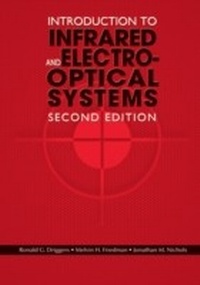
Introduction to Infrared and Electro-Optical Systems, Second Edition
1st Edition
Published on 1. January 2012
488 pages
978-1-60807-101-2 (ISBN)
Description

This newly revised and updated edition of a classic Artech House book offers a current and complete introduction to the analysis and design of Electro-Optical (EO) imaging systems. The Second Edition provides numerous updates and brand new coverage of today's most important areas, including the integrated spatial frequency approach and a focus on the weapons of terrorists as objects of interest. This comprehensive reference details the principles and components of the Linear Shift-Invariant (LSI) infrared and electro-optical systems and shows you how to combine this approach with calculus and domain transformations to achieve a successful imaging system analysis. Ultimately, the steps described in this book lead to results in quantitative characterizations of performance metrics such as modulation transfer functions, minimum resolvable temperature difference, minimum resolvable contrast, and probability of object discrimination. The book includes an introduction to two-dimensional functions and mathematics which can be used to describe image transfer characteristics and imaging system components. You also learn diffraction concepts of coherent and incoherent imaging systems which show you the fundamental limits of their performance. By using the evaluation procedures contained in this desktop reference, you become capable of predicting both sensor test and field performance and quantifying the effects of component variations. This practical resource includes over 780 time-saving equations.
More details
Other editions
Additional editions
Ronald Driggers | Melvin Friedman | Jonathan Nichols
Introduction to Infrared and Electro-Optical Systems, Second Edition
Book
09/2012
Artech House Publishers
€190.50
Shipment within 10-20 days
Content
- Intro
- Introduction to Infrared and Electro-Optical Systems
- Contents
- Preface
- Chapter 1 Introduction
- 1.1 Introduction to Imaging
- 1.2 Infrared and EO Systems
- 1.3 Wavelength Dependencies
- 1.4 Typical EO Scenario
- 1.5 Typical Infrared Scenario
- 1.6 Analytical Parameters
- 1.7 Sensitivity and Resolution
- 1.8 Linear Systems Approach
- 1.9 Summary
- 1.10 Guide to the References
- References
- Chapter 2 Mathematics
- 2.1 Complex Functions
- 2.2 Common One-Dimensional Functions
- 2.3 Two-Dimensional Functions
- 2.4 Convolution and Correlation
- 2.5 The Fourier Transform
- 2.6 Properties of the Fourier Transform
- 2.7 Transform Pairs
- 2.8 Probability
- 2.9 Important Examples
- 2.10 Guide to the References
- 2.11 Exercises
- References
- Software
- Chapter 3 Linear Shift-Invariant Systems
- 3.1 Linear Systems
- 3.2 Shift Invariance
- 3.3 Basics of LSI Systems
- 3.4 Impulse Response
- 3.5 Transfer Function
- 3.6 System PSF and MTF Versus Component PSF and MTF
- 3.7 Spatial Sampling
- 3.8 Spatial Sampling and Resolution
- 3.9 Sampled Imaging Systems
- 3.10 Guide to the References
- 3.11 Exercises
- References
- Chapter 4 Diffraction
- 4.1 Electromagnetic Waves
- 4.2 Coherence
- 4.3 Fresnel and Fraunhofer Diffraction from an Aperture
- Fresnel Diffraction
- Fraunhofer Diffraction
- 4.4 Fraunhofer Diffraction from a Thin Lens
- 4.5 Thin Lens Optical System Diffraction Psf
- 4.6 Thin Lens Diffraction Mtf
- Modulation and Modulation Transfer Function
- Incoherent Diffraction MTF
- Coherent Diffraction MTF
- 4.7 Calculating Diffraction Mtf with Pencil and Paper
- Circular Pupil: Coherent MTF
- Circular Pupil: Incoherent MTF
- 4.8 Programs for Calculating Incoherent Diffraction Mtf
- 4.9 Applications of Diffraction Theory
- 4.10 Exercises
- References
- Chapter 5 Sources of Radiation
- 5.1 Radiometry and Photometry
- Radiometric Units
- Photometric Units
- 5.2 Infrared Targets and Backgrounds
- Blackbody Radiation
- Emissivity
- Equivalent Differential Temperature (Delta T)
- Apparent Differential Temperature (Apparent Delta T)
- Technique 1: Temperature-Broadband Beer's Law Product
- Technique 2: Temperature-Broadband Transmission as a Function of Range
- Technique 3: Flux-Broadband Beer's Law Product
- Technique 4: Flux-Temperature Differential
- 5.3 Electro-Optical Targets and Backgrounds
- External Sources
- Contrast
- 5.4 Other Sensitivity Considerations
- Bidirectional Reflectance Distribution Function
- Color Considerations
- 5.5 Target and Background Spatial Characteristics
- Bar Target Representation of Targets
- Target Delta T and Characteristic Dimension
- Summary of Target Characteristics
- Clutter
- Simulation of Target Characteristics
- 5.6 Typical Midwave and Longwave Contrasts and Solar Effects
- 5.7 Exercises
- References
- Chapter 6 Atmospherics
- 6.1 Atmospheric Components and Structure
- 6.2 Atmospheric Transmission
- 6.3 Absorption
- 6.4 Scattering
- 6.5 Path Radiance
- 6.6 Turbulence
- 6.7 Atmospheric MTF
- 6.8 Models
- 6.9 Model Discussion
- 6.10 Some Practical Considerations
- 6.11 Exercises
- References
- Chapter 7 Optics
- 7.1 Light Representation and the Optical Path Length
- 7.2 Reflection and Snell's Law of Refraction
- 7.3 The Thin Lens Ray-Tracing Rules and Gauss's Equation
- 7.4 Spherical Mirrors
- 7.5 Modeling the Thick Lens
- 7.6 Vergence
- 7.7 Multiple-Lens Systems
- 7.8 Field of View
- 7.9 Resolution
- 7.10 Aperture Stop, Pupils, and Rays
- 7.11 The f-Number and Numerical Aperture
- 7.12 Telescopes and Angular Magnification
- 7.13 Modulation Transfer Function
- 7.14 Aberrations
- 7.15 Optical Materials
- 7.16 Cold Stop and Cold Shield
- 7.17 A Typical Optical System
- 7.18 Diffraction Blur
- 7.19 Guide To the References
- 7.20 Exercises
- References
- Chapter 8 Detectors
- 8.1 Types of Detectors
- 8.2 Photon Detectors
- Photoconductors
- Photovoltaic Detectors
- Photoemissive Detectors
- 8.3 Thermal Detectors
- Bolometers
- Pyroelectric Detectors
- 8.4 Charge-Coupled Devices
- 8.5 Detector Responsivity
- 8.6 Detector Sensitivity
- 8.7 Detector Angular Subtense
- 8.8 Scanning Configurations and Implementations
- 8.9 Detector Transfer Functions
- 8.10 Infrared Detectors
- 8.11 Electro-Optical Systems
- 8.12 Noise
- 8.13 Basic Background-Limited Infrared Photodetection
- 8.14 New Infrared Detector Arrays
- Large-Format Arrays
- Dual-Band (Third-Generation FLIR) Detectors
- Laser Range-Gated Detectors and Active/Passive Detectors
- 8.15 Exercises
- References
- Chapter 9 Electronics
- 9.1 Detector Circuits
- 9.2 Conversion of Spatial and Temporal Frequencies
- 9.3 Electronics Transfer Function
- 9.4 Noise
- Johnson Noise
- 1/f Noise
- Shot Noise
- 9.5 MTF Boost Filter
- 9.6 EO Mux MTF
- 9.7 Digital Filter MTF
- 9.8 CCDs
- 9.9 Uniformity Correction or "NUC"
- 9.10 Readout Integrated Circuits
- 9.11 Exercises
- References
- Chapter 10 Image Processing
- 10.1 Basics of Sampling Theory
- 10.2 Applications of Image Filtering
- Localized Contrast Enhancement
- Boost Filtering
- 10.3 Super-Resolution Image Reconstruction
- Image Acquisition: Microdither Scanner Versus Natural Jitter
- Subpixel Shift Estimation
- Image Reconstruction
- Example and Performance Estimates
- 10.4 Image Fusion
- Fusion Algorithms
- 10.5 Summary
- References
- Chapter 11 Displays, Human Perception, and Automatic Target Recognizers
- 11.1 Displays
- 11.2 Cathode-Ray Tubes
- 11.3 Light-Emitting Diodes
- 11.4 Liquid-Crystal Displays
- 11.5 Plasma Displays
- 11.6 Sampling and Display Processing
- 11.7 Human Perception and the Human Eye
- 11.8 Modulation Transfer Function of the Eye
- 11.9 Contrast Threshold Function of the Eye
- 11.10 Automatic Target Recognition
- 11.11 Exercises
- References
- Chapter 12 Historical Performance Models
- 12.1 Introduction
- 12.2 Johnson Model Fundamentals
- 12.3 The MRT Model
- 12.4 The First Flirs and Models
- 12.5 Model Improvements for Resolution and Noise
- 12.6 Incorporating Eye Contrast Limitations
- 12.7 Model Improvement to Add Sampling
- 12.8 Other Improvements Prior to the Target Task Performance Metric
- 12.9 The TRM3 Model
- 12.10 Triangle Orientation Discrimination
- 12.11 Imager Modeling, Measurement, and Field Performance
- 12.12 Exercises
- References
- Chapter 13 Contrast Threshold and TTP Metric
- 13.1 Contrast Threshold Function of the Naked Eye
- 13.2 Contrast Threshold Function for the Eye-Display System
- 13.3 Validation of Eye-Display Contrast Threshold Model
- 13.4 Eye-Display Contrast Threshold Model
- Eye-Display Contrast Threshold Model
- Define Functions
- Comparison With Existing Models
- 13.5 TTP Metric and Range Performance Modeling
- 13.6 Guide to the References
- 13.7 Exercises
- Appendix 13A: Direct Calculations of CTFeye-disp,h
- Derivation of Equation (13.4)
- Derivation of Equation (13.5a)
- References
- Chapter 14 Infrared and EO System Performance and Target Acquisition
- 14.1 Sensitivity and Resolution
- 14.2 Noise Equivalent Temperature Difference
- 14.3 EO Noise and Noise Equivalent Irradiance
- Photon-Electron Shot Noise
- Fixed-Pattern Noise
- Readout (Floor) Noise
- Total Noise Current
- Noise Equivalent Irradiance
- 14.4 Three-Dimensional Noise
- 14.5 Modulation Transfer Function
- 14.6 Minimum Resolvable Temperature Difference (Including 2D MRT)
- Two-Dimensional MRT
- 14.7 Target Acquisition with Limiting Frequency (Johnson's N50)
- 14.8 System Contrast Threshold Function
- 14.9 Target Acquisition with the Target Task Performance Metric (and Vollmerhausen's V50)
- 14.10 Target Sets
- 14.11 Classic ISR, NIIRS, and General Image Quality
- National Imagery Interpretability Rating System
- GIQE Model
- 14.12 The Newest Military Imaging Mode: Persistent Surveillance
- 14.13 Exercises
- References
- Chapter 15 Search
- 15.1 Problem Definition
- 15.2 Introduction to Search Theory
- 15.3 Technique for Estimating Search Parameters and Their Uncertainties
- 15.4 Search Parameters and NV-IPM
- 15.5 Time-Limited Search
- 15.6 Field of Regard Search
- 15.7 Multiple Observers, Single Sensor, Unlimited Time, and Shared Knowledge
- 15.8 Independent Search with Two Sensors, Unlimited Time, and Shared Knowledge
- 15.9 Time-Dependent Search Parameters Search Model
- 15.10 Other Work
- Neoclassical Search Model
- Georgia Tech Vision Model
- Combat Simulations and War Games
- Acquire
- GIQE/IIRS/NIIRS
- 15.11 Guide to the References
- 15.12 Exercises
- Appendix 15A: Time-Unlimited Field of Regard Search
- Appendix 15B: Detection Times and Probabilities with Shared Information
- Useful Mathematical Result
- Mean Time for First Observer to Detect Target Given n Observers and P¥
- Mean Time to Detect Target with Two Observers Using Two Sensors
- Probability Density Function for Detection Time with Two Observers Using Two Sensors
- Appendix 15C: Mathematica Search Code for TDSP Search Model
- References
- Chapter 16 Laboratory Measurements of Infrared Imaging System Performance
- 16.1 Sensitivity
- 16.2 Resolution
- 16.3 Human Performance: Minimum Resolvable Temperature Difference
- 16.4 Dynamic Minimum Resolvable Temperature Difference
- References
- List of Symbols
- List of Acronyms
- Table of Abbreviations and Concepts
- Table of Operators and Mathematical Functions
- Index
