

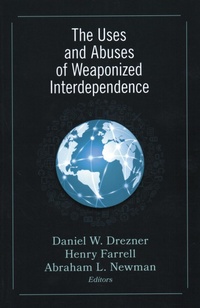
The Uses and Abuses of Weaponized Interdependence
1st Edition
Published on 2. March 2021
351 pages
978-0-8157-3838-1 (ISBN)
Description

How globalized information networks can be used for strategic advantage
Until recently, globalization was viewed, on balance, as an inherently good thing that would benefit people and societies nearly everywhere. Now there is growing concern that some countries will use their position in globalized networks to gain undue influence over other societies through their dominance of information and financial networks, a concept known as ¿weaponized interdependence.¿
In exploring the conditions under which China, Russia, and the United States might be expected to weaponize control of information and manipulate the global economy, the contributors to this volume challenge scholars and practitioners to think differently about foreign economic policy, national security, and statecraft for the twenty-first century. The book addresses such questions as: What areas of the global economy are most vulnerable to unilateral control of information and financial networks? How sustainable is the use of weaponized interdependence? What are the possible responses from targeted actors? And how sustainable is the open global economy if weaponized interdependence becomes a default tool for managing international relations?
Until recently, globalization was viewed, on balance, as an inherently good thing that would benefit people and societies nearly everywhere. Now there is growing concern that some countries will use their position in globalized networks to gain undue influence over other societies through their dominance of information and financial networks, a concept known as ¿weaponized interdependence.¿
In exploring the conditions under which China, Russia, and the United States might be expected to weaponize control of information and manipulate the global economy, the contributors to this volume challenge scholars and practitioners to think differently about foreign economic policy, national security, and statecraft for the twenty-first century. The book addresses such questions as: What areas of the global economy are most vulnerable to unilateral control of information and financial networks? How sustainable is the use of weaponized interdependence? What are the possible responses from targeted actors? And how sustainable is the open global economy if weaponized interdependence becomes a default tool for managing international relations?
More details
Edition
1. Auflage
Language
English
Place of publication
New York
United States
Publishing group
Bloomsbury Publishing Plc
ISBN-13
978-0-8157-3838-1 (9780815738381)
DOI
10.5771/9780815738381
Copyright in bibliographic data and cover images is held by Nielsen Book Services Limited or by the publishers or by their respective licensors: all rights reserved.
Schweitzer Classification
Other editions
Additional editions
Daniel W. Drezner | Henry Farrell | Abraham L. Newman
The Uses and Abuses of Weaponized Interdependence
Book
03/2021
Brookings Institution
€53.70
Shipment within 10-20 days
Persons
Daniel W. Drezner is professor of international politics at the Fletcher School of Law and Diplomacy, Tufts University, and a nonresident senior fellow at the Brookings Institution. Henry Farrell is the SNF Agora Professor at the Johns Hopkins School of Advanced International Studies. Abraham L. Newman is a professor in the Edmund A. Walsh School of Foreign Service and Government Department, Georgetown University, and director of the Mortara Center for International Studies.
Content
Contents:
1. Introduction: The Uses and Abuses of Weaponized Interdependence, Daniel W. Drezner
Part I: Theory
2. Weaponized Interdependence: How Global Economic Networks Shape State Coercion, Henry Farrell and Abraham L. Newman
3. Hegemony and Fear: The National Security Determinants of Weaponized Interdependence, Michael Mastanduno
4. The Road to Revisionism: How Interdependence Gives Revisionists Weapons for Change, Stacie E. Goddard
Part II: Finance
5. Weaponized Interdependence and International Monetary Systems, Harold James
6. Weaponizing International Financial Interdependence, Thomas Oatley
Part III: Tech
7. Internet Platforms Weaponizing Choke Points, Natasha Tusikov
8. Huawei, 5G, and Weaponized Interdependence, Adam Segal
Part IV: Energy
9. Weaponizing Energy Interdependence, Emily Meierding
10. Russia's Gazprom: A Case Study in Misused Interdependence, Mikhail Krutikhin
Part V: State-Owned Networks
11. Weaponized Weapons: The U.S. F-35 and European Eurofighter Networks, Florian David Bodamer and Kaija E. Schilde
12. Coercion Unbound? China's Belt and Road Initiative, Thomas P. Cavanna
Part VI: Responses to Weaponized Interdependence
13. Weaponized Interdependence, the Dynamics of Twenty-first Century Power, and U.S. Grand Strategy, Bruce W. Jentleson
14. Investment Screening in the Shadow of Weaponized Interdependence, Sarah Bauerle Danzman
15. Weaponized Interdependence and Human Rights, Charli Carpenter
16. Must the Weak Suffer What They Must? The Global South in a World of Weaponized Interdependence, Amrita Narlikar
17. Weaponized Interdependence and Networked Coercion: A Research Agenda, Henry Farrell and Abraham L. Newman
Contributors
Index
1. Introduction: The Uses and Abuses of Weaponized Interdependence, Daniel W. Drezner
Part I: Theory
2. Weaponized Interdependence: How Global Economic Networks Shape State Coercion, Henry Farrell and Abraham L. Newman
3. Hegemony and Fear: The National Security Determinants of Weaponized Interdependence, Michael Mastanduno
4. The Road to Revisionism: How Interdependence Gives Revisionists Weapons for Change, Stacie E. Goddard
Part II: Finance
5. Weaponized Interdependence and International Monetary Systems, Harold James
6. Weaponizing International Financial Interdependence, Thomas Oatley
Part III: Tech
7. Internet Platforms Weaponizing Choke Points, Natasha Tusikov
8. Huawei, 5G, and Weaponized Interdependence, Adam Segal
Part IV: Energy
9. Weaponizing Energy Interdependence, Emily Meierding
10. Russia's Gazprom: A Case Study in Misused Interdependence, Mikhail Krutikhin
Part V: State-Owned Networks
11. Weaponized Weapons: The U.S. F-35 and European Eurofighter Networks, Florian David Bodamer and Kaija E. Schilde
12. Coercion Unbound? China's Belt and Road Initiative, Thomas P. Cavanna
Part VI: Responses to Weaponized Interdependence
13. Weaponized Interdependence, the Dynamics of Twenty-first Century Power, and U.S. Grand Strategy, Bruce W. Jentleson
14. Investment Screening in the Shadow of Weaponized Interdependence, Sarah Bauerle Danzman
15. Weaponized Interdependence and Human Rights, Charli Carpenter
16. Must the Weak Suffer What They Must? The Global South in a World of Weaponized Interdependence, Amrita Narlikar
17. Weaponized Interdependence and Networked Coercion: A Research Agenda, Henry Farrell and Abraham L. Newman
Contributors
Index
