

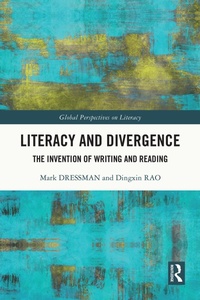
Literacy and Divergence
The Invention of Writing and Reading
1st Edition
Will be published approx. on 14. July 2026
194 pages
978-1-040-94228-4 (ISBN)
Description

This book presents a pioneering exploration of literacy, integrating multidisciplinary perspectives into a framework that conceptualizes literacy as an interaction among technologies, codes, purposes, and practices within and across cultural and historical contexts.
The volume traces the global emergence of writing and reading systems across five regions: East Asia (encompassing China, Korea, Japan, and Vietnam); the Mediterranean and Europe (spanning phonetic alphabetic traditions and their subsequent global dissemination); the Middle East and Africa (Semitic and Afro-Asiatic writing systems); India and Southeast Asia (Brahmic writing systems); and Indigenous North America (Mesoamerican writing systems). The concluding chapter synthesizes and compares these developments. It analyzes how early literacy, wielded by government and religious officials, simultaneously fostered cultural advancement and facilitated population control. This established the foundation for widespread literacy through revolutionary advances in printing technology, industrialization, and mass education.
This work will be an invaluable resource for scholars, educators, and students of cultural studies, linguistics, historical research, anthropology, and educational theory. It will be particularly valuable to those interested in the evolution of literacy across diverse civilizations and throughout history.
The volume traces the global emergence of writing and reading systems across five regions: East Asia (encompassing China, Korea, Japan, and Vietnam); the Mediterranean and Europe (spanning phonetic alphabetic traditions and their subsequent global dissemination); the Middle East and Africa (Semitic and Afro-Asiatic writing systems); India and Southeast Asia (Brahmic writing systems); and Indigenous North America (Mesoamerican writing systems). The concluding chapter synthesizes and compares these developments. It analyzes how early literacy, wielded by government and religious officials, simultaneously fostered cultural advancement and facilitated population control. This established the foundation for widespread literacy through revolutionary advances in printing technology, industrialization, and mass education.
This work will be an invaluable resource for scholars, educators, and students of cultural studies, linguistics, historical research, anthropology, and educational theory. It will be particularly valuable to those interested in the evolution of literacy across diverse civilizations and throughout history.
More details
Series
Edition
1. Auflage
Language
English
Place of publication
London
United Kingdom
Publishing group
Taylor & Francis Ltd
Target group
College/higher education
Illustrations
15 Tables, black and white; 10 Line drawings, black and white; 12 Halftones, black and white; 22 Illustrations, black and white
File size
16,76 MB
ISBN-13
978-1-040-94228-4 (9781040942284)
Copyright in bibliographic data and cover images is held by Nielsen Book Services Limited or by the publishers or by their respective licensors: all rights reserved.
Schweitzer Classification
Other editions
Additional editions
Book
approx. 07/2026
1st Edition
Routledge
€191.50
Not yet published
Persons
Mark Dressman is Professor Emeritus at the University of Illinois at Urbana-Champaign (US), in the College of Education. His areas of research currently are comparative literacy, informal digital learning of English, and second-language writing. He has previously published Using Social Theory in Educational Research: A Practical Guide (2008) with Routledge.
Dingxin Rao is Associate Professor at Hangzhou Normal University (China), in the Jinghengyi School of Education. His areas of research currently are comparative literacy, Chinese language and literature education, and digital literacy.
Dingxin Rao is Associate Professor at Hangzhou Normal University (China), in the Jinghengyi School of Education. His areas of research currently are comparative literacy, Chinese language and literature education, and digital literacy.
Content
1 What Is Literacy? 2 Literacy in China and East Asia 3 European Alphabetic Literacy 4 Literacy in the Middle East and Africa 5 Brahmic Scripts and Southeast Asian Literacy 6 Indigenous Literacy in the Americas 7 Convergence and Divergence: What Was Literacy at Its Beginnings?
