

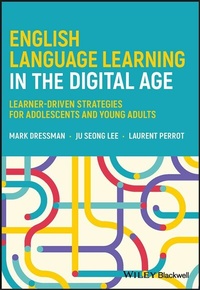
English Language Learning in the Digital Age
Description

English Language Learning in the Digital Age is a comprehensive introduction to the theoretical background and real-world application of IDLE (Informal Digital Learning of English). Designed for teachers and future teachers preparing to teach English as a second or other language, this highly practical guide focuses on incorporating digital technology into curricula to draw upon the extracurricular exposures to English that many students experience outside of the classroom. With some creativity and care, teachers can find ways to bring these experiences with English into the classroom, ultimately improving student learning outcomes.
Offering a specific focus on examples and case studies drawn from language education in the Middle East, Asia, and Europe, this text employs a three-part structure beginning with the theories behind autonomous learning and the importance of informal language learning for young adults. Part two demonstrates various methods for integrating games, social media, e-books, language software, mobile apps, and other digital resources into the classroom. The third section addresses the use of IDLE methods to bridge the gap between informal and formal uses of English, the advantages and disadvantages of IDLE in flipped classrooms and online teaching, and how IDLE strategies can enhance mandated curricula and better prepare students for national exams. The book concludes with a brief discussion of the future of language learning and the need to include digital technologies and learner-driven strategies in education policy. This unique text:
* Offers practical methods for bringing informal student learning into the classroom
* Presents a wide range of engaging digital learning activities that can complement traditional language courses and improve language acquisition
* Reviews mobile apps for the translation and practice of vocabulary, grammar, and other components of language learning
* Provides real-life examples of how teachers can develop lessons and curricula, such as watching and making vlogs and reading transcripts of podcasts and audiobooks
* Includes access to a companion website containing video interviews with English learners and teaching plans reflecting TESOL Technology Standards and CEFR Reference Level Descriptors for English
English Language Learning in the Digital Age is an ideal textbook for upper-level undergraduate and graduate students in the fields of language education and language acquisition, as well as teachers and teachers-in-training who are preparing to teach English in countries where English is not the primary language.
More details
Other editions
Additional editions
Persons
Mark Dressman is Professor Emeritus, Department of Curriculum and Instruction, University of Illinois at Urbana-Champaign, USA. He is the co-editor of The Handbook of Informal Language Learning and the author of four books and numerous book chapters and research articles on English education and literacy.
Ju Seong Lee is Associate Head and Assistant Professor, Department of English Language Education, The Education University of Hong Kong SAR, People's Republic of China. He is a leading researcher in the field of IDLE (Informal Digital Learning of English) and has published many journal articles and book chapters on English language acquisition. He is the author of Informal Digital Learning of English: Research to Practice.
Laurent Perrot holds a doctorate in language sciences from the University of Paris-Cité, France. He has worked as a teacher-trainer for two decades and is co-author of Enseigner l'anglais: Mise en oeuvre du CECRL - Pédagogie actionnelle - Pratiques de classe - Usages des TICE, one of the leading textbooks for ELL/ESL teachers in France.
Content
Contents
List of Figures viii
List of Tables ix
Acknowledgments xi
Part I Introduction: Informal Digital Learning of English and Its Implications 1
1 The Age of IDLE and the IDLE Age 3
2 Seeing and Hearing the English All Around Us 22
3 Complementarity: Tradition and Innovation in English Learning and Teaching 44
Part II IDLE in the Classroom 73
4 Songs, Video, and Vlogging 75
5 Audiobooks, E-Books, and Podcasting 101
6 Social Networking and Ethical/Safety Considerations 126
7 Games and Other Virtual Learning Environments 152
8 Mobile Apps: Translation, Vocabulary, and Grammar 177
Part III Language Curriculum in the Digital Age 201
9 Beyond the Pandemic: Online and Flipped Learning 203
10 From IDLE to Academic Literacy 230
11 Curriculum, Assessment, and Professional Development in the Age of IDLE 257
12 Autonomous, Informal Learning and the Future of English Language Education 284
Index 308
