

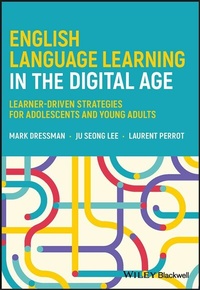
English Language Learning in the Digital Age
Description

English Language Learning in the Digital Age is a comprehensive introduction to the theoretical background and real-world application of IDLE (Informal Digital Learning of English). Designed for teachers and future teachers preparing to teach English as a second or other language, this highly practical guide focuses on incorporating digital technology into curricula to draw upon the extracurricular exposures to English that many students experience outside of the classroom. With some creativity and care, teachers can find ways to bring these experiences with English into the classroom, ultimately improving student learning outcomes.
Offering a specific focus on examples and case studies drawn from language education in the Middle East, Asia, and Europe, this text employs a three-part structure beginning with the theories behind autonomous learning and the importance of informal language learning for young adults. Part two demonstrates various methods for integrating games, social media, e-books, language software, mobile apps, and other digital resources into the classroom. The third section addresses the use of IDLE methods to bridge the gap between informal and formal uses of English, the advantages and disadvantages of IDLE in flipped classrooms and online teaching, and how IDLE strategies can enhance mandated curricula and better prepare students for national exams. The book concludes with a brief discussion of the future of language learning and the need to include digital technologies and learner-driven strategies in education policy. This unique text:
* Offers practical methods for bringing informal student learning into the classroom
* Presents a wide range of engaging digital learning activities that can complement traditional language courses and improve language acquisition
* Reviews mobile apps for the translation and practice of vocabulary, grammar, and other components of language learning
* Provides real-life examples of how teachers can develop lessons and curricula, such as watching and making vlogs and reading transcripts of podcasts and audiobooks
* Includes access to a companion website containing video interviews with English learners and teaching plans reflecting TESOL Technology Standards and CEFR Reference Level Descriptors for English
English Language Learning in the Digital Age is an ideal textbook for upper-level undergraduate and graduate students in the fields of language education and language acquisition, as well as teachers and teachers-in-training who are preparing to teach English in countries where English is not the primary language.
More details
Other editions
Additional editions
Persons
Mark Dressman is Professor Emeritus, Department of Curriculum and Instruction, University of Illinois at Urbana-Champaign, USA. He is the co-editor of The Handbook of Informal Language Learning and the author of four books and numerous book chapters and research articles on English education and literacy.
Ju Seong Lee is Associate Head and Assistant Professor, Department of English Language Education, The Education University of Hong Kong SAR, People's Republic of China. He is a leading researcher in the field of IDLE (Informal Digital Learning of English) and has published many journal articles and book chapters on English language acquisition. He is the author of Informal Digital Learning of English: Research to Practice.
Laurent Perrot holds a doctorate in language sciences from the University of Paris-Cité, France. He has worked as a teacher-trainer for two decades and is co-author of Enseigner l'anglais: Mise en oeuvre du CECRL - Pédagogie actionnelle - Pratiques de classe - Usages des TICE, one of the leading textbooks for ELL/ESL teachers in France.
Content
Contents
List of Figures viii
List of Tables ix
Acknowledgments xi
Part I Introduction: Informal Digital Learning of English and Its Implications 1
1 The Age of IDLE and the IDLE Age 3
2 Seeing and Hearing the English All Around Us 22
3 Complementarity: Tradition and Innovation in English Learning and Teaching 44
Part II IDLE in the Classroom 73
4 Songs, Video, and Vlogging 75
5 Audiobooks, E-Books, and Podcasting 101
6 Social Networking and Ethical/Safety Considerations 126
7 Games and Other Virtual Learning Environments 152
8 Mobile Apps: Translation, Vocabulary, and Grammar 177
Part III Language Curriculum in the Digital Age 201
9 Beyond the Pandemic: Online and Flipped Learning 203
10 From IDLE to Academic Literacy 230
11 Curriculum, Assessment, and Professional Development in the Age of IDLE 257
12 Autonomous, Informal Learning and the Future of English Language Education 284
Index 308
1
The Age of IDLE and the IDLE Age
Four independent digital learners of English (IDLERs) at a university library in Morocco. Note the combined use of smartphones and notebooks and the computer with plug-in modem.
Introduction and Plan for the Book
Taking a Learner-Driven Approach
This book is about the integration of instructional technology, often abbreviated as IT, or sometimes ICT (information and communications technology) with English language instruction in classroom settings, but it takes a different approach from most books on the subject. In a typical Computer-Assisted Language Learning (CALL) or Mobile-Assisted Language Learning (MALL) approach, the focus is "top-down" and often technology-driven, with additional concern for research-derived theories and principles of language acquisition and learning, almost exclusively within formal classroom settings.
Our approach in this book is quite different and somewhat unique. It takes a "bottom-up" view of how, over the past two decades, learners across the globe have increasingly relied on the informal use of information and communications technology to both acquire and learn English outside classroom settings. Inspired by our own research and that of others, this book takes a "learner-driven" approach, focusing on strategies adapted from what adolescents and young adults tell researchers about how they are learning English while playing video games, watching television and movies, and chatting with others online when they are not in the classroom, and how this learning contributes to their success in the classroom. These strategies are powerful, not only because their grounding in the interests and social behaviors of learners makes them highly motivating, but because they effectively solve many of the logistical issues that have persistently challenged formal language instruction for over a century, such as regular, inexpensive access to authentic sources of input, and opportunities for interaction with more proficient speakers.
In keeping with this bottom-up, learner-driven approach, each chapter begins with a series of fictional but research-based, authentic portraits of English learners and their teachers using digital technologies in the early twenty-first century. We follow these portraits with a discussion of current research and theory in second language acquisition and CALL and conclude the chapters of Part II and the first three chapters of Part III with three scenarios for teaching at the middle, secondary, and tertiary levels. Although the specific focus of these is on the learning of adolescents and young adults, many of the scenarios (especially those in middle schools) are easily adaptable for primary school settings.
Our goal in writing this book, then, is to provide an approach to the integration of CALL and MALL that is naturalistic in focus, highly readable and engaging, and grounded in cutting-edge research and theory on second language acquisition and learning. We welcome you, our readers, into a world of English language learning and teaching that embodies the full potential of ubiquitous technologies and autonomous learning in the early twenty-first century.
Imagine This
Team Teaching in Taipei
Li Mei (Liz) Wang is a middle-school English teacher in Taipei, Taiwan. Li Mei was born in Taiwan, but when she was nine, she emigrated with her family to the United States and settled in Chicago, where she became known by her schoolmates and teachers as Liz. Li Mei graduated from the University of Illinois with a degree in primary education but in her early 20s her family returned to Taiwan and Li Mei followed them, lured by a new program aimed at increasing the English proficiency of students by teaming teachers from English-speaking countries with Taiwanese teachers.
Li Mei is enjoying her return to Taiwan and is charmed by her new students, who are fascinated not only by her bilingualism but by her bicultural habits, and who shyly quiz her about life in the United States. However, she is troubled by the English curriculum, which is focused more on grammatical rules than on communication, and by some of her colleagues who lack Li Mei's fluency and insist on continuing to teach English from the textbook.
In her conversations with students, which are conducted partly in Taiwanese dialect and partly in English, Li Mei has discovered that her students are gaining quite a bit of English receptively from online sources, especially video streaming, online gaming, and music videos. Along with Japanese anime, Hallyu, and Taiwanese stars, her students are avid fans of Ariana Grande, Justin Bieber, and Drake. They tell her they grew up watching My Little Pony and SpongeBob SquarePants and now watch The Voice on television every week, and that they "try to understand without reading the subtitles." Moreover, she has discovered that her students' curiosity and engagement with these sources of English contrast sharply with their demeanor and performance in formal English classes, where they are reluctant to speak and seem to struggle with English grammar exercises.
In weekly meetings, Li Mei has suggested finding ways to use materials from popular culture or even trying to use captioned videos in classes, but her ideas have not been accepted. One colleague suggested that she should "save those ideas for the English club." Another was more direct. "That is not good English," the teacher told her. "We teach correct English." Another asked Li Mei why teachers should "take time for SpongeBob" in their classrooms when students were "doing that on their own." Class time, she was told, was "for serious study, not playing around." Li Mei also discussed the matter with her school director, who smiled and told her, "Your job is to help students with their fluency and pronunciation. Leave the rest of the teaching to the older teachers."
A Bilingual Bachillerato in Spain
Miguel Días teaches English and physics in a bilingual bachillerato, or upper-grades high school, located on the outskirts of Cordoba, Spain. The school only opened in 2019 and is part of the Spanish national government's efforts to increase the English proficiency of students, especially those intending to major in the sciences at university. Miguel, who studied physics as an undergraduate, spent three summers with relatives in Miami as a teenager and "picked up" English during those visits, from high school and a few university English classes, and from playing massively multiplayer online role-playing games (MMORPGs) through much of his time at the university. For the past two summers, he has participated in a TESOL certification program at a British university, where his fluency and ability to write in English have increased dramatically.
Miguel has thought deeply about his own learning processes as part of his professional development. His position is 50% in the English department and 50% in physics, and he is required to teach at least 30% of physics content in English. He typically introduces subjects in Spanish but later reviews and tries to extend the same concepts in English through a variety of means, including video clips and articles from Scientific American, National Geographic, and other popular sources. Khan Academy, which offers videos on much of the content in his classes in both English (with captions) and Spanish, has become an important resource for him and for his students, especially for review.
However, Miguel's teaching as well as the bilingual program of the school have recently come under criticism, not only in the press and popular opinion but from some parents and from his colleagues in both English and physics. Miguel has heard that some of his colleagues in English have mocked his "gringo" (American) accent and occasional errors in usage and grammar. They also cite recent articles in Spanish newspapers about the failure of Spanish schools to teach a British standard of English-despite their own frequent lack of a Castilian accent in Spanish. His colleagues in physics, on the other hand, have challenged the "rigor" of his teaching, arguing that the "simplification" of content required for instruction in English is a disservice to students preparing to study science and engineering at university. In addition, some parents have complained that their children's poor background in English places them at a disadvantage compared to other students whose parents can afford to send their children to English-speaking countries on holiday or pay for private classes at English centers.
These complaints have left Miguel distracted and discouraged, but they have not weakened his determination or enthusiasm for teaching his students. He has noticed that a number are learning to speak "California dialect," nurtured by their fondness for pirated television series like "Breaking Bad," "Buffy the Vampire Slayer," or the "Fast and Furious" movie franchise, as well as several Latinx and Caribbean hip-hop artists and pop singers who move effortlessly in their lyrics from Spanish to English and back. They, in turn, are embracing highly communicative forms of English expression that, Miguel knows, may or may not help them in their future university careers, but in the meantime offer them release from the inauthenticity of the topics in their English textbooks, such as "A Trip to the Bakery" or "The Story of the Premier...
