

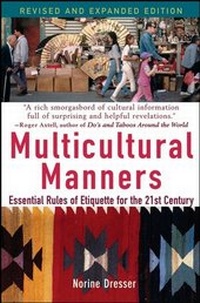
Multicultural Manners
Essential Rules of Etiquette for the 21st Century, Revised Edition
Published on 12. January 2011
304 pages
978-1-118-04028-7 (ISBN)
Description

Both highly informative and entertaining, Multicultural Manners gives readers the understanding they need, the perfect words to say, and the correct behavior to use in a wide range of cross-cultural situations. This incisive and award-winning guide to etiquette features completely updated etiquette guidelines with special emphasis on post-September 11 culture clashes as well as a brand-new section that demystifies unfamiliar cultures in the news. Norine Dresser identifies key cross-cultural hot spots and suggests methods that foster respect for diversity. Readers will discover the dos and don'ts of successful business and social interaction, detailed tips on avoiding embarrassment in a variety of social settings, amusing firsthand accounts of cultural gaffes, a breakdown of customs, religions, languages, and ethnicities for seventy different countries, and appropriate etiquette for innumerable settings.
More details
Other editions
Additional editions
Book
08/2005
Wiley
€23.50
Shipment within 10-20 days
Person
NORINE DRESSER is a professional consultant, speaker, folklorist, and educator. From 1993 to 2001, she wrote the award-winning "Multicultural Manners" column for the Los Angeles Times. Dresser has been interviewed on the Voice of America and numerous other radio and TV shows.
Content
Acknowledgments.
Introduction.
1. The New Rules of Communication.
Body Language.
Child-Rearing Practices.
Classroom Behavior.
Clothing and Jewelry.
Colors.
Foodways.
Gifts.
Health Practices.
Holidays.
Luck and Supernatural Forces.
Male/Female Relations and Gender Issues.
Miscellany.
Prejudice.
Time.
Verbal Expressions.
2. Clearing Cultural Confusions.
A Quick Reference Guide.
Map.
Africans.
Asians.
South Asians.
Southeast Asians.
The Balkans.
Independent Members of the Former USSR.
Middle Easterners.
Bibliography.
Index.
Introduction
While in a hospital cafeteria, I looked for tea to go with my sandwich. I tapped the shoulder of a man standing in front of me in the checkout line. "Excuse me. Can you please tell me where the tea is?" He wheeled around. He was Chinese and clearly offended by my question. Emphatically he answered, "I don't drink tea."
I felt embarrassed. Of course, by only seeing his back I had no clue that he was Chinese. By asking him about tea it seemed as if I was making a stereotypical assumption about his foodways. Obviously, that irritated him. Despite my innocence, I felt guilty. What irony! I'm supposed to have heightened sensitivity about avoiding cross-cultural blunders, but in this situation nothing could rescue me. Nonetheless, as important as it is to be cross-culturally savvy, equally important is the ability to laugh at oneself. Blunders don't have to turn into world wars. As long as we maintain a sense of humor, mistakes may even serve to strengthen bonds, as they did in the following situation.
I arranged to interview a Hmong family for my Multicultural Celebrations book. I had read that they remove their shoes indoors, and when I arrived at their home I saw a pile of shoes outside the front door. Feeling smug about having prepared for the visit, I took off my sandals. Lia stood at the door protesting that it was unnecessary, but I wanted to show her I knew about Hmong customs. To my chagrin, when I entered her living room filled with family, no one was barefoot except me. They thought it was comical. I did, too. I was also able to turn it around and make fun of myself, breaking the ice as I interviewed them about Hmong weddings.
Basically, this is still a how-to book-how to get along with others who are culturally different. As before, it is not targeted just to those who travel or conduct international business. Cultural information has many applications: To help interact more effectively with new populations from East Africa, the San Diego Police Department has created a videotape for officers about the customs and folkways of these recent residents; the U.S. Marine Corps offers cultural information to its occupational forces in Iraq, counseling them on do's and don'ts for their own safety and to increase rapport with the locals. Moreover, Lt. Col. Michael T. Mahoney, the U.S. Army commanding officer of Forward Operating Base Thunder in Iraq, has worked hard to absorb Iraqi customs and etiquette. His motivation? To win the peace. So, my goal is still to demystify the behaviors of people of different cultural backgrounds. Holocausts and ethnic cleansings are monstrous results of people who refuse to accept those unlike themselves in religious practice, language, or color. Instead, I'd like to increase appreciation for all peoples and emphasize that showing respect for differences usually creates respect in return. Mainly, however, the information is relevant to ordinary Americans, for we all deal daily with those who are culturally different: in the workplace, the neighborhood, and perhaps even our own families. Since one in nine U.S. residents was born in another country, and the total foreign-born population now exceeds 33 million with an estimated 1.3 million immigrants arriving annually, we regularly encounter people who are culturally different more frequently than in the past. In 2004, more than 70 percent of the residents of Elmhurst, Queens, New York, were foreign born. The U.S. Census Bureau projects that by 2050 the Hispanic and Asian American populations will triple. My own awareness of multicultural issues developed over more than twenty-five years as a folklorist teaching at various colleges in the Los Angeles area, later collecting first-person stories about cross-cultural miscommunication, particularly from non-native English speakers. For eight years I wrote a twice-monthly "Multicultural Manners" column for the Los Angeles Times about the ways that cultural differences sabotage effective communication, emphasizing the "what went wrong?" in each situation. In 1998, the column and the original Multicultural Manners book received an award from the Los Angeles County Department of Human Relations for contributions toward promoting intergroup harmony. For me as a folklorist, this award acknowledges the importance of knowing about others' customs and beliefs. This knowledge and this book do not venture to cure racism, nor is the book intended as a finger-pointing book of "shoulds." Rather, it points to cross-cultural hot spots and suggests methods of creating respect for diversity. The goal is to help identify what went wrong in cross-cultural interactions that failed and to help avoid future blunders. Every part of our planet today is multicultural. Even the most isolated, such as North Korea, has a small Chinese community and a few ethnic Japanese. Yet for some, the word "multiculturalism" has become a dirty word-the "M" word. Diana Eck, Harvard Professor of Comparative Religion and Indian Studies, illuminates the bias against multiculturalism: "Some people mistake it for a political platform rather than a social reality." Readers of my Los Angeles Times column occasionally protested that reality: "They're in our country now. Let them adapt to our ways. Why should we have to adjust to them?" Of course, no one has to adjust to newcomers in a society, but those who do are more likely to reap rewards. It's all quite pragmatic. Having information about other people's folkways can improve human relations-as those who work in the business world have known for some time. In California, Rose Hills Memorial Park provides incinerators for bereaved Chinese families who burn paper money to ensure a happy afterlife. To honor the Chinese/ Vietnamese Lunar New Year 2000, Year of the Dragon, certain J.C. Penney's distributed beautifully illustrated dragon posters. Western Union and State Farm Insurance gave out traditional good-luck red envelopes to Lunar New Year celebrants. Responding to cultural differences of customers, clients, employees, patients, students, neighbors, and family pays off! Increasingly, in more and more parts of this country, there is an overwhelming quantity of cultural information to absorb and accept. Pity the latest immigrants who, in order to get along, must become accustomed not only to mainstream rules but also to those of other newcomers as well. Think about the Mexican cook in a Pakistani restaurant who must learn English and master Muslim food taboos at the same time. According to Eck, "It's one thing to be unconcerned about or ignorant of Muslim or Buddhist neighbors on the other side of the world, but when Buddhists are our next-door neighbors, when our children are best friends with Muslim classmates, when a Hindu is running for a seat on the school committee, all of us have a new vested interest in our neighbors, both as citizens and as people of faith." As a folklorist, I delight in learning about cultural differences in customs and beliefs. Nonetheless, I know that these differences sometimes cause people who are unacquainted with the significance of particular acts to respond negatively. Therefore, I wanted to use my expertise to explain unfamiliar practices. However, I hope that I have not inadvertently created or reinforced stereotypes. Moreover, I have tried to avoid generalizations, yet some were necessary to make the book useful. Accordingly, based on my research, the guidelines apply to the majority of the people to whom they refer. Treat these rules as general principles, but remember that there will be exceptions. No blanket statement can apply to everyone. I have also tried to be sensitive to sexist issues, but I have had to be forthright in differences in gender issues that exist for people coming from many countries outside the United States. In addition, I have strived throughout to use non-value-laden language. I have avoided the use of the word superstition, for one person's superstition is another person's belief. Academic training in anthropology and folklore has influenced my emphasis on cultural relativity-attempting to see the validity and function of cultures without value judgment. I would like readers also to avoid being judgmental. Despite this desire to be objective, I know it is more an ideal than a reality. The outlooks of all of us have been shaped by our backgrounds and have given us particular lenses through which we view the world. One of my greatest apprehensions is that I will appear patronizing by encouraging others to bend over backwards to understand the behavior of newcomers. This deliberate attempt to comprehend unfamiliar behavior is never intended to be insulting. I only want to cast some illumination upon cultural rules and traditions. Be that as it may, my concern is that these good intentions may boomerang. I wrote Multicultural Manners because I wanted to ease the conflicts and misunderstandings that happen to all of us every day. My experience as a teacher has convinced me that we really want to understand and accept one another; most of our failures to do so stem from ignorance rather than from bad intentions. Finally, this book is my attempt to guide well-meaning people such as you through the increasingly complicated labyrinth of modern...
Introduction to the Revised Edition
While in a hospital cafeteria, I looked for tea to go with my sandwich. I tapped the shoulder of a man standing in front of me in the checkout line. "Excuse me. Can you please tell me where the tea is?" He wheeled around. He was Chinese and clearly offended by my question. Emphatically he answered, "I don't drink tea."
I felt embarrassed. Of course, by only seeing his back I had no clue that he was Chinese. By asking him about tea it seemed as if I was making a stereotypical assumption about his foodways. Obviously, that irritated him. Despite my innocence, I felt guilty. What irony! I'm supposed to have heightened sensitivity about avoiding cross-cultural blunders, but in this situation nothing could rescue me. Nonetheless, as important as it is to be cross-culturally savvy, equally important is the ability to laugh at oneself. Blunders don't have to turn into world wars. As long as we maintain a sense of humor, mistakes may even serve to strengthen bonds, as they did in the following situation.
I arranged to interview a Hmong family for my Multicultural Celebrations book. I had read that they remove their shoes indoors, and when I arrived at their home I saw a pile of shoes outside the front door. Feeling smug about having prepared for the visit, I took off my sandals. Lia stood at the door protesting that it was unnecessary, but I wanted to show her I knew about Hmong customs. To my chagrin, when I entered her living room filled with family, no one was barefoot except me. They thought it was comical. I did, too. I was also able to turn it around and make fun of myself, breaking the ice as I interviewed them about Hmong weddings.
How Is Multicultural Manners, Revised Edition, the Same as the First Edition?
Basically, this is still a how-to book-how to get along with others who are culturally different. As before, it is not targeted just to those who travel or conduct international business. Cultural information has many applications: To help interact more effectively with new populations from East Africa, the San Diego Police Department has created a videotape for officers about the customs and folkways of these recent residents; the U.S. Marine Corps offers cultural information to its occupational forces in Iraq, counseling them on do's and don'ts for their own safety and to increase rapport with the locals. Moreover, Lt. Col. Michael T. Mahoney, the U.S. Army commanding officer of Forward Operating Base Thunder in Iraq, has worked hard to absorb Iraqi customs and etiquette. His motivation? To win the peace. So, my goal is still to demystify the behaviors of people of different cultural backgrounds. Holocausts and ethnic cleansings are monstrous results of people who refuse to accept those unlike themselves in religious practice, language, or color. Instead, I'd like to increase appreciation for all peoples and emphasize that showing respect for differences usually creates respect in return. Mainly, however, the information is relevant to ordinary Americans, for we all deal daily with those who are culturally different: in the workplace, the neighborhood, and perhaps even our own families. Since one in nine U.S. residents was born in another country, and the total foreign-born population now exceeds 33 million with an estimated 1.3 million immigrants arriving annually, we regularly encounter people who are culturally different more frequently than in the past. In 2004, more than 70 percent of the residents of Elmhurst, Queens, New York, were foreign born. The U.S. Census Bureau projects that by 2050 the Hispanic and Asian American populations will triple. My own awareness of multicultural issues developed over more than twenty-five years as a folklorist teaching at various colleges in the Los Angeles area, later collecting first-person stories about cross-cultural miscommunication, particularly from non-native English speakers. For eight years I wrote a twice-monthly "Multicultural Manners" column for the Los Angeles Times about the ways that cultural differences sabotage effective communication, emphasizing the "what went wrong?" in each situation. In 1998, the column and the original Multicultural Manners book received an award from the Los Angeles County Department of Human Relations for contributions toward promoting intergroup harmony. For me as a folklorist, this award acknowledges the importance of knowing about others' customs and beliefs. This knowledge and this book do not venture to cure racism, nor is the book intended as a finger-pointing book of "shoulds." Rather, it points to cross-cultural hot spots and suggests methods of creating respect for diversity. The goal is to help identify what went wrong in cross-cultural interactions that failed and to help avoid future blunders. Every part of our planet today is multicultural. Even the most isolated, such as North Korea, has a small Chinese community and a few ethnic Japanese. Yet for some, the word "multiculturalism" has become a dirty word-the "M" word. Diana Eck, Harvard Professor of Comparative Religion and Indian Studies, illuminates the bias against multiculturalism: "Some people mistake it for a political platform rather than a social reality." Readers of my Los Angeles Times column occasionally protested that reality: "They're in our country now. Let them adapt to our ways. Why should we have to adjust to them?" Of course, no one has to adjust to newcomers in a society, but those who do are more likely to reap rewards. It's all quite pragmatic. Having information about other people's folkways can improve human relations-as those who work in the business world have known for some time. In California, Rose Hills Memorial Park provides incinerators for bereaved Chinese families who burn paper money to ensure a happy afterlife. To honor the Chinese/ Vietnamese Lunar New Year 2000, Year of the Dragon, certain J.C. Penney's distributed beautifully illustrated dragon posters. Western Union and State Farm Insurance gave out traditional good-luck red envelopes to Lunar New Year celebrants. Responding to cultural differences of customers, clients, employees, patients, students, neighbors, and family pays off! Increasingly, in more and more parts of this country, there is an overwhelming quantity of cultural information to absorb and accept. Pity the latest immigrants who, in order to get along, must become accustomed not only to mainstream rules but also to those of other newcomers as well. Think about the Mexican cook in a Pakistani restaurant who must learn English and master Muslim food taboos at the same time. According to Eck, "It's one thing to be unconcerned about or ignorant of Muslim or Buddhist neighbors on the other side of the world, but when Buddhists are our next-door neighbors, when our children are best friends with Muslim classmates, when a Hindu is running for a seat on the school committee, all of us have a new vested interest in our neighbors, both as citizens and as people of faith." As a folklorist, I delight in learning about cultural differences in customs and beliefs. Nonetheless, I know that these differences sometimes cause people who are unacquainted with the significance of particular acts to respond negatively. Therefore, I wanted to use my expertise to explain unfamiliar practices. However, I hope that I have not inadvertently created or reinforced stereotypes. Moreover, I have tried to avoid generalizations, yet some were necessary to make the book useful. Accordingly, based on my research, the guidelines apply to the majority of the people to whom they refer. Treat these rules as general principles, but remember that there will be exceptions. No blanket statement can apply to everyone. I have also tried to be sensitive to sexist issues, but I have had to be forthright in differences in gender issues that exist for people coming from many countries outside the United States. In addition, I have strived throughout to use non-value-laden language. I have avoided the use of the word superstition, for one person's superstition is another person's belief. Academic training in anthropology and folklore has influenced my emphasis on cultural relativity-attempting to see the validity and function of cultures without value judgment. I would like readers also to avoid being judgmental. Despite this desire to be objective, I know it is more an ideal than a reality. The outlooks of all of us have been shaped by our backgrounds and have given us particular lenses through which we view the world. One of my greatest apprehensions is that I will appear patronizing by encouraging others to bend over backwards to understand the behavior of newcomers. This deliberate attempt to comprehend unfamiliar behavior is never intended to be insulting. I only want to cast some illumination upon cultural rules and traditions. Be that as it may, my concern is that these good intentions may boomerang. I wrote Multicultural Manners because I wanted to ease the conflicts and misunderstandings that happen to all of us every day. My experience as a teacher has convinced me that we really want to understand and accept one another; most of our failures to do so stem from ignorance rather than from bad intentions. Finally, this book is my attempt to guide well-meaning people such as you through the increasingly complicated labyrinth of modern...
