

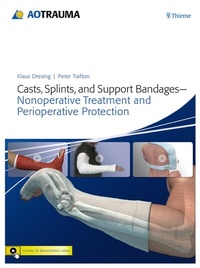
Casts, Splints, and Support Bandages
Description

Casts, Splints, and Support Bandages: Nonoperative Treatment and Perioperative Protection provides an extensive overview of the history, principles, methods, and techniques for applying a modern plaster or synthetic cast. The book comprises three sections:
- The Principles of Casting section outlines the basic principles of casting and splinting, the physical properties of cast materials, and socioeconomic considerations
- The Guidelines section explores nonoperative treatment for fractures, ligament, nerve, and soft-tissue injuries, overload injuries, and infections, in the upper and lower extremities and the spine
- Finally, the Techniques section provides step-by-step descriptions on 55 individual cast, splint, orthosis, and bandaging techniques, presented in high quality online video, and as stills with explanatory captions.
Hear the authors discuss Casts, Splints, and Support Bandages.
AOTrauma is proud to bring you this incredibly important and comprehensive text, which will be of interest to a wide range of medical professionals including trauma and orthopedic surgeons, specialist cast technicians, rural doctors, residents in training, and ORP. It is the ideal resource for any busy hospital or orthopedic/trauma practice.
More details
Other editions
Additional editions

Content
Section 1: Principles of casting
1 Introduction
2 History of casting-from the beginning to the present
3 Principles of casting
4 Thrombosis prophylaxis
5 Logistics and resources in the cast room
6 Properties of cast materials
7 Socioeconomic considerations
8 Outcomes after nonoperative fracture treatment-what information can be gained from evidence-based medicine?
Section 2: Guidelines for nonoperative treatment and perioperative protection
9.1 Fractures, dislocations, and subluxations of the upper extremity
9.2 Fractures, dislocations, and subluxations of the lower extremity
9.3 Nonoperative treatment of spinal fractures
9.4 Pediatric fractures
10 Soft-tissue damage and defects
11.1 Ligament and tendon injuries
11.2 Nerve injuries
12 Indications for nonoperative treatment of infections
13 Overload Injuries
Section 3: Techniques-casts, splints, and support bandages
14.1 Overview of cast, splint, orthosis, and bandage techniques
14.2 Overview of cast, splint, orthosis, and bandage techniques-demonstration format and icons
15 Upper extremity
16 Lower extremity
17 Spine
18 Support bandages
