

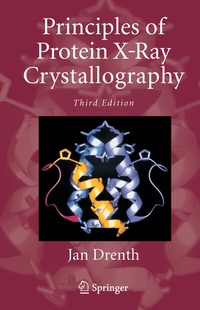
Principles of Protein X-Ray Crystallography
Description

X-ray crystallography is an established method for studying the structure of proteins and other macromolecules. As the importance of proteins grows, researchers in many fields have found that a working knowledge of X-ray diffraction is an indispensable tool. In this new edition of his essential work, Dr. Jan Drenth, recognized internationally for his numerous contributions to crystallographic research, provides an up-to-date and technically rigorous introduction to the subject. Principles of Protein X-ray Crystallography provides the theoretical background necessary to understand how the structure of proteins is determined at atomic resolution. The book is an introduction for graduate students, postdoctoral researchers, and established scientists who want to use protein crystallography in their own endeavors, or need to understand the subject in order to critically evaluate the literature. New material in the 3rd edition includes a section on twinning, an additional chapter on crystal growth and a discussion of single-wavelength anomalous dispersion.
Reviews / Votes
From the reviews of the third edition:
"This book, Principles of Protein X-ray Crystallography, aims to satisfy nearly everyone; . The volume is well organized . . this is a solid book by an experienced protein crystallographer. It covers the full spectrum of subjects for a professional structural biologist. Specialized subjects are kept in separate chapters so the book can be parsed by those interested in the big picture of the method. . it is probably the most definitive work that is currently available for structural biologists." (Jon Robertus, Journal of the American Chemical Society, Vol. 129 (17), 2007)
More details
Other editions
Additional editions
Previous edition
Person
Dr. Jan Drenth is a professor emeritus at the Laboratory of Biophysical Chemistry at the University of Groningen, The Netherlands.
Contributing author Dr. Jeroen R. Mesters Ph.D. is a Senior Research Assistant at the Institute of Biochemistry, University of Luebeck, Germany.
