

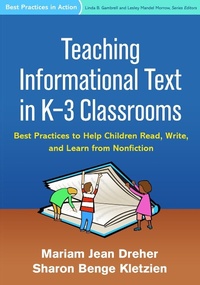
Teaching Informational Text in K-3 Classrooms
Best Practices to Help Children Read, Write, and Learn from Nonfiction
Published on 9. September 2015
192 pages
978-1-4625-2229-3 (ISBN)
Description

K-3 classroom teachers; reading specialists and coaches; teacher educators and graduate students. May serve as a text in such courses as Reading Methods, Early Literacy Instruction, and Content-Area Literacy.
More details
Other editions
Additional editions
Mariam Jean Dreher | Sharon Benge Kletzien
Teaching Informational Text in K-3 Classrooms
Best Practices to Help Children Read, Write, and Learn from Nonfiction
Book
10/2015
1st Edition
Guilford Press
€34.00
Shipment within 15-20 days
Persons
Mariam Jean Dreher, PhD, is Professor in the Department of Teaching and Learning, Policy and Leadership at the University of Maryland, College Park. Previously she was an elementary classroom teacher and Title I specialist. Her research interests include ways to integrate informational text into literacy instruction to enhance students' comprehension, vocabulary, and motivation. Dr. Dreher has published numerous articles and books and has served on many editorial advisory boards, receiving the Outstanding Reviewer Award from the Journal of Literacy Research. She is a consultant to National Geographic Children's Books on a series of information books for young children. Dr. Dreher is also a recipient of a Fulbright Senior Specialist Grant and was recently awarded an honorary doctorate from the University of Oulu, Finland.
Sharon Benge Kletzien, PhD, is Professor Emerita at West Chester University of Pennsylvania, where she was Chair of the Literacy Department, taught reading courses, and supervised the Reading Center. Previously she served as a reading specialist in elementary, middle, and high schools. Her research focuses on the areas of comprehension, using information books for instruction, and supporting students who struggle with reading. Dr. Kletzien has published many articles and book chapters and serves on the editorial boards of several major literacy journals. She is a recipient of the Outstanding Student Research Award from the American Educational Research Association, Division C, and the Program of Excellence Award from the National Council for the Social Studies.
Content
1. Supporting Motivation and Achievement with Informational Text
2. Developing Classroom Libraries with a Full Range of Informational Text
3. Choosing Information Books and Websites for the Classroom
4. Using Information Books for Read-Alouds
5. Comprehension and Close Reading of Informational Text
6. Vocabulary Development with Informational Text
7. Using Information Books and Internet Resources for Research
8. Teaching Children to Write Informational Text
9. Putting It All Together
2. Developing Classroom Libraries with a Full Range of Informational Text
3. Choosing Information Books and Websites for the Classroom
4. Using Information Books for Read-Alouds
5. Comprehension and Close Reading of Informational Text
6. Vocabulary Development with Informational Text
7. Using Information Books and Internet Resources for Research
8. Teaching Children to Write Informational Text
9. Putting It All Together
