

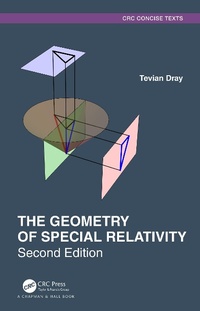
The Geometry of Special Relativity
2nd Edition
Published on 10. June 2021
196 pages
978-1-315-16070-2 (ISBN)
Description

This unique book presents a particularly beautiful way of looking at special relativity. The author encourages students to see beyond the formulas to the deeper structure.
The unification of space and time introduced by Einstein's special theory of relativity is one of the cornerstones of the modern scientific description of the universe. Yet the unification is counterintuitive because we perceive time very differently from space. Even in relativity, time is not just another dimension, it is one with different properties
The book treats the geometry of hyperbolas as the key to understanding special relativity. The author simplifies the formulas and emphasizes their geometric content. Many important relations, including the famous relativistic addition formula for velocities, then follow directly from the appropriate (hyperbolic) trigonometric addition formulas.
Prior mastery of (ordinary) trigonometry is sufficient for most of the material presented, although occasional use is made of elementary differential calculus, and the chapter on electromagnetism assumes some more advanced knowledge.
Changes to the Second Edition
The treatment of Minkowski space and spacetime diagrams has been expanded.
Several new topics have been added, including a geometric derivation of Lorentz transformations, a discussion of three-dimensional spacetime diagrams, and a brief geometric description of "area" and how it can be used to measure time and distance.
Minor notational changes were made to avoid conflict with existing usage
in the literature.
Table of Contents
Preface
1. Introduction.
2. The Physics of Special Relativity.
3. Circle Geometry.
4. Hyperbola Geometry.
5. The Geometry of Special Relativity.
6. Applications.
7. Problems III.
8. Paradoxes.
9. Relativistic Mechanics.
10. Problems II.
11. Relativistic Electromagnetism.
12. Problems III.
13. Beyond Special Relativity.
14. Three-Dimensional Spacetime Diagrams.
15. Minkowski Area via Light Boxes.
16. Hyperbolic Geometry.
17. Calculus.
Bibliography.
Author Biography
Tevian Dray is a Professor of Mathematics at Oregon State University. His research lies at the interface between mathematics and physics, involving differential geometry and general relativity, as well as nonassociative algebra and particle physics; he also studies student understanding of "middle-division" mathematics and physics content. Educated at MIT and Berkeley, he held postdoctoral positions in both mathematics and physics in several countries prior to coming to OSU in 1988. Professor Dray is a Fellow of the American Physical Society for his work in relativity, and an award-winning teacher.
The unification of space and time introduced by Einstein's special theory of relativity is one of the cornerstones of the modern scientific description of the universe. Yet the unification is counterintuitive because we perceive time very differently from space. Even in relativity, time is not just another dimension, it is one with different properties
The book treats the geometry of hyperbolas as the key to understanding special relativity. The author simplifies the formulas and emphasizes their geometric content. Many important relations, including the famous relativistic addition formula for velocities, then follow directly from the appropriate (hyperbolic) trigonometric addition formulas.
Prior mastery of (ordinary) trigonometry is sufficient for most of the material presented, although occasional use is made of elementary differential calculus, and the chapter on electromagnetism assumes some more advanced knowledge.
Changes to the Second Edition
The treatment of Minkowski space and spacetime diagrams has been expanded.
Several new topics have been added, including a geometric derivation of Lorentz transformations, a discussion of three-dimensional spacetime diagrams, and a brief geometric description of "area" and how it can be used to measure time and distance.
Minor notational changes were made to avoid conflict with existing usage
in the literature.
Table of Contents
Preface
1. Introduction.
2. The Physics of Special Relativity.
3. Circle Geometry.
4. Hyperbola Geometry.
5. The Geometry of Special Relativity.
6. Applications.
7. Problems III.
8. Paradoxes.
9. Relativistic Mechanics.
10. Problems II.
11. Relativistic Electromagnetism.
12. Problems III.
13. Beyond Special Relativity.
14. Three-Dimensional Spacetime Diagrams.
15. Minkowski Area via Light Boxes.
16. Hyperbolic Geometry.
17. Calculus.
Bibliography.
Author Biography
Tevian Dray is a Professor of Mathematics at Oregon State University. His research lies at the interface between mathematics and physics, involving differential geometry and general relativity, as well as nonassociative algebra and particle physics; he also studies student understanding of "middle-division" mathematics and physics content. Educated at MIT and Berkeley, he held postdoctoral positions in both mathematics and physics in several countries prior to coming to OSU in 1988. Professor Dray is a Fellow of the American Physical Society for his work in relativity, and an award-winning teacher.
More details
Series
Edition
2nd edition
Language
English
Place of publication
London
United Kingdom
Publishing group
Taylor & Francis Ltd
Target group
College/higher education
Illustrations
86 Line drawings, black and white; 86 Illustrations, black and white
File size
9,09 MB
ISBN-13
978-1-315-16070-2 (9781315160702)
Copyright in bibliographic data and cover images is held by Nielsen Book Services Limited or by the publishers or by their respective licensors: all rights reserved.
Schweitzer Classification
Other editions
Additional editions
Tevian Dray
The Geometry of Special Relativity
Book
06/2021
2nd Edition
CRC Press
€96.00
Shipment within 10-20 days
Tevian Dray
The Geometry of Special Relativity
Book
06/2021
2nd Edition
Chapman & Hall/CRC
€220.70
Shipment within 10-20 days
Person
Tevian Dray is a Professor of Mathematics at Oregon State University. His research lies at the interface between mathematics and physics, involving differential geometry and general relativity, as well as nonassociative algebra and particle physics; he also studies student understanding of "middle-division" mathematics and physics content. Educated at MIT and Berkeley, he held postdoctoral positions in both mathematics and physics in several countries prior to coming to OSU in 1988. Professor Dray is a Fellow of the American Physical Society for his work in relativity, and an award-winning teacher.
Content
1. Introduction. 1.1 Newton's Relativity. 1.2. Einstein's Relativity. 2. The Physics of Special Relativity. 2.1. Observers and Measurement. 2.2. The Postulates of Special Relativity. 2.3. Time Dilation and Length Contraction. 2.4. Lorentz Transformations. 2.5. Addition of Velocities. 2.6. The Interval. 3. Circle Geometry. 3.1. The Geometry of Trigonometry. 3.2. Distance. 3.3. Circle Trigonometry. 3.4. Triangle Trigonometry. 3.5. Rotations. 3.6. Projections. 3.7. Addition Formulas. 4. Hyperbola Geometry. 4.1. Hyperbolic Trigonometry. 4.2 Distance. 4.3. Hyperbola Trigonometry. 4.4. Triangle Trigonometry. 4.5. Rotations. 4.6. Projections. 4.7. Addition Formulas. 4.8. Combining Circle and Hyperbola Trigonometry. 5. The Geometry of Special Relativity. 5.1. The Surveyors. 5.2. Spacetime Diagrams. 5.3. Lorentz Transformations. 5.4. Space and Time. 5.5. The Geometry of Lorentz Transformations. 5.6. Dot Product. 6. Applications. 6.1. Drawing Spacetime Diagrams. 6.2. Addition of Velocities. 6.3. Length Contraction. 6.4. Time Dilation. 6.5. Doppler Shift. 7. Problems I. 7.1. Warmup. 7.2. Practice. 7.3. The Getaway. 7.4. Angles Are Not Invariant. 7.5. Interstellar Travel. 7.6. Observation. 7.7 Cosmic Rays. 7.8. Doppler Effect. 8. Paradoxes. 8.1. Special Relativity Paradoxes. 8.2. The Pole and Barn Paradox. 8.3. The Twin Paradox. 8.4. Manhole Covers. 9. Relativistic Mechanics. 9.1. Proper Time. 9.2. Velocity. 9.3. Conservation Laws. 9.4. Energy. 9.5. Useful Formulas. 9.6. Higher Dimensions. 10. Problems II. 10.1. Mass Isn't Conserved. 10.2. Identical Particles. 10.3. Pion Decay I. 10.4. Mass and Energy. 10.5. Pion Decay II. 11. Relativistic Electromagnetism. 11.1. Magnetism from Electricity. 11.2. Lorentz Transformations. 11.3. Vectors. 11.4. Tensors. 11.5. The Electromagnetic Field. 11.6. Maxwell's Equations. 11.7. The Unification of Special Relativity. 12. Problems III. 12.1. Vanishing Fields. 12.2. Parallel and Perpendicular Fields. 13. Beyond Special Relativity. 13.1. Problems with Special Relativity. 13.2. Tidal Effects. 13.3. Differential Geometry. 13.4. General Relativity. 13.5. Uniform Acceleration and Black Holes. 14. Three-Dimensional Spacetime Diagrams. 14.1. Introduction. 14.2. The Rising Manhole. 14.3. The Moving Spotlight. 14.4. The Lorentzian Inner Product. 14.5. Transverse Directions. 15. Minkowski Area via Light Boxes. 15.1. Area in Special Relativity. 15.2. Measuring with Light Boxes. 16. Hyperbolic Geometry. 16.1. Non-Euclidean Geometry. 16.2. The Hyperboloid. 16.3. The Poincare Disk. 16.4. The Klein Disk. 16.5. The Pseudosphere. 17. Calculus. 17.1. Circle Trigonometry. 17.2. Hyperbolic Trigonometry. 17.3. Exponentials (and Logarithms). Bibliography. Index.
