

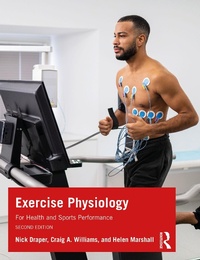
Exercise Physiology
for Health and Sports Performance
2nd Edition
Published on 8. May 2024
622 pages
978-1-003-80038-5 (ISBN)
Description

This second edition of Exercise Physiology: For Health and Sports Performance brings together all the essential human anatomy and applied physiology that students of exercise science, physical education, and sports coaching will need to know.
Written in a friendly, accessible style, and containing a wide range of features to help develop understanding, this book provides a complete one-stop shop for exercise physiology broken down into three fundamental parts: foundations of exercise physiology, applied exercise physiology, and the new Part 3, exercise prescription.
With Parts 1 and 2 examining the theory, testing, and practical applications of exercise physiology, the new Part 3 reflects the changes in the field by increasing focus on physical activity and diverse populations and helps provides a more complete course text for any exercise physiology course at universities around the world.
This newly revised book is key reading for undergraduate and postgraduate students in the fields of exercise physiology, sports performance, sports therapy, fitness and personal training, and other related sport science courses.
Written in a friendly, accessible style, and containing a wide range of features to help develop understanding, this book provides a complete one-stop shop for exercise physiology broken down into three fundamental parts: foundations of exercise physiology, applied exercise physiology, and the new Part 3, exercise prescription.
With Parts 1 and 2 examining the theory, testing, and practical applications of exercise physiology, the new Part 3 reflects the changes in the field by increasing focus on physical activity and diverse populations and helps provides a more complete course text for any exercise physiology course at universities around the world.
This newly revised book is key reading for undergraduate and postgraduate students in the fields of exercise physiology, sports performance, sports therapy, fitness and personal training, and other related sport science courses.
More details
Edition
2nd edition
Language
English
Place of publication
London
United Kingdom
Publishing group
Taylor & Francis Ebooks
Target group
College/higher education
Illustrations
53 Tables, black and white; 33 Line drawings, black and white; 172 Halftones, black and white; 205 Illustrations, black and white
ISBN-13
978-1-003-80038-5 (9781003800385)
Copyright in bibliographic data and cover images is held by Nielsen Book Services Limited or by the publishers or by their respective licensors: all rights reserved.
Schweitzer Classification
Other editions
Additional editions
Book
05/2024
2nd Edition
Routledge
€246.50
Shipment within 15-20 days
Book
05/2024
2nd Edition
Routledge
€120.20
Shipment within 15-20 days
Persons
Nick Draper has been a researcher and teacher at the University of Canterbury, New Zealand, for more than a decade but has a wealth of experience developed as a practitioner. Nick's research has a translational focus, with the aim of finding solutions to real-world problems. Nick completed his research training at the Universities of London and New Mexico, where he received a thorough grounding in qualitative and quantitative methods, both of which he applies to research problems in his chosen field of exercise physiology.
Craig A. Williams is the director of the Children's Health and Exercise Research Centre (CHERC), Devon, UK. He lectures on the physiological aspects of the BSc and MSc degree programmes at the University of Exeter. He is internationally recognised for research in paediatric exercise physiology. Professor Williams specialises in investigating the physiological responses to high-intensity exercise and fatigue in children and adolescents (6-18 years). This work is translated into clinical settings, for example, children with cystic fibrosis and congenital heart disease, as well as applied youth sports performance (particularly in relation to the long-term development of young athletes).
Helen Marshall, PhD, is a team leader and the health promotion degree coordinator at Ara Institute of Canterbury, New Zealand. Her main teaching focus is around the multiple ways by which people can be enabled to take control of their health, while her collaborative research has specifically focussed on the many health benefits of physical activity for a variety of populations.
Craig A. Williams is the director of the Children's Health and Exercise Research Centre (CHERC), Devon, UK. He lectures on the physiological aspects of the BSc and MSc degree programmes at the University of Exeter. He is internationally recognised for research in paediatric exercise physiology. Professor Williams specialises in investigating the physiological responses to high-intensity exercise and fatigue in children and adolescents (6-18 years). This work is translated into clinical settings, for example, children with cystic fibrosis and congenital heart disease, as well as applied youth sports performance (particularly in relation to the long-term development of young athletes).
Helen Marshall, PhD, is a team leader and the health promotion degree coordinator at Ara Institute of Canterbury, New Zealand. Her main teaching focus is around the multiple ways by which people can be enabled to take control of their health, while her collaborative research has specifically focussed on the many health benefits of physical activity for a variety of populations.
Content
PART 1
Foundations of exercise physiology
1 Introduction
2 Nutrition for health and sports performance
3 From cells to systems
4 The control systems: The nervous and endocrine systems
5 The movement systems: Skeletal and muscular
6 The transport systems: The respiratory and cardiovascular systems
PART 2
Essential exercise physiology
7 General concepts for exercise physiology
8 Power and power endurance: The explosive sports
9 Anaerobic endurance: The speed endurance sports
10 High-intensity aerobic endurance sports
11 Lower-intensity aerobic endurance sports
12 Intermittent sports
PART 3
Applied exercise physiology
13 Introduction to exercise programming, conditioning, and strength training
14 Physical activity prescription for people with chronic complex medical diseases - pulmonary, respiratory, cardiac, and circulatory conditions, obesity, and cancer
15 Physical activity prescription for people with chronic complex medical diseases - neurological, musculoskeletal, metabolic, and mental health conditions
16 Applied exercise physiology and the environment
Appendix A: Recommended daily allowances for a range of vitamins
Appendix B: Gas conversion table
Appendix C: Body composition and its analysis
Foundations of exercise physiology
1 Introduction
2 Nutrition for health and sports performance
3 From cells to systems
4 The control systems: The nervous and endocrine systems
5 The movement systems: Skeletal and muscular
6 The transport systems: The respiratory and cardiovascular systems
PART 2
Essential exercise physiology
7 General concepts for exercise physiology
8 Power and power endurance: The explosive sports
9 Anaerobic endurance: The speed endurance sports
10 High-intensity aerobic endurance sports
11 Lower-intensity aerobic endurance sports
12 Intermittent sports
PART 3
Applied exercise physiology
13 Introduction to exercise programming, conditioning, and strength training
14 Physical activity prescription for people with chronic complex medical diseases - pulmonary, respiratory, cardiac, and circulatory conditions, obesity, and cancer
15 Physical activity prescription for people with chronic complex medical diseases - neurological, musculoskeletal, metabolic, and mental health conditions
16 Applied exercise physiology and the environment
Appendix A: Recommended daily allowances for a range of vitamins
Appendix B: Gas conversion table
Appendix C: Body composition and its analysis
