

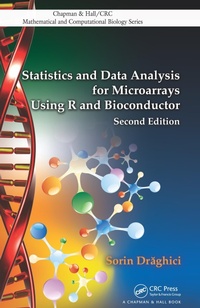
Statistics and Data Analysis for Microarrays Using R and Bioconductor
2nd Edition
Published on 19. April 2016
1036 pages
978-1-4398-0976-1 (ISBN)
Description

Richly illustrated in color, Statistics and Data Analysis for Microarrays Using R and Bioconductor, Second Edition provides a clear and rigorous description of powerful analysis techniques and algorithms for mining and interpreting biological information. Omitting tedious details, heavy formalisms, and cryptic notations, the text takes a hands-on, example-based approach that teaches students the basics of R and microarray technology as well as how to choose and apply the proper data analysis tool to specific problems.
New to the Second EditionCompletely updated and double the size of its predecessor, this timely second edition replaces the commercial software with the open source R and Bioconductor environments. Fourteen new chapters cover such topics as the basic mechanisms of the cell, reliability and reproducibility issues in DNA microarrays, basic statistics and linear models in R, experiment design, multiple comparisons, quality control, data pre-processing and normalization, Gene Ontology analysis, pathway analysis, and machine learning techniques. Methods are illustrated with toy examples and real data and the R code for all routines is available on an accompanying downloadable resource.
With all the necessary prerequisites included, this best-selling book guides students from very basic notions to advanced analysis techniques in R and Bioconductor. The first half of the text presents an overview of microarrays and the statistical elements that form the building blocks of any data analysis. The second half introduces the techniques most commonly used in the analysis of microarray data.
New to the Second EditionCompletely updated and double the size of its predecessor, this timely second edition replaces the commercial software with the open source R and Bioconductor environments. Fourteen new chapters cover such topics as the basic mechanisms of the cell, reliability and reproducibility issues in DNA microarrays, basic statistics and linear models in R, experiment design, multiple comparisons, quality control, data pre-processing and normalization, Gene Ontology analysis, pathway analysis, and machine learning techniques. Methods are illustrated with toy examples and real data and the R code for all routines is available on an accompanying downloadable resource.
With all the necessary prerequisites included, this best-selling book guides students from very basic notions to advanced analysis techniques in R and Bioconductor. The first half of the text presents an overview of microarrays and the statistical elements that form the building blocks of any data analysis. The second half introduces the techniques most commonly used in the analysis of microarray data.
Reviews / Votes
Praise for the First EditionThe book by Draghici is an excellent choice to be used as a textbook for a graduate-level bioinformatics course. This well-written book with two accompanying CD-ROMs will create much-needed enthusiasm among statisticians.-Journal of Statistical Computation and Simulation, Vol. 74
I really like Draghici's book. As the author explains in the Preface, the book is intended to serve both the statistician who knows very little about DNA microarrays and the biologist who has no expertise in data analysis. The author lays out a study plan for the statistician that excludes 5 of the 17 chapters (4-8). These chapters present the basics of statistical distributions, estimation, hypothesis testing, ANOVA, and experimental design. What that leaves for the statistician is the three-chapter primer on microarrays and image processing, plus all of the data analysis tools specific to the microarray situation. ... it includes two CDs with trial versions of several specialised software packages. Anyone who uses microarray data should certainly own a copy.
-Technometrics, Vol. 47, No. 1, February 2005 Praise for the First EditionThe book by Draghici is an excellent choice to be used as a textbook for a graduate-level bioinformatics course. This well-written book with two accompanying CD-ROMs will create much-needed enthusiasm among statisticians.
-Journal of Statistical Computation and Simulation, Vol. 74
I really like Draghici's book. As the author explains in the Preface, the book is intended to serve both the statistician who knows very little about DNA microarrays and the biologist who has no expertise in data analysis. The author lays out a study plan for the statistician that excludes 5 of the 17 chapters (4-8). These chapters present the basics of statistical distributions, estimation, hypothesis testing, ANOVA, and experimental design. What that leaves for the statistician is the three-chapter primer on microarrays and image processing, plus all of the data analysis tools specific to the microarray situation. ... it includes two CDs with trial versions of several specialised software packages. Anyone who uses microarray data should certainly own a copy.
-Technometrics, Vol. 47, No. 1, February 2005
More details
Series
Edition
2nd edition
Language
English
Place of publication
London
United Kingdom
Publishing group
Taylor & Francis Ltd
Target group
College/higher education
Upper undergraduate and beginning graduate students in data analysis, statistics, or bioinformatics; practitioners and researchers in biology and bioinformatics.
Edition type
Revised edition
Illustrations
344 s/w Abbildungen, 24 s/w Tabellen
344 b/w images, 24 tables and 200+
ISBN-13
978-1-4398-0976-1 (9781439809761)
Copyright in bibliographic data and cover images is held by Nielsen Book Services Limited or by the publishers or by their respective licensors: all rights reserved.
Schweitzer Classification
Other editions
Additional editions
Book
12/2023
2nd Edition
Chapman & Hall/CRC
€71.79
The article will not be published
Book
12/2011
2nd Edition
Chapman & Hall/CRC
€129.50
Shipment within 15-20 days
Person
Sorin Draghici the Robert J. Sokol MD Endowed Chair in Systems Biology in the Department of Obstetrics and Gynecology, professor in the Department of Clinical and Translational Science and Department of Computer Science, and head of the Intelligent Systems and Bioinformatics Laboratory at Wayne State University. He is also the chief of the Bioinformatics and Data Analysis Section in the Perinatology Research Branch of the National Institute for Child Health and Development. A senior member of IEEE, Dr. Draghici is an editor of IEEE/ACM Transactions on Computational Biology and Bioinformatics, Journal of Biomedicine and Biotechnology, and International Journal of Functional Informatics and Personalized Medicine. He earned a Ph.D. in computer science from the University of St. Andrews.
Content
Introduction. The Cell and Its Basic Mechanisms. Microarrays. Reliability and Reproducibility Issues in DNA Microarray Measurements. Image Processing. Introduction to R. Bioconductor: Principles and Illustrations. Elements of Statistics. Probability Distributions. Basic Statistics in R. Statistical Hypothesis Testing. Classical Approaches to Data Analysis. Analysis of Variance (ANOVA). Linear Models in R. Experiment Design. Multiple Comparisons. Analysis and Visualization Tools. Cluster Analysis. Quality Control. Data Pre-Processing and Normalization. Methods for Selecting Differentially Regulated Genes. The Gene Ontology (GO). Functional Analysis and Biological Interpretation of Microarray Data. Uses, Misuses, and Abuses in GO Profiling. A Comparison of Several Tools for Ontological Analysis. Focused Microarrays- Comparison and Selection. ID Mapping Issues. Pathway Analysis. Machine Learning Techniques. The Road Ahead. References.
