

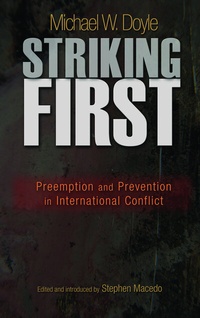
Striking First
Preemption and Prevention in International Conflict
1st Edition
Published on 16. June 2015
216 pages
978-1-4008-2963-7 (ISBN)
Description

Does the United States have the right to defend itself by striking first, or must it wait until an attack is in progress? Is the Bush Doctrine of aggressive preventive action a justified and legal recourse against threats posed by terrorists and rogue states? Tackling one of the most controversial policy issues of the post-September 11 world, Michael Doyle argues that neither the Bush Doctrine nor customary international law is capable of adequately responding to the pressing security threats of our times.
In Striking First, Doyle shows how the Bush Doctrine has consistently disregarded a vital distinction in international law between acts of preemption in the face of imminent threats and those of prevention in the face of the growing offensive capability of an enemy. Taking a close look at the Iraq war, the 1998 attack against al Qaeda in Afghanistan, and the Cuban Missile Crisis, among other conflicts, he contends that international law must rely more completely on United Nations Charter procedures and develop clearer standards for dealing with lethal but not immediate threats.
After explaining how the UN can again play an important role in enforcing international law and strengthening international guidelines for responding to threats, he describes the rare circumstances when unilateral action is indeed necessary. Based on the 2006 Tanner Lectures at Princeton University, Striking First includes responses by distinguished political theorists Richard Tuck and Jeffrey McMahan and international law scholar Harold Koh, yielding a lively debate that will redefine how--and for what reasons--tomorrow's wars are fought.
In Striking First, Doyle shows how the Bush Doctrine has consistently disregarded a vital distinction in international law between acts of preemption in the face of imminent threats and those of prevention in the face of the growing offensive capability of an enemy. Taking a close look at the Iraq war, the 1998 attack against al Qaeda in Afghanistan, and the Cuban Missile Crisis, among other conflicts, he contends that international law must rely more completely on United Nations Charter procedures and develop clearer standards for dealing with lethal but not immediate threats.
After explaining how the UN can again play an important role in enforcing international law and strengthening international guidelines for responding to threats, he describes the rare circumstances when unilateral action is indeed necessary. Based on the 2006 Tanner Lectures at Princeton University, Striking First includes responses by distinguished political theorists Richard Tuck and Jeffrey McMahan and international law scholar Harold Koh, yielding a lively debate that will redefine how--and for what reasons--tomorrow's wars are fought.
All prices
More details
Edition
Course Book
Language
English
Place of publication
Princeton, NJ
United States
Publishing group
De Gruyter
Target group
Professional and scholarly
Edition type
Digital original
Product notice
Reflowable
Illustrations
1 table.
File size
0,42 MB
ISBN-13
978-1-4008-2963-7 (9781400829637)
Schweitzer Classification
Other editions
Additional editions
Book
03/2011
Princeton University Press
€19.60
Article not available at the moment
Book
04/2008
Princeton University Press
€24.76
Article exhausted; check different version
Persons
Michael W. Doyle is the Harold Brown Professor of International Affairs, Law, and Political Science at Columbia University. He served as assistant secretary-general and special adviser to U.N. Secretary-General Kofi Annan, and is currently the chair of the U.N. Democracy Fund. His books include Making War and Building Peace (Princeton) and Ways of War and Peace.
Content
Acknowledgments by Michael W. Doyle vii
Introduction by Stephen Macedo xi
Striking First
Michael W. Doyle
International Law and Current Standards 7
Standards 43
Comment by Harold Hongju Koh 99
Comment by Richard Tuck 119
Comment byJeff McMahan 129
Response to Commentators by Michael W. Doyle 149
Contributors 161
Index 165
Introduction by Stephen Macedo xi
Striking First
Michael W. Doyle
International Law and Current Standards 7
Standards 43
Comment by Harold Hongju Koh 99
Comment by Richard Tuck 119
Comment byJeff McMahan 129
Response to Commentators by Michael W. Doyle 149
Contributors 161
Index 165

