

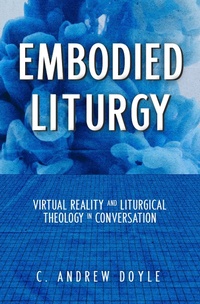
Embodied Liturgy
Description

Can the 'reality' of the Eucharist be maintained online?
Author C. Andrew Doyle, in a well-researched and thoughtful study of both virtual reality and liturgy, argues that the Eucharist is not a formulaic rehearsal of words and rituals but an embodied and lived experience. This requires a shared place and presence. While the church should not shy away from virtual ministry, we should be wary of using the technological realm for the celebration of the Eucharist, an act that is an outward and visible sign of our spiritual union with God and one another. It brings us closer to friend and stranger for the transformation of individuals into unity in Christ. The context of the ritual-with people, objects, words, and all sorts of nuance-creates intimacy with God and each other.
This unique book is especially timely and will be of interest to scholars, liturgists, and those interested in sacramental theology in the digital age.
More details
Other editions
Additional editions
Person
C. Andrew Doyle, the ninth bishop of the Episcopal Diocese of Texas, summarizes his autobiography in six words: "Met Jesus on pilgrimage; still walking." He is author of Vocatio, Unabashedly Episcopalian, Orgullosamente Episcopal, A Generous Community, and The Jesus Heist. He lives in Houston, Texas.
Content
- Cover Page
- Title Page
- Copyright
- Contents
- Preface: Two Movements of the Past That Inform the Future The Rt. Rev. Dr. William Franklin
- Introduction
- 1. LOCATING LITURGY
- 2. VIRTUAL REALITY AS A REAL LOCATION FOR LITURGY
- 3. IMPLICATIONS OF A CONSTRUCTED REALITY UPON THE CONSTRUCTION OF A MEANING-MAKING LITURGY
- 4. LITURGICAL LANGUAGE WITHIN THE FRAME OF LANGUAGE-MAKING
- 5. THE LANGUAGE-MAKING CREATURE'S LITURGY
- 6. LITURGICAL MEANING-MAKING AS NARRATIVE
- 7. CONSIDERING THE SOCIOLOGICAL LITURGICAL CONTEXT
- 8. WHO DOES THE VIRTUAL SPHERE BELONG TO?
- 9. LITURGICAL PROXIMITY AND METAPHYSICS
- 10. LITURGICAL PROXIMITY AND CHRISTOLOGY
- 11. VIRTUAL LITURGY AND THE INDIVIDUALIST SOCIETY
- 12. SACRAMENTAL ROOTEDNESS IN CREATION
- 13. THE AMPLIFIED HUMAN AND THE LITURGY
- 14. CIVITAS EUCHARISTICUS
- CONCLUSION
- Acknowledgments
- Notes
- Bibliography
- About the Author
