

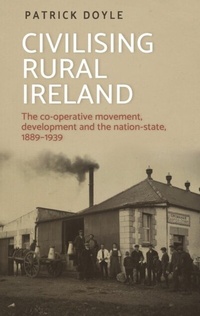
Civilising Rural Ireland
The Co-Operative Movement, Development and the Nation-State, 1889-1939
1st Edition
Published on 21. January 2019
248 pages
978-1-5261-2458-6 (ISBN)
Description

The introduction of co-operative societies into the Irish countryside during the late-nineteenth century transformed rural society and created an enduring economic legacy. Civilising rural Ireland challenges predominant narratives of Irish history that explain the emergence of the nation-state through the lens of political conflict and violence. Instead the book takes as its focus the numerous leaders, organisers, and members of the Irish co-operative movement. Together these people captured the spirit of change as they created a modern Ireland through their reorganisation of the countryside, the spread of new economic ideas, and the promotion of mutually-owned businesses. Besides giving a comprehensive account of the co-operative movement's introduction to Irish society the book offers an analysis of the importance of these radical economic ideas upon political Irish nationalism.
An electronic edition of this book is freely available under a Creative Commons (CC BY-NC-ND) licence. -- .
An electronic edition of this book is freely available under a Creative Commons (CC BY-NC-ND) licence. -- .
Reviews / Votes
'A compelling history of the co-operative movement. ... Civilizing Rural Ireland can be seen as complicating the perception that post-Famine Ireland gave rise to the ascent of "economic man", with no strange gods before him, in the countryside. ... A much needed social and economic contribution to the decade of centenaries ... Doyle's book can also be seen as laying to rest one of the cultural myths that sanctioned the conservative turn in rural policy, the idyll of Romantic Ireland.'Dublin Review of Books
'Civilising Rural Ireland challenges Irish historiography by asserting that modernization efforts in Ireland did not begin in the mid-20th century but rather emerged much earlier due to the actions of the cooperative movement ... Doyle focuses on the "radical economic blueprint" fostered by various cooperatives in Ireland to convincingly confirm his thesis. ... He does an admirable job of highlighting the actions taken by key figures.'
CHOICE
'A welcome intervention into the history of the Irish revival, a work that aptly demonstrates how social and economic anxieties were at the heart of early twentieth-century Irish nationalist political discourse.'
H-Net Review
'Civilising Rural Ireland challenges Irish historiography by asserting that modernization efforts in Ireland did not begin in the mid-20th century but rather emerged much earlier due to the actions of the cooperative movement, which was spearheaded by the Irish Agricultural Organisation Society beginning in 1894. Doyle (Univ. of Manchester, UK) focuses on the "radical economic blueprint" fostered by various cooperatives in Ireland, especially creameries, to convincingly confirm his thesis. The cooperative movement served as a catalyst for rural unification, economic independence, and cultural expression on the part of Ireland's agricultural workers, as Ireland navigated the tumultuous transition from colony to republic. When difficulties emerged-particularly the outbreak of the First World War, the subsequent formation of the Irish Free State, and the Irish War of Independence-the cooperative movement persisted but was not always successful. Doyle does an admirable job of highlighting the actions taken by key figures of the cooperative movement in Ireland, particularly Oliver Plunkett, George Russell (known by the pen name AE), Robert Anderson, and Father T. A. Finlay. The book includes relevant primary and secondary sources in chapter-by-chapter endnotes and useful images and tables.'
Choice Connect -- .
More details
Language
English
Place of publication
United Kingdom
Target group
College/higher education
Professional and scholarly
Illustrations
5 black & white illustrations
File size
1,23 MB
ISBN-13
978-1-5261-2458-6 (9781526124586)
Copyright in bibliographic data and cover images is held by Nielsen Book Services Limited or by the publishers or by their respective licensors: all rights reserved.
Schweitzer Classification
Other editions
Additional editions
Patrick Doyle
Civilising Rural Ireland
The Co-Operative Movement, Development and the Nation-State, 1889-1939
Book
05/2020
Manchester University Press
€36.20
Shipment within 15-20 days
Patrick Doyle
Civilising Rural Ireland
The Co-Operative Movement, Development and the Nation-State, 1889-1939
Book
01/2019
Manchester University Press
€125.30
Shipment within 15-20 days
Person
Patrick Doyle is Hallsworth Research Fellow at the University of Manchester -- .
Content
Introduction
1 The origins of co-operation in Ireland
2 A civilisation among the fields
3 Ireland in the new century
4 Co-operation and life during wartime
5 The co-operative movement and the War of Independence
6 A Co-operative Commonwealth in the Free State?
Conclusion
Bibliography
Index -- .
1 The origins of co-operation in Ireland
2 A civilisation among the fields
3 Ireland in the new century
4 Co-operation and life during wartime
5 The co-operative movement and the War of Independence
6 A Co-operative Commonwealth in the Free State?
Conclusion
Bibliography
Index -- .
