

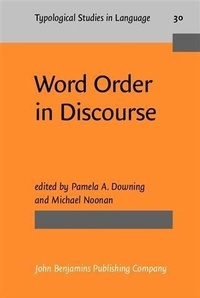
Word Order in Discourse
1st Edition
Published on 1. June 1995
X, 595 pages
978-90-272-8494-5 (ISBN)
Description

This volume brings together a collection of 18 papers dealing with the problem of word order variation in discourse. Word order variation has often been treated as an essentially unpredictable phenomenon, a matter of selecting randomly one of the set of possible orders generated by the grammar. However, as the papers in this collection show, word order variation is not random, but rather governed by principles which can be subjected to scientific investigation and are common to all languages.The papers in this volume discuss word order variation in a diverse collection of languages and from a number of perspectives, including experimental and quantitative text based studies. A number of papers address the problem of deciding which order is 'basic' among the alternatives. The volume will be of interest to typologists, to other linguists interested in problems of word order variation, and to those interested in discourse syntax.
More details
Other editions
Additional editions
Pamela A. Downing | Michael Noonan
Word Order in Discourse
Book
06/1995
John Benjamins Publishing Co
€171.72
Shipment within 10-15 days
Persons
Content
- WORD ORDER IN DISCOURSE
- Editorial page
- Title page
- Copyright page
- Preface
- Table of contents
- List of Abbreviations
- Word order in discourse: By way of introduction
- 1. Introduction
- 2. Methods of investigation
- 3. Motivations for word order variation
- 4. Remaining problems
- 5. Conclusion
- Notes
- References
- What are discourse principles made of?
- Notes
- References
- Agent position in the Sejarah Melayu
- 1. Introduction
- 2. Coding possibilities for the agent
- 3. Functions of the contrasts
- Appendix: Glossing conventions
- Notes
- References
- Preverbal nominals in Colville-Okanagan
- 1. Introduction
- 2. Preliminaries
- 3. The function of preverbal nominais
- 4. Conclusion
- Notes
- References
- Frequency and pragmatically unmarked word order
- 1. Introduction
- 2. Case 1: Tojolabal
- 3. Markedness as a general notion
- 4. Pragmatic markedness as additional meaning
- 5. Pragmatic markedness in terms of discourse factors
- 6. Tojolabal again
- 7. Case 2: Ojibwa
- 8. Case 3: Yagua
- 9. Case 4: Macushi
- 10. Some recent proposals by Givón
- 11. Conclusion
- Notes
- References
- Subject-verb word order and the function of early position
- 1. Introduction
- 2. Proposal
- 3. Language data
- 4. Organization and other constituents
- 5. Conclusions
- Notes
- References
- Focus position in sov languages
- 1. Introduction: focus and word order
- 2. Sinhala
- 3. Tamil
- 4. Implications and conclusions
- Notes
- References
- Word order at the noun phrase level in Japanese
- 1. Introduction
- 2. Previous classifications
- 3. Distributions and functional profiles
- 4. Concluding remarks
- Notes
- Appendix
- References
- WH-clefts and left-dislocation in English conversation
- 1. Introduction
- 2. WH-clefts in conversation
- 3. Left-dislocation
- 4. Conclusions: Implications for topicality
- Notes
- References
- Pragmatic relations and word order in Chinese
- 1. Introduction
- 2. The question of "definiteness
- 3. Marked focus constructions
- 4. Conclusions
- Notes
- References
- Left shifts in strongly vso languages
- 0. Introduction
- 1. Trique
- 2. Luwo/Jür-Luwo
- 3. Biblical Hebrew
- 4. Conclusion
- Notes
- References
- The pragmatics of verb initial sentences in some ancient Indo-European languages
- 0. Introduction
- 1. Initial verbs and communicative function
- 2. Initial verbs in Latin and in Classical Greek
- 3. Discussion
- 4. Conclusions
- Notes
- References
- Morphological and prosodie forces shaping word order
- 0. Introduction
- 1. The Siouan languages
- 2. Caddoan
- 3. Iroquoian
- 4. The intonation factor
- 5. Conclusion
- References
- The word order of two-constituent constructions in spoken Spanish
- 1. Introduction
- 2. Informational word order
- 3. Contrary to expectation
- 4. Focus of contrast
- 5. Focal referent
- 6. Topics
- 7. Generalizations
- Notes
- References
- Verb initial languages and information order
- 1. Introduction
- 2. The functions of initial position
- 3. The functions of postverbal positions
- 4. Conclusion
- Abbreviations
- Notes
- References
- On the discourse functions of possessor movement in Emai prose narratives
- Introduction
- Possessor movement
- Data base
- Analysis of possessor movement
- Secondary topic
- Peak marking
- Conclusion
- Notes
- Appendix
- References
- Focal attention, voice, and word order An experimental, cross-linguistic study
- 0. Introduction
- 1. Functional approaches to linguistics
- 2. Thematic management in discourse production
- 3. The experiment
- 4. Cross-linguistic comparisons: some pilot data
- 5. Discussion
- Notes
- Appendix A
- References
- Noun incorporation and object placement in discourse: The case of Guaraní
- 0. Introduction
- 1. General methodological approach
- 2. The communicative motivation of incorporation
- 3. The discourse function of object placement in Guaraní
- 4. Concluding remarks
- Notes
- References
- SUBJECT INDEX
- AUTHOR INDEX
