

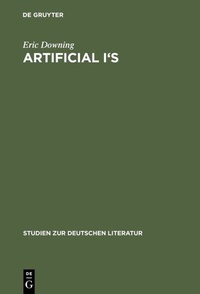
Artificial I's
Description

This study explores three works in which the protagonist undertakes to fashion a literary artwork out of himself: Ovid's »Ars Amatoria«, Kierkegaard's »Diary of the Seducer«, and Thomas Mann's »Felix Krull«. For each work, particular attention is paid to the self-conscious interplay between the author's project of book-making and the character's project of self-making, as well as to the effect of changing notions of self-identity on the protagonist's attempt at life as literature. For »Felix Krull«, this includes a sustained analysis of Mann's incorporation and problematization of various Nietzschean models of aesthestics, reality, and self-identity. In Ovid and Kierkegaard, this study also considers a related project, the attempt to fashion a literary artwork out of another, namely out of a woman.
More details
Other editions
Additional editions
Content
- Intro
- Introduction
- Chapter I: Ovid and the Ars Amatoria
- I. The Problem
- II. The didactic imitation
- III. The elegiac imitation
- IV. Book I and the nullus pulvis principle
- V. Book II and the servitium artis
- VI. Book III and the anti-Pygmalion principle
- Chapter 2: Kierkegaard and the »Diary of the Seducer«
- I. Kierkegaard and the Ars Amatoria
- II. Literary form and personal identity
- III. Johannes' life as literature
- IV. The dialectic of self-fashioning
- V. Cordelia and the anti-Pygmalion principle
- Chapter 3: Thomas Mann and the early Felix Krull
- I. Manolescu in the mirror
- II. Inheritance and imitation: Goethe in Felix Krull
- III. Interlude: the new and novel play between
- IV. Felix's retrospective life as literature
- V. Felix's dialectic of self-fashioning
- VI. Conscription
- Chapter 4: Thomas Mann and the late Felix Krull
- I. »Wiederkehr«
- II. »Das zitathafte Leben«
- Conclusion
- Bibliography
